Executive Overview
The contemporary romantic-drama streaming pipeline has long relied on a predictable economic and creative formula: take a sun-drenched, highly photogenic international locale, cast two impossibly attractive young leads with a baseline of social media capital, inject a dash of YA-adjacent angst, and distribute directly to a global subscription platform. Amazon Prime Video’s latest release, The Last Sunrise, follows this playbook to the letter. Directed by Carlson Young (Upgraded) and adapted from a standalone novel by After franchise architect Anna Todd, the film attempts to marry the glossy escapism of destination travelogues with the emotional stakes of a high-concept medical melodrama.
Yet, despite starring Maia Reficco (La Dolce Villa) alongside newcomer Fernando Lindez, and featuring a supporting turn from Desperate Housewives alumnus Eva Longoria, The Last Sunrise ultimately collapses under the weight of its own generic conventions. Rather than forging an authentic emotional connection, the production trades in recycled tropes, passive character agency, and a third-act conflict so manufactured it drains the narrative of any residual tension. As platforms like Prime Video continue to saturate their libraries with algorithm-friendly "just-add-water" romances, The Last Sunrise stands as a prime example of the creative fatigue currently plaguing the genre.
Detailed Chronology and Narrative Breakdown
To understand the structural flaws of The Last Sunrise, one must examine the mechanical progression of its plot—a narrative arc that ticks every box on the streaming-romance checklist while consistently undermining its own dramatic potential.
Act I: The Catalyst and the Escape
The film opens with an ill-fated pirouette. Oriah, known to all as "Ry" (Maia Reficco), is a rising professional dancer whose aspirations are abruptly halted when she collapses mid-performance, wracked by sudden, violent seizures. A brief, largely abandoned voiceover establishes her internal state—“My body has become my enemy”—before mercifully vanishing from the rest of the runtime.
Rushed to the hospital, Ry receives a life-altering medical verdict: she is suffering from epilepsy triggered by cerebral tumors. The medical options present a stark binary. She can undergo invasive brain surgery that carries a severe risk of permanently altering her memory, or she can manage the condition through a heavy regimen of pharmaceutical intervention that leaves her feeling perpetually numb, listless, and detached. Opting for the latter, Ry embarks on a restorative getaway to Mallorca, accompanied by her ambitious mother, Isolde (Eva Longoria).
Mallorca is presented not merely as a geographic destination, but as an aggressively saturated postcard of Mediterranean perfection. The island serves up the requisite cinematic checklist: endless sun-bleached cobblestone streets, crystalline azure waters, artisan shops, and chiseled local fishermen.
Act II: The Meet-Cute and the Double Life
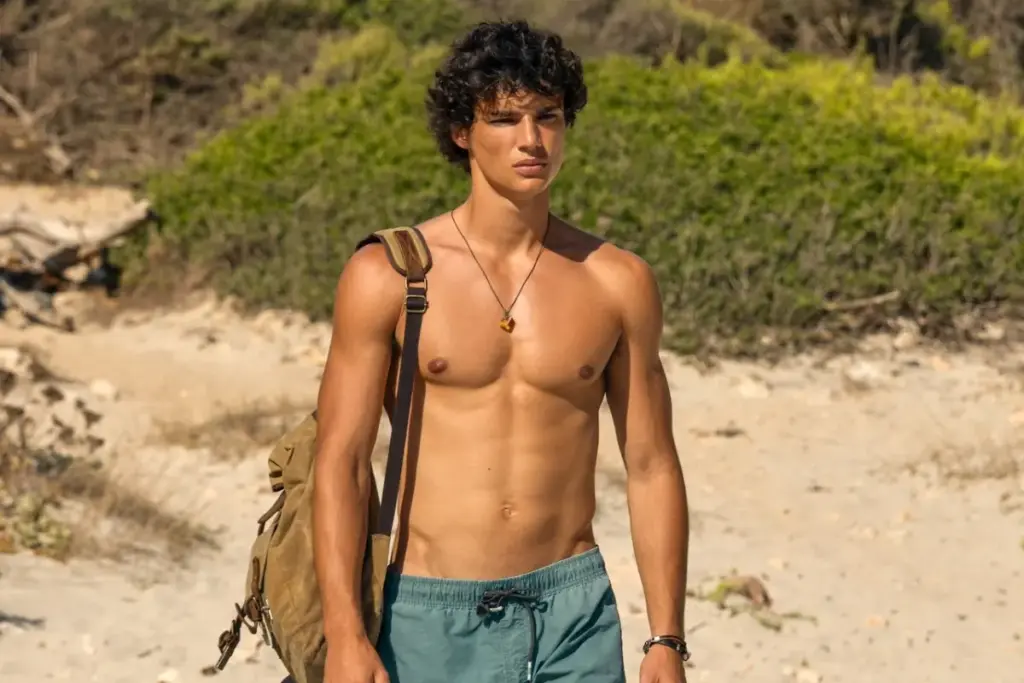
During an outing orchestrated by her new, bubbly confidante Amara (Chloe Sweetlove), Ry is nudged onto a clothing-optional beach. There, she has a literal eyeful of Julian (Fernando Lindez), a local fisherman whose introduction involves minimal textile encumbrance. Rather than treating the encounter with organic charm, the scene relies on tired rom-com friction: Julian sternly chastises Ry for staring, conveniently ignoring the fact that he is entirely nude while she is clad in a full swimsuit.
Predictably, the initial hostility melts into intense physical attraction. However, the narrative immediately stacks the deck with conflicting secrets:
- The Corporate Threat: Isolde heads a powerful hotel conglomerate explicitly angling to acquire land in Mallorca to build a sprawling luxury resort. The primary target for expropriation is the humble, historically rooted dock property owned by Julian’s working-class family.
- The Medical Rebellion: Choosing to fully experience the visceral, electric rushes that Julian inspires, Ry makes the reckless decision to secretly halt her pharmaceutical regimen, setting up a medical crisis for the final act.
- The Local Underworld: Julian is harboring his own financial liabilities, owing substantial sums to local creditors who are more than willing to use physical intimidation—explaining the urgent economic pressure forcing his family to sell their ancestral home.
As Julian guides Ry through the cultural and scenic highlights of the island, the two characters engage in a delicate dance of deception. Ry keeps her mother’s corporate ambitions and her neurological diagnosis under wraps, while Julian conceals the violent debt collectors circling his family.
Act III: The Manufactured Crisis and Resolution
As expected of the subgenre, the narrative eventually demands a crisis of disclosure. When the truth of Isolde’s resort development inevitably collides with Ry and Julian’s budding romance, the revelation arrives with all the dramatic resonance of a damp squib. The conflict feels entirely avoidable, engineered solely to manufacture a parting-of-ways before the mandatory reconciliation.
Ry’s abrupt cessation of her epilepsy medication yields the expected third-act medical emergency, transforming what should be a sobering look at chronic illness into a superficial plot device designed to force Julian into the role of physical savior. When a local beachside harasser targets Ry, Julian literally scoops her up and carries her away—a sequence that visually encapsulates the film’s broader thematic issue: its protagonist is rarely an active participant in her own life, reduced instead to a passive passenger in a narrative driven entirely by external forces.
Supporting Context & Metrics: The Economics of Streamer Romances
To view The Last Sunrise in a vacuum is to miss the broader industrial context governing modern content production. The film represents a calculated financial and logistical strategy by major studios and streaming conglomerates to capture niche demographics with minimal fiscal risk.
The Rise of the Direct-to-Streaming YA Adaptations
In the wake of franchises like After—which parlayed Anna Todd’s Wattpad-born fan fiction into a surprisingly durable, multi-film international box-office and streaming juggernaut—studios have scoured the literary and digital landscapes for similar properties. The strategy relies on built-in audiences:
- Pre-Existing IP: Leveraging authors with dedicated online fanbases drastically reduces marketing acquisition costs.
- International Appeal: Setting narratives in universally desired vacation hotspots (such as Mallorca, Tuscany, or the Amalfi Coast) broadens global engagement metrics.
- Lean Budgets: These productions typically feature compressed shooting schedules, relying on digital cinematography that prioritizes bright, hyper-saturated color palettes over complex lighting setups or deep visual texture.
Critical Reception and Audience Metrics
While algorithms consistently prioritize the completion rates of these escapist titles, critical consensus has increasingly pushed back against the assembly-line nature of the genre. Comparisons to other contemporary streaming entries—such as Colleen Hoover adaptations or derivative travelogue romances like Under the Tuscan Sun updates—highlight a growing fatigue among reviewers.
Industry analysts point out that while titles like The Last Sunrise reliably chart within a platform’s top ten most-watched lists during their debut weekends, their long-tail engagement and cultural footprint remain virtually nonexistent. They function as white noise for streaming subscribers: visually palatable, emotionally frictionless content designed to run in the background.
Official Statements and Industry Perspectives
While major promotional rollouts for direct-to-streaming romantic dramas often emphasize the chemistry of their casts and the romantic allure of their locations, behind-the-scenes insights reveal the stringent commercial parameters within which directors like Carlson Young must operate.
In promotional featurettes distributed by Amazon MGM Studios, director Young emphasized the challenge of balancing physical romance with emotional vulnerability:
"We wanted to capture the overwhelming intensity of first loves and life-altering medical diagnoses against a backdrop that feels timeless. Mallorca gave us that idyllic canvas, but the core of the story had to rest on the vulnerability of our leads as they navigate forces far larger than themselves."
However, film critics and industry observers have noted a disconnect between these artistic aspirations and the final product’s execution. Writing in major entertainment reviews, critics have highlighted how the film’s heavy reliance on digital sheen strips away genuine texture. Independent cinematic analyses frequently characterize these projects as "content widgets"—products engineered to fill quarterly content quotas rather than artistic statements designed to endure.
Eva Longoria’s involvement as both a recognizable marquee name and a maternal anchor has also been a focal point of industry commentary. Analysts note that casting established veterans in parental or authority roles has become a standard industry mechanism to lend a veneer of prestige to otherwise standard young-adult romance narratives.
Future Outlook: The Evolution of the Streaming Romance
The release and subsequent reception of The Last Sunrise raise critical questions about the trajectory of the romance content industry on platforms like Prime Video, Netflix, and others. As audiences grow increasingly literate in algorithmic content creation, the limits of the "sun-drenched, secret-keeping, medical-drama romance" are becoming starkly apparent.
1. The Demand for Authentic Agency
One of the most persistent criticisms leveled against The Last Sunrise is the profound passivity of its protagonist. As modern audiences—particularly younger demographic cohorts—demand richer, more nuanced representations of mental health, chronic illness, and personal autonomy, characters who merely serve as empty vessels for audience projection are losing cultural currency. Future iterations of the genre will likely need to grant their leads genuine narrative agency rather than reducing them to damsels waiting for a physical rescue on a nude beach.
2. Fatigue with Glossy Digital Aesthetics
The "soulless, depthless visual approach" characteristic of many direct-to-streaming romances is facing mounting creative pushback. Cinematographers and directors working within the indie and mid-budget streaming spaces are increasingly experimenting with film stocks, more naturalistic lighting, and gritty textural elements to distinguish their work from the homogenous look of algorithmic content.
3. The Pivot Toward Subversive Rom-Coms
While the traditional YA tearjerker and the international destination romance will remain staples of the streaming library due to reliable baseline viewership, platforms are beginning to experiment with self-aware, subversive takes on the genre. Whether these shifts will permanently disrupt the assembly-line production of titles like The Last Sunrise remains to be seen, but one thing is clear: audiences and critics alike are increasingly unwilling to accept a sun-kissed setting as a substitute for a compelling narrative heartbeat.
Final Assessment
The Last Sunrise ultimately serves as a case study in the limitations of formulaic streaming content. By prioritizing glossy aesthetics, predictable plot mechanics, and passive character arcs over genuine emotional depth, the film squanders both its picturesque Mallorcan backdrop and the collective talents of its cast. For viewers seeking genuine romance, compelling dramatic conflict, or substantive character growth, the recommendation remains definitive: Skip it.