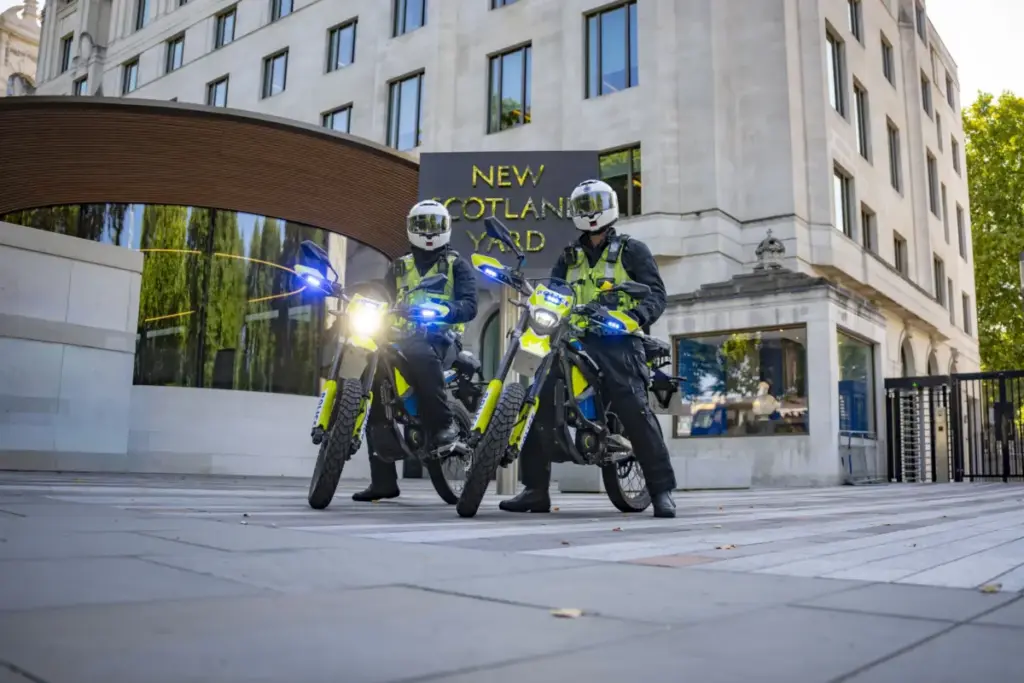
Executive Overview
In a decisive strategic pivot to counter a rampant wave of tech-enabled street crime, Scotland Yard has dramatically expanded its elite high-performance electric bicycle unit. The Metropolitan Police have scaled up their specialized fleet from just 5 to 25 high-powered Sur-Ron e-bikes, deploying them across central London’s most vulnerable districts, including the busy West End.
For years, moped muggers and criminal gangs utilizing modified two-wheeled transport have exploited London’s labyrinthine geography. They have effortlessly evaded traditional police interceptors by diving down narrow alleyways, cutting through pedestrianized zones, and tearing across housing estates. However, this new tactical capability fundamentally alters the dynamic of urban pursuit. Capable of hitting 50mph and navigating environments completely inaccessible to conventional police cars and heavy motorcycles, the expanded e-bike unit is designed to hunt down phone snatchers in real time and intercede moments after a crime occurs.
Backing this operational expansion are impressive early indicators of success: the Met credits the pilot phase of these nimble crime-fighting units with helping to drive down phone thefts by a staggering 13,000 offences over the past year. Funded in part by the Home Office using reinvested criminal assets, this initiative marks a watershed moment in modern urban policing—fighting fire with fire by using high-performance personal electric vehicles to neutralise offenders who rely on the very same technology to evade justice.
Detailed Chronology: Turning the Tide on Two Wheels
The deployment of the 25-strong e-bike fleet is the culmination of a successful, months-long tactical trial that tested the limits of lightweight electric motorcycles in high-density urban environments. For the past year, a handful of specially trained Metropolitan Police riders tested the feasibility of using Sur-Ron machines to patrol London’s congested arteries.
Historically, street criminals operating mopeds, stolen motorcycles, and illegally modified e-bikes enjoyed a massive geographical advantage. When chased by standard police vehicles, suspects would routinely scatter into pedestrian shopping zones, accelerate down stairwells, or weave through gridlocked traffic where heavy patrol cars simply could not follow. This impunity emboldened opportunistic gangs, who targeted tourists and commuters in high-footfall areas like Oxford Street, Soho, and Covent Garden, snatching high-end smartphones in seconds before vanishing into the urban maze.
The introduction of the trial fleet shattered that tactical playbook. Officers mounted on agile, silent, and rapid-acceleration Sur-Rons proved capable of keeping pace with fleeing suspects through tight alleyways and housing estates. The operational footprint of the unit was formally expanded to 25 riders following a series of high-profile arrests that underscored the value of the machinery.

In a recent operation highlighting the unit’s efficacy, a suspect attempted to evade authorities by rocketing into a municipal council estate on a high-powered bike. Traditional squad cars were forced to halt at the perimeter, but the pursuing e-bike officer effortlessly followed the suspect onto pedestrian pathways, cut off his escape route, and effected an immediate arrest—subsequently recovering a quantity of Class A drugs alongside the stolen property.
Supporting Context & Metrics: The Scale of the Threat
The rollout of the expanded e-bike unit does not happen in a vacuum; it is a direct response to a technological and criminal evolution that has caught authorities flat-footed across major global cities. Over recent years, the market has been flooded with affordable, easily accessible electric personal transport. While the vast majority of e-bikes are purchased legally by commuters and food delivery couriers, a significant underground economy has emerged centered on illegal modifications.
Online marketplaces and rogue retailers offer conversion kits for under £300, allowing standard pedal-cycles to be retrofitted with high-voltage batteries and heavy-duty motors. Unregulated and frequently uninsured, many of these modified machines are capable of speeds exceeding 70mph—effectively transforming them into unregistered, high-performance electric motorcycles capable of outrunning standard city traffic.
Criminals quickly recognized the utility of these machines. They are cheap to acquire, difficult to trace, highly maneuverable, and silent, making them the ultimate vehicle for smash-and-grab street robberies.
Yet, the Metropolitan Police are hitting back on multiple fronts. Beyond the deployment of the pursuit units, Scotland Yard has unleashed a relentless confiscation campaign. So far this year alone, officers have seized more than 2,500 illegal e-bikes and e-scooters across the capital.
The strategy is demonstrably bearing fruit. According to Scotland Yard’s latest performance metrics, neighborhood crime across London has fallen by 14% over the past year, anchored by the elimination of 13,000 phone thefts compared to the previous period. By cutting off the mobility advantage that criminal gangs relied upon, law enforcement has reclaimed the initiative on the streets.

Official Statements: Leadership Perspectives
The strategic importance of the expanded e-bike unit has been heavily emphasized by senior leadership within the Metropolitan Police, who view the initiative as a model for future urban crime-fighting operations.
Deputy Assistant Commissioner Louise Puddefoot highlighted the tactical shift during the official unveiling of the expanded fleet:
"Expanding our Sur-Ron fleet gives officers another powerful tool to stay one step ahead of criminals. These bikes allow officers to move quickly through busy streets, access areas traditional vehicles cannot reach, respond faster to crime, and arrest more suspects."
Puddefoot explicitly acknowledged the sophisticated methods currently being deployed by modern criminal networks, noting that gangs are increasingly relying on illicitly upgraded hardware to perpetrate high-speed robberies.
"Criminals are using high-powered, often illegally modified e-bikes to commit offences such as phone theft and robbery," Puddefoot added. "By expanding this capability, we are ensuring our officers have the tools they need to disrupt criminality and keep Londoners safe. Londoners are already seeing the results of our relentless focus on tackling street crime, with neighbourhood crime down 14 per cent over the past year and 13,000 fewer phone thefts."
The funding model behind the expansion has also drawn praise, showcasing effective cross-agency collaboration. Supported by the Home Office, the procurement of the specialized machinery has been heavily subsidized by funds seized directly from convicted criminals under proceeds-of-crime legislation—turning the financial gains of illegal enterprises into tools for their own dismantling.

Future Outlook: The Road Ahead for London Policing
As the Metropolitan Police integrate the full complement of 25 e-bike officers into daily operations across central London, the long-term outlook for street-level acquisitive crime is undergoing a profound transformation.
The success of the Sur-Ron unit proves that modern policing must evolve dynamically alongside the tools used by criminal elements. As personal electric vehicles become more ubiquitous, law enforcement agencies worldwide are watching London’s experiment closely. The ability to project tactical force into pedestrianized zones, parks, housing estates, and narrow historic thoroughfares without relying on heavy, polluting combustion engines represents a blueprint for sustainable, responsive city policing.
However, challenges remain. While the tactical response units can successfully hunt down perpetrators on the ground, law enforcement agencies continue to lobby for tighter regulatory frameworks surrounding the sale of online conversion kits and high-voltage batteries. Curbing the supply chain of illegal, high-speed kits at the point of import remains a critical priority if authorities are to completely stem the tide of unregulated machines entering the capital.
For now, phone-snatchers and moped muggers operating in London’s West End face a newly leveled playing field. The days of escaping down an alleyway or darting across a pedestrian square with impunity are drawing to a close, as Scotland Yard’s silent, swift, and highly trained e-bike riders patrol the shadows of the capital, ready to cut off any escape.