PUBLISHED: August 26, 2026 | UPDATED: August 26, 2026
LOCATION: Piedmont, Italy
AUTHOR: Global Investigative Desk
Executive Overview
In a horrifying aviation disaster that has left local communities and aviation authorities in shock, two people have been confirmed dead following the crash of a small gyrocopter in the rugged northern Italian region of Piedmont. The fatal incident occurred on Wednesday morning at approximately 11:30 AM local time (10:30 AM BST), unfolding near the strategically significant Campiccioli dam in the remote Antrona Schieranco area.
Preliminary investigations conducted by the Vigili del Fuoco (Italian national firefighters) indicate that the lightweight aircraft catastrophically struck a set of cable car wires spanning the mountainous terrain before losing structural integrity and plummeting to the ground. Eyewitness reports from the nearby picturesque town of Antrona add harrowing detail to the event, with local residents describing the aircraft transformed into a "fireball" engulfed in intense flames as it spiraled out of the sky.
As emergency response teams combed the treacherous alpine debris field, questions immediately arose regarding the safety protocols surrounding low-flying aerial vehicles, the visibility of industrial and utility cables in mountainous flight paths, and the inherent risks associated with recreational and utility gyrocopter navigation in high-altitude environments. This comprehensive report explores the timeline of the disaster, the technical and geographic context of the crash site, official responses from Italian authorities, and the broader implications for alpine aviation safety.
Detailed Chronology of Events
Morning Departure and Flight Path
While authorities have yet to release the official flight origin and destination of the doomed gyrocopter, flight tracking reconstructions and eyewitness accounts place the aircraft in the skies above the Piedmont province of Verbano-Cusio-Ossola during the late morning hours of Wednesday, August 26, 2026. Weather conditions in the region at the time of the flight were reported as generally clear, though localized alpine winds and treacherous thermal updrafts are perennial challenges for aviators navigating the narrow valleys of the Italian Alps.
The Strike and Descent
At approximately 11:30 AM local time, the gyrocopter approached the vicinity of the Campiccioli dam—an imposing engineering structure nestled deep within the Antrona Valley. According to initial technical assessments by the Vigili del Fuoco, the small aircraft’s rotor or forward chassis inadvertently made high-speed contact with high-tension utility or cable car wires suspended across the valley.
In aviation, wire strikes represent one of the most insidious hazards for low-flying helicopters, light aircraft, and gyrocopters. Due to their thin profile and the speed of the aircraft, cables are notoriously difficult for pilots to spot in time to execute evasive maneuvers. The impact likely severed critical flight controls and destabilized the gyrocopter’s rotor dynamics, rendering the aircraft impossible to pilot.
The Fireball and Ground Impact
Ground witnesses in the nearby town of Antrona watched in horror as the crippled vehicle instantly caught fire upon or immediately before impact with the terrain. According to reports broadcast by Sky TG24, multiple residents described seeing the gyrocopter transform into a burning "fireball" as it fell rapidly toward the rugged ground near the dam’s perimeter. The intense combustion was likely fueled by the aircraft’s onboard aviation fuel reservoir rupturing upon structural failure.
Emergency Response and Recovery
The remote, mountainous nature of the Antrona Schieranco area presented an immediate logistical hurdle for emergency responders. Within minutes of the initial impact, local emergency services received frantic calls from witnesses reporting the explosion and smoke billowing near the Campiccioli dam.
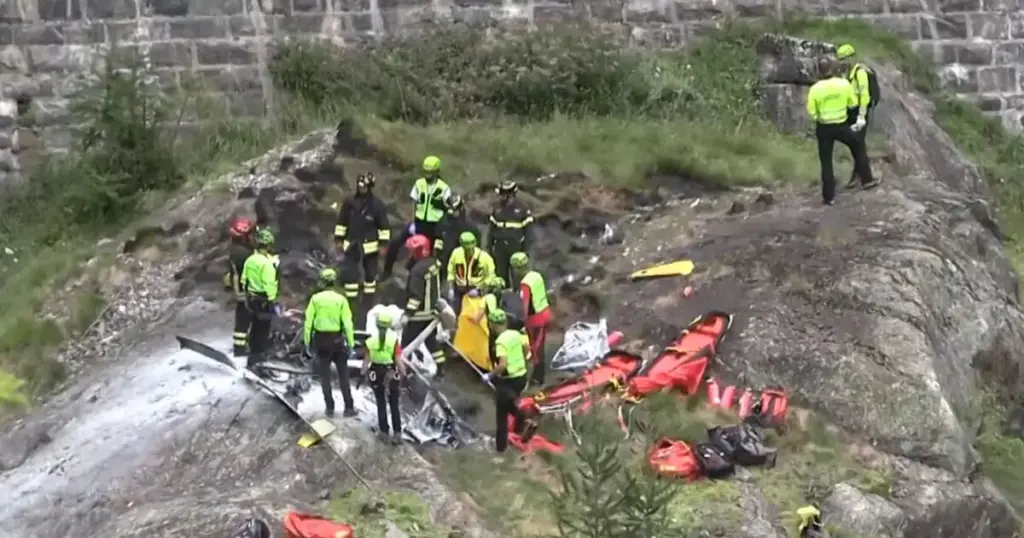
The Vigili del Fuoco, alongside alpine rescue teams (Corpo Nazionale Soccorso Alpino e Speleologico), carabinieri, and medical helicopter units, were swiftly mobilized. Responders had to navigate winding mountain roads and utilize specialized hiking and air-support equipment to access the impact zone. Upon arrival, firefighters worked tirelessly to extinguish the remaining hotspots and secure the wreckage. Tragically, first responders confirmed that both occupants of the gyrocopter had succumbed to their injuries at the scene, the severity of the crash and subsequent fire leaving no margin for survival.
Supporting Context & Metrics: The Anatomy of Alpine Aviation and Gyrocopter Risks
To fully comprehend the gravity of Wednesday’s tragedy, it is necessary to examine the specific environmental hazards of the Piedmont region, the operational mechanics of gyrocopters, and the sobering statistics surrounding alpine aviation incidents in Europe.
The Geography of the Antrona Valley
The Piedmont region, bordering Switzerland, is characterized by dramatic topography. Towering peaks, deep glacial valleys, and steep gorges create microclimates notorious for unpredictable wind shears, downdrafts, and sudden visibility shifts. The Antrona Valley (Valle Antrona) is a narrow, steep-sided alpine valley where infrastructure such as dams, hydroelectric pipelines, and industrial cableways are frequently installed to harness the region’s natural resources. These installations often feature cables strung across vast expanses of open air—creatin g invisible death traps for unwary or low-flying aviators.

Understanding Gyrocopters (Autogyros)
A gyrocopter—also known as an autogyro or rotocraft—is a type of rotorcraft that uses an unpowered rotor in autorotation to develop lift, and an engine-powered propeller (similar to a fixed-wing aircraft) to provide thrust. While popular among recreational pilots due to their maneuverability, relatively low cost, and reputation for stability in turbulent air, gyrocopters possess distinct operational vulnerabilities:
- Vulnerability to Wire Strikes: Because gyrocopters frequently fly at lower altitudes to allow pilots to enjoy scenic landscapes or conduct surveys, they operate in the exact altitude band where utility wires and cableways are most prevalent.
- Open-Air Cockpits: Many light gyrocopters feature open or semi-enclosed cockpits, offering minimal structural protection to the pilot and passenger in the event of a low-speed collision or heavy landing.
- Post-Crash Fire Risks: Carrying volatile aviation fuel close to the engine compartment creates an acute risk of rapid-onset fire following any structural impact.
Statistical Overview of Alpine Aviation Incidents
The European Alps remain one of the most densely flown recreational airspace zones in the world, accommodating commercial traffic, military exercises, private fixed-wing aircraft, helicopters, gliders, and gyrocopters. According to European Union Aviation Safety Agency (EASA) and national safety boards:
- Wire and Obstacle Strikes: Obstacle collisions (including trees, power lines, and cableways) account for approximately 12% to 15% of all fatal general aviation accidents in mountainous European territories.
- Terrain Masking: Pilots unfamiliar with local topography frequently fall victim to "terrain masking," where background vegetation or shadows conceal cables until it is too late to react.
- Fatality Rates: Due to the severe topography of crash sites, rescue times in alpine regions are inherently longer than in urban environments, contributing to a high mortality rate in severe impact scenarios.
Official Statements and Ongoing Investigations
In the wake of the tragedy, local authorities, emergency services, and aviation safety regulators have mobilized to piece together the exact sequence of events that led to the crash.
The Firefighters (Vigili del Fuoco)
The Vigili del Fuoco released preliminary incident summaries highlighting the structural dynamics of the crash. Their initial assessment underscores the probability of a wire strike:
"Operations at the site of the Campiccioli dam have confirmed the complete destruction of the small aircraft following a violent impact with the terrain. Early technical inspections of the wreckage and surrounding airspace strongly suggest the gyrocopter collided with suspended cables prior to its uncontrolled descent and subsequent ignition."
Local Authorities and Civil Protection
The Mayor of Antrona Schieranco and regional civil protection representatives expressed profound sorrow over the loss of life, while praising the rapid, highly coordinated response of the alpine rescue units who braved difficult terrain to secure the site. Local municipalities have repeatedly raised concerns regarding the visibility of high-altitude industrial cabling, though regulations governing the marking of cableways are strictly enforced across northern Italy.
The Investigation Process
The Italian National Agency for Flight Safety (Agenzia Nazionale per la Sicurezza del Volo — ANSV) has opened a formal inquiry into the accident. Investigators will examine:
- Maintenance and Flight Logs: Examining the technical service history of the gyrocopter, engine performance records, and avionics data (if recoverable).
- Pilot Qualifications and Flight Plan: Verifying the certification level of the pilot in command and determining whether a formal flight plan or local transit notice was filed.
- Meteorological Data: Analyzing weather conditions, wind speeds, and sunlight angles in the Antrona Valley at 11:30 AM on Wednesday to determine if glare or optical illusions played a role in obscuring the cables.
- Cable Infrastructure Compliance: Inspecting the specific cable car wires struck during the incident to ensure they met all national and international visibility, marker, and lighting requirements for low-altitude aviation.
Future Outlook: Safety Implications and Preventative Measures
Tragedies such as the Piedmont gyrocopter crash inevitably spark renewed debate among aviation safety experts, legislators, and recreational pilot associations regarding how to eliminate or mitigate the persistent threat of wire strikes in mountainous regions.
Technological Advancements in Wire Detection
For decades, wire strikes have plagued low-level aviators. However, modern aviation technology is beginning to offer viable solutions:
- Wire-Strike Protection Systems (WSPS): Commonly installed on commercial and military utility helicopters, these mechanical cable cutters attached to the landing gear and cabin roof can deflect and sever wires before they entangle the main rotor or cockpit. While less common on lightweight recreational gyrocopters due to weight constraints, industry advocates are pushing for miniaturized safety adaptations.
- Advanced Avionics and Radar Warning Systems: Modern synthetic vision systems (SVS) and terrain awareness warning systems (TAWS) are increasingly incorporating detailed databases of utility poles, power lines, and cableways. When paired with real-time GPS tracking and forward-looking radar, these systems can provide auditory and visual warnings to pilots approaching uncharted obstacles.
Regulatory and Infrastructure Recommendations
Safety experts argue that preventing future alpine aviation disasters requires a dual approach involving both pilot education and infrastructure visibility enhancements:
- Mandatory High-Visibility Markers: Ensuring that all cable car lines, ski lifts, and high-tension wires spanning alpine valleys are equipped with high-visibility spherical markers (balles de balisage) and strobe lighting.
- Stricter Pre-Flight Briefings: Urging aero-clubs and flight schools across Europe to emphasize mountain-flying hazards, stressing that pilots unfamiliar with local valley infrastructure should maintain higher minimum altitudes or utilize local flight advisory channels.
Community Mourning and Remembrance
As the investigation continues and the identities of the two victims are formally released following notification of next-of-kin, the communities of the Antrona Valley and the broader Italian aviation fraternity are left to mourn. Memorial tributes are expected to be organized locally, serving as both a solemn remembrance of the lives lost and a sobering reminder of the unforgiving nature of alpine skies.
Additional updates, official identification releases, and findings from the ANSV inquiry will be reported as more information becomes available.