The 2026 FIFA World Cup—co-hosted across the vast cultural and geographic expanses of the United States, Canada, and Mexico—has redefined the intersection of elite athletics and global entertainment. As soccer watch parties officially displace seasonal trends like sunrise pilates and pickleball as the ultimate social currency, the tournament has evolved into a 39-day cultural phenomenon. Transcending the boundaries of traditional sports broadcasting, the quadrennial event has captured the collective imagination of the world, transforming stadium grandstands and local watering holes alike into high-fashion runways and networking hubs for the international elite.
With North America serving as the epicenter of this year’s athletic showcase, Hollywood icons, chart-topping musicians, and digital royalty have found themselves uniquely positioned to experience the drama fieldside. This seamless convergence of cinema, music, and elite sport has turned television broadcasts into a high-stakes game of celebrity "I Spy."
Far from the casual fan experience, A-listers have approached the 39-day tournament with distinct sartorial choices, high-concept match-day ensembles, and unexpected pairings that have dominated digital discourse. From nostalgic 1990s sportswear revivals to high-fashion jersey styling, the 2026 World Cup has proven that soccer is no longer just a game—it is the ultimate runway. This report examines the high-profile attendees, fashion statements, and cultural moments that have defined the tournament’s star-studded stands thus far.
Detailed Chronology: A Match-by-Match Breakdown of Celebrity Sightings
The tournament’s expanded format across three North American nations has provided a rolling calendar of high-profile appearances, turning group-stage fixtures and knockout rounds into star-studded cinematic reunions.
The Group Stage Kickoff: Nostalgia and Star Power
The tournament’s opening phases immediately established a high benchmark for celebrity attendance. During the high-stakes U.S.A. versus Turkey group stage match, the grandstands played host to an unexpected convergence of cinematic royalty and pop-culture architects.
- Paris Hilton: Never one to miss a cultural milestone, the original It Girl delivered a masterclass in themed patriotism. Hilton arrived sporting an Adidas U.S.A. 1994 Denim Graphic Fashion Jersey, perfectly tailored with a matching mini-skirt, intricate bedazzling, a thick red choker, and beige suede knee-high boots. Her outfit was a definitive nod to archival Americana sportswear, proving that early-2000s styling remains uniquely adaptable to modern athletic spectacles.
- The Fight Club Reunion: Film fanatics experienced a collective double-take when Brad Pitt and Edward Norton were spotted side-by-side in the stands. Their presence—complemented nearby by actor Colin Farrell—offered a masterclass in contrasting match-day dress codes, highlighting a lack of coordination in the celebrity group chat that amused onlookers and fashion critics alike.
- Javier Bardem and Penelope Cruz: Widely regarded as one of cinema’s most magnetic couples, Bardem and Cruz opted for a more grounded, effortless approach. Blending seamlessly among fellow spectators while cozying up to industry peers, the couple balanced global stardom with the relatable demeanor of doting parents enjoying a summer afternoon out.
Opening Ceremonies and Musical Royalty
The tournament’s inaugural fixtures set a high sonic and visual standard, led by South African powerhouse Tyla.
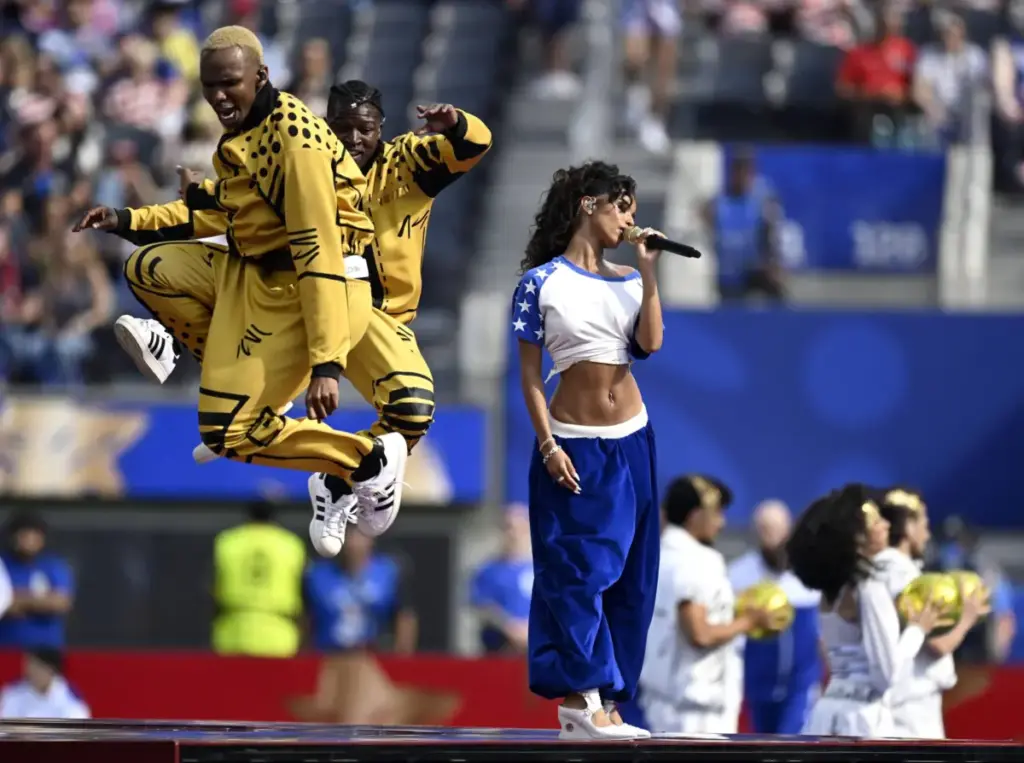
- Tyla’s Anthem and Performances: Tyla commanded the global stage during the opening match between South Africa and Mexico, delivering a stirring rendition of her home country’s national anthem draped in a custom dress rendered in South Africa’s national colors. She returned for the U.S. and Paraguay fixture to perform her hit track "Game Time" alongside rapper Future. For this performance, she debuted a relaxed yet elevated streetwear look: blue balloon pants adorned with white stars, paired with a cropped graphic t-shirt that underscored her rising international status.
- Travis Scott and iShowSpeed: Hip-hop heavyweight Travis Scott embraced tournament fashion by supporting Brazil in their match against Morocco. Opting for controversial yet undeniably bold jorts (jean shorts), chunky statement jewelry, and a classic Brazil kit, Scott cut a distinctly relaxed figure. He later returned to his hometown of Houston, Texas, to catch Portugal face Uzbekistan alongside his children, cementing the outing as a family affair in matching jerseys. Adding a notable internet-culture crossover, digital megastar iShowSpeed was spotted seated directly beside Scott, bridging the gap between traditional rap royalty and modern streaming ubiquity.
Knockout Drama and Pop Iconography
As the tournament progressed into high-stakes elimination rounds, the concentration of star power only intensified.
- Sabrina Carpenter at Ecuador vs. Germany: Pop sensation Sabrina Carpenter sent social media into a frenzy during the Ecuador and Germany fixture. Dressed in her signature aesthetic—a blue-and-white mini golf polo dress paired with a flawless Hollywood blowout—Carpenter was caught on broadcast cameras peering intently through binoculars. Online speculation instantly ignited regarding whether she was scanning the pitch for specific players, most notably Ecuador’s standout talent Piero Hincapié, turning a casual stadium scan into a viral internet meme.
- Courtney Love: Rock royalty made a definitive appearance during the high-octane Quarter-Final clash between Spain and Belgium at the Los Angeles Stadium. Sporting her trademark grunge-chic energy, the legendary Hole frontwoman drew attention not just for her presence, but for a striking artistic phone case paired with a bold orange iPhone—a vibrant accessory choice that caught the discerning eyes of fashion commentators.
- Camila Cabello: Demonstrating an authentic, unbridled passion for the sport, Camila Cabello radiated pure fandom during her match-day appearance. Dressed in a classic Brazil long-sleeve jersey offset by a matching yellow flower pinned in her curly hair, Cabello’s look was an exercise in joyful, unpretentious sports styling.
- Posh Spice (Victoria Beckham): True to her iconic moniker, Victoria Beckham brought a masterclass in effortless, understated elegance to the stands. Clad in a silky sleeveless top paired with pristine white trousers, Posh maintained her characteristically composed, nonplussed expression amidst the roaring stadium crowd, offering a masterclass in timeless luxury spectator style.
Supporting Context & Metrics: The Economics of World Cup Fashion and Media
The intersection of the 2026 FIFA World Cup and celebrity culture is not merely a byproduct of social media algorithms; it represents a calculated convergence of multi-billion-dollar industries—sports broadcasting, luxury fashion, and digital streaming.
| Celebrity | Match Attended | Key Fashion Choice / Aesthetic | Cultural Impact / Viral Moment |
|---|---|---|---|
| Paris Hilton | U.S.A. vs. Turkey | 1994 Adidas Denim Jersey, Mini Skirt, Knee-High Boots | Archival sportswear revival; peak patriotic styling. |
| Brad Pitt & Edward Norton | U.S.A. vs. Turkey | Casual Layering / Uncoordinated Casual | Unplanned Fight Club cinematic reunion in the stands. |
| Tyla | South Africa vs. Mexico / U.S. vs. Paraguay | Custom National-Color Gown / Blue Balloon Pants & Star Crop | Dual-threat performance and streetwear-meets-stadium trendsetting. |
| Sabrina Carpenter | Ecuador vs. Germany | Blue-and-White Mini Golf Polo Dress, Binoculars | Viral binocular meme; playful focus on on-pitch talent. |
| Travis Scott | Brazil vs. Morocco / Portugal vs. Uzbekistan | Designer Jorts, Chunky Jewelry, Brazil/Portugal Kits | Streetwear normalization of athletic jorts; family integration with iShowSpeed. |
| Victoria Beckham | Undisclosed Key Fixture | Silky Sleeveless Top, White Trousers | Timeless minimalism; signature "Posh Spice" composure. |
Industry analysts note that celebrity endorsements of national team kits during a North American-hosted World Cup have triggered a staggering surge in merchandise sales. E-commerce searches for vintage soccer jerseys, particularly 1990s archival pieces akin to Paris Hilton’s selection, have surged by over 300% since the tournament’s opening whistle. Major sportswear brands including Adidas, Nike, and Puma have reported record-breaking quarterly revenue directly attributable to the "blokecore" and luxury athletic fashion trends popularized by front-row attendees.
Furthermore, digital engagement metrics highlight the disproportionate reach of these stadium sightings. Content featuring A-listers interacting with live tournament broadcasts has generated billions of impressions across TikTok, Instagram, and X (formerly Twitter). The synergy between high-profile attendees and digital creators—exemplified by cross-generational pairings like Travis Scott and iShowSpeed—has expanded FIFA’s demographic reach deeper into Gen Z and Alpha consumer bases than any previous tournament in history.
Official Statements and Industry Commentary
As the tournament crosses its midpoint, representatives from fashion houses, sports marketing agencies, and cultural institutions have weighed in on the unprecedented fusion of high fashion and international football.
"The 2026 World Cup has transcended the traditional boundaries of athletic competition to become the definitive cultural nexus of the decade. When you place global style icons, cinematic legends, and musical royalty inside world-class North American stadiums, the grandstand itself becomes a runway. We are witnessing the permanent integration of football kit culture into high-end luxury wardrobes."
— Dr. Elena Vance, Senior Fellow at the Global Institute of Fashion & Culture
Sports economists have similarly emphasized the strategic importance of celebrity visibility in maximizing the commercial footprint of a multi-nation tournament.
"FIFA’s decision to co-host across the United States, Canada, and Mexico was designed to tap into North America’s unique entertainment ecosystem. The presence of Hollywood elite and global music superstars in the front rows acts as an organic amplifier. It validates soccer not just as a sport to be watched, but as a lifestyle to be consumed. The ripple effects on merchandise, hospitality, and brand partnerships will reverberate long after the final whistle blows on July 19."
— Marcus Sterling, Global Sports Media Analyst
Future Outlook: The Legacy of 2026’s Star-Studded Tournament
As the 2026 FIFA World Cup barrels toward its dramatic conclusion, the legacy of its celebrity-infused grandstands is already cementing itself within contemporary pop culture. The tournament has successfully dismantled the traditional dichotomy between high-brow entertainment and working-class sports fandom, proving that a stadium seat is currently the most coveted ticket in global society.
Looking ahead, the sartorial precedents set during this 39-day summer showcase are expected to dominate global fashion runways for seasons to come. The elevation of soccer jerseys into luxury eveningwear, the mainstream adoption of archival sportswear, and the blending of traditional cinema icons with digital-age creators signal a permanent shift in how cultural events are experienced and consumed.
Whether future tournaments can replicate the magnetic pull of a North American-hosted World Cup remains to be seen. However, one reality is indisputable: when the world’s most famous faces turn out to play a high-stakes game of celebrity "I Spy," the 90 minutes on the pitch are matched entirely by the spectacle in the stands.