Executive Overview
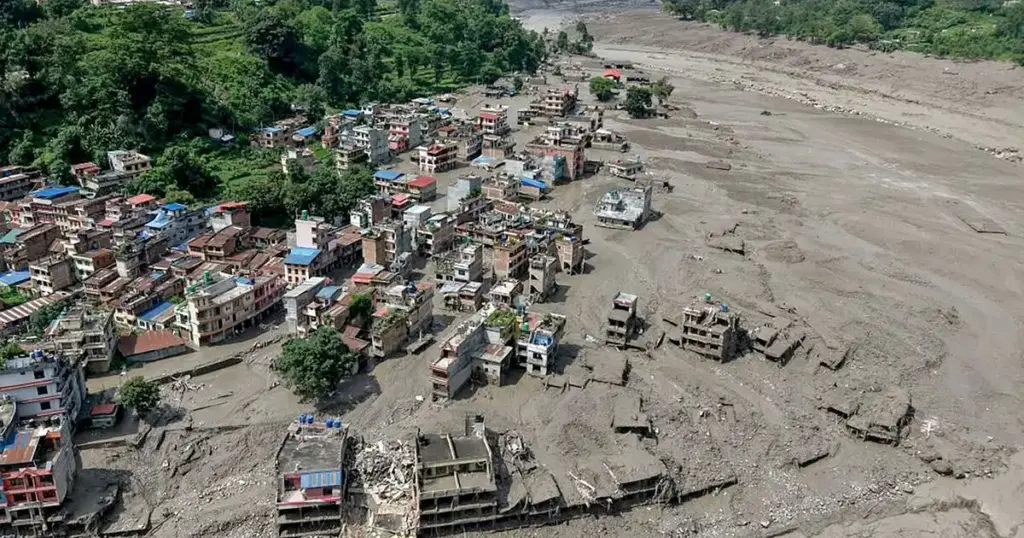
In what local authorities are describing as a disaster of unprecedented proportions, Nepal has been struck by catastrophic flash floods and mudslides following a catastrophic glacier avalanche near the Tibetan border. The deluge, which struck without warning on Wednesday morning, has left at least 17 people confirmed dead and a staggering 384 tourists missing—including 12 British nationals.
The disaster unfolded when an ice-rock avalanche from a high-altitude Himalayan glacier collapsed into the upper reaches of the Lhende Khola River, a vital tributary of the Bhotekoshi River. The sudden displacement of massive volumes of water, mixed with glacial debris and mud, created a massive wall of water that raced downstream. Entire villages, vital infrastructure, roads, and hydropower projects have been swept away or severely compromised.
As search-and-rescue operations scale up under extreme conditions, the Nepalese government has issued urgent appeals for international assistance, prompting neighboring India and China to mobilize resources. With communications severed, major roadways to the capital Kathmandu blocked, and scores of security personnel among the missing, the true human and economic toll of this disaster remains agonizingly obscured.

Detailed Chronology of the Disaster
Wednesday Morning: The Sudden Deluge
The catastrophe began at approximately 9:00 AM local time on Wednesday. According to climate and disaster specialists, the trigger was an extreme ice-rock avalanche originating from a glacier on the Nepalese side of the border. The avalanche catastrophically blocked the Lhende Khola River before bursting through its natural barrier, sending an immense, sudden surge of water downstream into the Bhotekoshi River basin.
Residents and businesses in the path of the flood had virtually no time to evacuate. Yee Liang, a Chinese businessman operating logistics in Kathmandu, recounted the harrowing initial moments: "As far as I know, there was no warning. Our logistics company has seven container trucks there, all staffed by Nepalese employees. We have lost contact with all of them. There is no signal, so we cannot reach anyone."
Immediate Aftermath and Missing Security Personnel
Within hours of the initial impact, regional police and disaster management units reported widespread devastation. The Bagmati Province Police Office confirmed that the hardest-hit areas include Rasuwa, Nuwakot, and Dhading.

The danger of the rushing torrent was so absolute that it overwhelmed those tasked with protecting others. Rajendra Prasad Dhamala, spokesman for the Bagmati Province Police Office, revealed that 32 security personnel—comprising members of the Nepal Police and the Armed Police Force stationed in Timure, Rasuwa—are currently missing. Thirteen of these officers vanished directly from two separate posts in the Rasuwa district, and units have been unable to establish radio or cellular contact with dozens of other field officers.
Casualties and Missing Tourists
As recovery operations began in receding mud and treacherous waters, search teams pulled the first grim figures from the debris. Rajendra Prasad Dhamala confirmed that 16 bodies have been recovered from various locations—one in Rasuwa, nine in Nuwakot, and six in Dhading—bringing the known death toll to at least 17, though officials warn this number is a fraction of the final count.
Compounding the gravity of the crisis is the staggering number of unaccounted-for travelers. Officials report that 384 tourists are missing, among them 291 foreign nationals originating from a multitude of countries, including the United Kingdom (12 missing), the United States, India, and Malaysia. With peak travel seasons and remote trekking routes heavily populated, embassies in Kathmandu are scrambling to verify the safety of their citizens.

Supporting Context & Metrics: Climate Change and the Melting Himalayas
An Accelerating Crisis in the Third Pole
While flash floods and landslides are not uncommon during the volatile South Asian monsoon season, experts emphasize that Wednesday’s disaster is symptomatic of a much larger, systemic crisis driven by human-induced climate change.
The Hindu Kush Himalaya region—often referred to as the "Third Pole" because it holds the largest reserve of glacial ice outside the polar regions—is warming at a rate significantly faster than the global average. According to research published earlier this year by Kathmandu-based scientific groups, glaciers across the mountain range are melting at an alarming and accelerating rate. Data indicates that ice loss rates have doubled since the year 2000, directly fueled by rising global temperatures.
The Science of Glacier Avalanches
Saswata Sanyal, a disaster risk reduction specialist with the International Centre for Integrated Mountain Development (ICIMOD), shed light on the mechanics of Wednesday’s event:

"The Lhende Khola has flooded twice in fourteen months, this time triggered by an ice rock avalanche from a glacier on the Nepal side that blocked the river and released a sudden surge downstream. In a warming Himalaya, early warning is the first line of adaptation."
As glaciers retreat and destabilize, hanging ice and unstable moraine walls become ticking time bombs. When an avalanche breaches these temporary natural dams, the resulting glacial lake outburst flood (GLOF) or sudden ice-rock surge unleashes unimaginable kinetic energy, scouring valleys clean of human habitation in minutes.
Official Statements and International Response
Government and Military Mobilization
In response to the escalating crisis, the Nepalese government has moved swiftly to transition from crisis reporting to active rescue management. Prime Minister Balendra Shah announced that emergency protocols have been fully activated:

"Work has started to take necessary steps in coordination with the medical team, scouts, and the Red Cross."
The Nepal Army has deployed specialized disaster response units alongside military helicopters to pierce through the blocked terrain and reach isolated pockets of survivors. However, rescue efforts are heavily bottlenecked. The main highway connecting the disaster zone to the capital Kathmandu has been completely closed due to massive landslides and washed-out bridges. Power grids and telecommunication towers have collapsed, plunging entire districts into digital and physical darkness.
The National Disaster Risk Reduction and Management Authority has issued continuous, high-priority warnings to residents inhabiting vulnerable low-lying areas, explicitly instructing them to steer clear of the swollen banks of the Bhotekoshi, Trishuli, and Narayani rivers.

International Outreach and Beijing’s Response
Recognizing that domestic resources alone cannot handle a catastrophe of this magnitude, Nepali government spokesperson Sasmit Pokharel issued a direct plea for cross-border cooperation: "We have asked both India and China to help us with the rescue efforts."
The geopolitical significance of the region—bridging Nepal and Chinese-controlled Tibet—brought immediate high-level attention from Beijing. Chinese President Xi Jinping broke his silence via the state news agency Xinhua, calling for an "all-out" rescue operation.
President Xi emphasized: "The most urgent task is doing everything possible to search for and rescue the missing people… quickly treat injured people and minimise casualties to the greatest extent possible." China is expected to coordinate with Nepalese authorities to assess upstream conditions in Tibet, where the avalanche originated, to prevent secondary floods.

Future Outlook: Long-Term Vulnerabilities and Recovery
As search-and-rescue teams race against the clock to locate the hundreds of missing tourists, security personnel, and locals, the immediate horizon looks bleak. Unpredictable weather patterns threaten to trigger further landslides, hampering the deployment of heavy engineering equipment needed to clear the blocked arteries leading to Kathmandu.
Beyond immediate life-saving operations, the disaster serves as a harsh wake-up call for governments across the Himalayan arc. Experts argue that traditional disaster management—reactive deployment after a catastrophe occurs—is no longer sufficient in an era of rapid climate breakdown.
Long-term survival in the region will require unprecedented investments in transboundary early-warning systems, climate-resilient infrastructure, and the continuous monitoring of high-risk glacial lakes and unstable mountain slopes. Until then, communities living in the shadow of the world’s highest peaks remain precariously exposed to the raw, untamed forces of a rapidly warming planet.