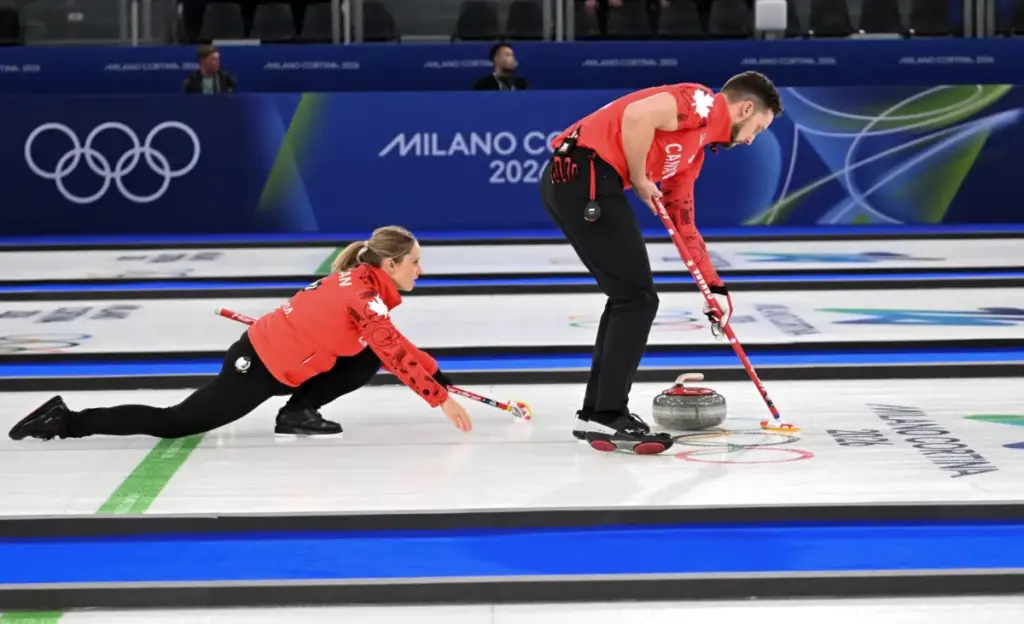
Welcome to your definitive guide to the 2026 Winter Olympics. As we track every angle of the Milano Cortina Games—from real-life heated rivalries to under-the-radar disciplines and surprise podium standouts—our comprehensive coverage brings the entire Olympic landscape into focus.
Executive Overview
To the casual sports fan tuning into the 2026 Milano Cortina Winter Olympics, curling often presents an optical paradox. At first glance, it can appear deceptively sedate—a quiet, calculated exercise that looks more like intense housecleaning than a high-octane athletic competition. But beneath the veneer of polite sportsmanship, tactical maneuvering, and the rhythmic, thunderous cadence of specialized brushes lies a razor-thin margin of error. It is a game of microscopic physics, tactical chess on ice, and, as the ongoing 2026 Games have unexpectedly revealed, a breeding ground for high-stakes controversy.
The tranquility of the curling sheet was shattered this week when an unprecedented wave of cheating accusations engulfed both the Canadian men’s and women’s national teams. What began as a tense, localized dispute during a high-profile match against Sweden quickly spiraled into a viral international talking point, casting a rare shadow of doubt over one of the Winter Olympics’ most traditionally gentlemanly disciplines.
Far from being a sleepy pastime, modern elite curling is an unforgiving arena where fractions of a second, millimeter-thick trajectories, and intense psychological warfare dictate international glory. As the world watches Team USA battle through the playoff brackets and reflects on a stellar silver-medal performance in mixed doubles, the unfolding drama at Milano Cortina serves as a stark reminder: curling is a rigorous, deeply tactical battleground where the stakes could not be higher.
Detailed Chronology: The Anatomy of the Milano Cortina Curling Controversy
Curling has long prided itself on being the ultimate gentleman’s sport. Governed by an unwritten code of ethics known as the "Spirit of Curling," players are historically expected to call their own fouls, acknowledge opponent excellence, and maintain a stoic, respectful decorum. That institutional reputation was severely tested mid-tournament during a pivotal clash in the men’s division between powerhouse Canada and a fierce Swedish squad.
The Men’s Match: The Spark That Lit the Fire
During the high-stakes round-robin fixture, Swedish players registered a formal, on-ice grievance against seasoned Canadian curler Marc Kennedy. The allegation was as specific as it was damning: Swedish athletes claimed that Kennedy had maintained physical contact with the 44-pound granite stone after its official release from his delivery hand.
Under World Curling Federation regulations, any post-release contact—no matter how infinitesimal—is strictly prohibited. Because the human touch imparts heat, friction, or unintended directional momentum, even a fraction of a millimeter’s brush can fundamentally alter the rock’s deceleration and curl as it navigates the textured ice sheet.
Television broadcasts and high-definition fan-captured clips quickly flooded social media platforms, showing what appeared to be Kennedy’s finger brushing the granite just past the hog line. On-ice umpires did not immediately assess a formal penalty during real-time play, but the interaction triggered a visibly tense, frost-laden verbal exchange between the rival rinks. Kennedy firmly denied any intentional wrongdoing, maintaining that his delivery mechanics were clean. Nevertheless, the incident instantly ignited a global debate regarding officiating transparency and human error in automated stone-tracking technologies.
The Women’s Match: Escalation and Institutional Backlash
If the men’s incident was viewed by some as an isolated optical illusion, the flames were fanned into a full-scale crisis mere hours later during the women’s tournament.
In a chillingly similar sequence of events, Canadian skip Rachel Homan found herself at the center of an identical infraction. An on-ice umpire intervened, ruling that a delivered stone violated release protocols and ordering it removed entirely from play. The decision sent shockwaves through the Canadian camp. Homan and her teammates vehemently contested the call, arguing that the enforcement was inconsistent, heavy-handed, and fundamentally flawed.
This dramatic double-whammy targeting Canada’s premier rinks transformed a routine rules enforcement into a raging international controversy. It forced technical committees, sports scientists, and sports journalists worldwide to re-examine how elite curling manages officiating oversight, accountability, and the delicate balance between human judgment and technological intervention.
Supporting Context & Metrics: Understanding "The Roaring Game"
To truly comprehend the gravity of the Milano Cortina controversy—and why a millimeter-wide touch can spark international fury—one must understand the physics, history, and intricate mechanics of the sport.
Origins and Evolution
With roots tracing back to the 16th-century frozen lochs and ponds of Scotland, curling stands as one of the oldest continuous team sports in the world. Early participants slid rough, flat-bottomed stones across natural ice, a scene immortalized in historic European paintings.
Curling made its official Olympic debut at the inaugural Winter Games in Chamonix, France, in 1924. However, after a lengthy hiatus, it vanished from the official program until returning triumphantly as a medal event at the 1998 Nagano Winter Games. The women’s tournament was introduced in Nagano, while mixed doubles made its high-energy Olympic debut at the 2018 PyeongChang Games, expanding the sport’s global footprint.
Equipment, Physics, and Terminology
At the elite level, a standard curling match features teams of four players on a dedicated sheet of pebble-textured ice. Each player is equipped with a specialized brush and dual-soled footwear—one shoe featuring a Teflon slider for gliding across the sheet, and the other featuring a rubberized gripper for stable footing.
- The Stone: Machined from specific types of Scottish granite (such as Ailsa Craig common green and Blue Hone), each official Olympic stone weighs precisely 44 pounds (19.1 kg).
- The House: The circular target at each end of the sheet, consisting of concentric rings (the 4-foot, 8-foot, and 12-foot circles) centered around the "tee."
- The Sweep: Sweeping serves a dual purpose. Vigorous brushing by teammates clears microscopic debris that could impede the rock, while friction slightly melts the top layer of the pebble ice, creating a thin film of water that allows the stone to travel farther and curl less aggressively.
- The Nomenclature: The sport earns its poetic moniker, "The Roaring Game," from the deep, rumbling sound that heavy granite stones make as they travel across the pebbled ice sheet.
Scoring and Strategic Complexity
A standard professional curling match is played over 10 ends (rounds). In four-person team play, each team throws eight stones per end—two per athlete, alternating with the opponent. The sequence runs from the lead, who throws the first two rocks, up to the skip (team captain), who delivers the final two decisive throws.

Scoring is calculated at the end of each round:
- A team scores one point for each of its stones located inside or touching the house that are closer to the center than any opposing team’s stone.
- The Hammer: The final throw of an end is known as the hammer. Possessing the hammer is a massive tactical advantage, allowing a team to play aggressively and hunt for multiple points. Because the team that fails to score in the previous end is awarded the hammer in the next, elite teams will occasionally intentionally blank an end (score zero points) or strategically give up a single point to retain the hammer for a more favorable subsequent attack.
Official Statements and Institutional Response
As the Milano Cortina competition presses forward, governing bodies have found themselves under mounting pressure to address the fallout from the Canadian controversies.
The World Curling Federation Speaks
In a formal press briefing issued from the Olympic venue in Italy, representatives for the World Curling Federation (WCF) defended the integrity of the on-ice officials while acknowledging the growing discourse surrounding rule enforcement.
"Our technical officials operate under strict international guidelines to maintain the absolute fairness of competition," the WCF statement read. "The integrity of the game relies upon adherence to delivery rules, including the absolute release threshold at the hog line. We are reviewing match logs and camera angles to ensure that our officiating standards remain transparent, consistent, and reflective of the modern elite game."
Athlete Reactions
Marc Kennedy and Rachel Homan have both released statements emphasizing their dedication to fair play while expressing frustration over the media storm.
"We play this game with the utmost respect for our competitors and the rules that govern it," Kennedy noted in a social media address. "In the heat of elite competition, split-second mechanics are scrutinized under microscopic camera angles. We are focused entirely on our remaining matches and representing our country with honor."
Sports analysts have pointed out that these incidents may accelerate the integration of automated sensor technologies—such as electronic hog-line sensors currently utilized in high-level championships—to remove human subjectivity entirely from the equation, much like goal-line technology in association football or tennis’s Hawk-Eye system.
Beyond the Traditional Sheet: Wheelchair Curling and the Noise of the Rink
While the standard team disciplines capture headlines, the broader Olympic ecosystem highlights the incredible versatility and inclusive reach of the sport.
Wheelchair Curling at the Paralympics
A cornerstone of the Paralympic Winter Games since its debut at Turin 2006, wheelchair curling adapts the core tenets of traditional play with specific structural modifications. Designed for athletes with lower-limb physical impairments, the discipline utilizes the exact same ice sheets and house dimensions as able-bodied curling.
However, athletes do not sweep the ice (removing a variable that heavily alters pacing), and they utilize specialized delivery sticks to propel the 44-pound stones from a stationary seated position. Played in mixed-gender teams of four, wheelchair curling showcases the same intense strategic depth, tactical shot-making, and emotional highs as its Olympic counterpart.
Deciphering the Rink Roar
For viewers wondering why curlers spend so much time shouting across the sheet, the acoustics and spatial dynamics of the venue provide the answer. Rinks are loud, echoing environments filled with crowd noise, broadcasting audio, and ambient refrigeration hums.
Skips must project their voices at maximum volume to communicate tactical adjustments in real-time. Popular commands include:
- “Woah! Woah!” – Cease sweeping immediately.
- “Hard! / Yup!” – Sweep aggressively to maintain speed and reduce curl.
- “Right to it!” – Direct sweeping efforts toward the right side of the stone’s path.
Per USA Curling regulations, foul or abusive language is strictly prohibited; the yelling is exclusively tactical, keeping synchronization razor-sharp across the sheet.
Future Outlook: The Road to the Podium at Milano Cortina 2026
As the Milano Cortina Winter Olympics barrel toward their dramatic conclusion, the curling tournament remains one of the most-watched and intensely debated spectacles of the Games.
Team USA has already etched its name into the medal tally, securing a brilliant silver medal in mixed doubles earlier in the competition. Meanwhile, the U.S. men’s and women’s four-person rinks are locked in fierce battles through the playoff round-robins, fighting for critical positioning and looking to cap off an unforgettable Olympic fortnight with hardware.
Yet, the lasting legacy of the 2026 curling competition may well extend beyond the medals won and lost on the Italian ice. The intense national debates over stone release rules, the viral scrutiny of athletic mechanics, and the persistent tension between tradition and modern officiating technology have permanently altered how the world views "The Roaring Game." Far from a quiet, quaint winter diversion, curling has proven itself to be a visceral, high-stakes sport where passion runs deep, margins are microscopic, and every single sweep matters.