Executive Overview
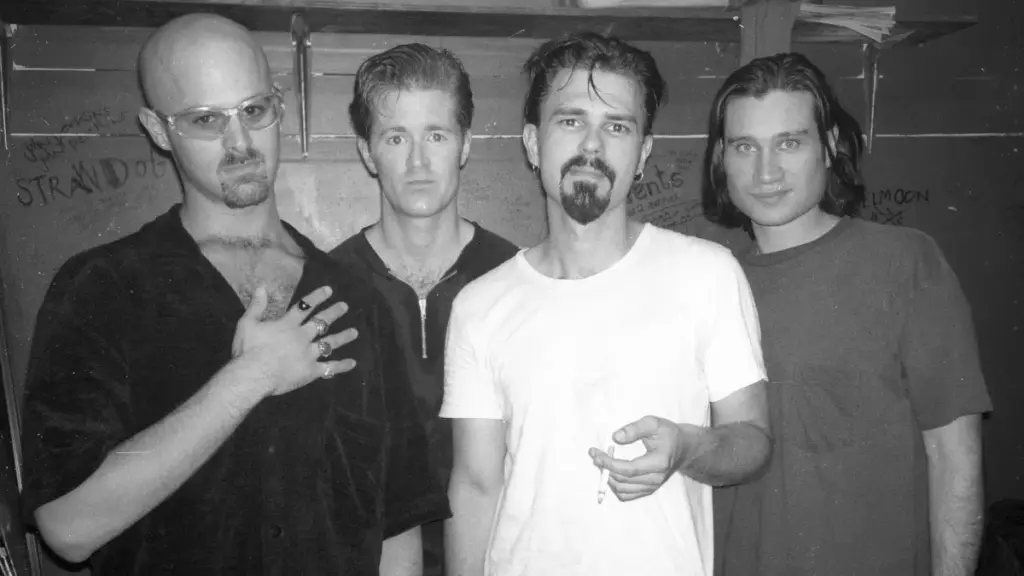
For patient devotees of the avant-garde, the long game has finally reached its triumphant payoff. Shudder to Think, one of the most intellectually rigorous, idiosyncratic, and influential rock acts to emerge from the fertile American underground of the late 20th century, has officially broken a nearly thirty-year recorded studio silence.
Following a surprise announcement in June 2026 outlining a concise, four-date September reunion tour, the band delivered a seismic shock to the alternative music community on August 25, 2026. The group revealed they will release their first collection of brand-new music since their landmark 1997 studio album, 50,000 B.C.
The upcoming release, a tightly wound, three-song mini-EP titled Who Sent You?, is slated to drop on September 11, 2026. Equally thrilling to purists and longtime collectors is the band’s reunion with Dischord Records, the legendary Washington, D.C. punk institution that nurtured their early-career masterpieces. This homecoming represents a full-circle aesthetic migration back to the bracing, dissonant post-punk roots that initially catapulted them out of the capital’s hardcore landscape and into the national consciousness.
Spearheaded by co-founder, primary lyricist, and cinematic composer Craig Wedren, Who Sent You? is far more than a nostalgic cash-grab or a routine victory lap. According to Wedren’s revealing artist statements, the project functions as a deeply personal time capsule, an affectionate yet unflinching sonic exploration of his adolescent years growing up in 1980s Cleveland, Ohio. Characterizing his teenage self with characteristic candor as "young, horny, [and] bored," Wedren has imbued the EP with a distinct emotional identity that balances youthful rebellion with the hard-won wisdom of hindsight.
This release follows a carefully orchestrated sequence of breadcrumbs dropped over the past two years, including rare vinyl singles and a celebrated return to the live circuit. As the alternative landscape continues to reckon with the legacies of 1990s innovation, Shudder to Think’s return proves that their singular vocabulary—marked by complex time signatures, operatic vocal acrobatics, and soaring art-rock dynamics—remains as vital, sharp, and uncompromising as ever.
Detailed Chronology: From D.C. Hardcore to the 2026 Renaissance
To fully appreciate the magnitude of the Who Sent You? release, one must trace the winding, unpredictable trajectory of a band that consistently refused to color inside the lines of standard rock-and-roll convention.
The Formative Years and the Dischord Era (1986–1991)
Emerging from the vibrant, politically charged Washington, D.C. hardcore punk scene in the mid-1980s, Shudder to Think—initially featuring Wedren alongside guitarist Nathan Larson, bassist Stuart Hill, and various drummers (culminating in the powerhouse addition of Mike Russell)—quickly distinguished themselves from their contemporaries. While bands like Fugazi and Minor Threat weaponized punk as a vehicle for direct socio-political action, Shudder to Think injected an unexpected element of theatricality, progressive rock complexity, and sweeping melodic sophistication into their attack.
Their early releases on Dischord Records, including foundational works like Curs(e) Please (1990) and Funeral at the Movies (1991), established them as architects of a sophisticated post-hardcore subgenre. They blended jagged, dissonant guitar riffs with Wedren’s soaring, multi-octave falsetto, establishing a blueprint that countless alternative and emo bands would spend the next two decades imitating.
The Major-Label Leap and Critical Acclaim (1992–1997)
As the mainstream alternative rock boom of the early 1990s reached a fever pitch following the explosion of Nirvana, major record labels scoured the underground for the next wave of innovators. Shudder to Think made the leap to Epic Records, a move that yielded their commercial and critical breakthrough, Pony Express Record (1994).
An extraordinarily dense, challenging, yet rewarding masterwork, Pony Express Record defied easy categorization, alienating casual listeners while securing the band a fiercely loyal, cult-like following of musicians and critics. They followed this with 1997’s 50,000 B.C., a sleek, art-pop-inflected record that further expanded their sonic palette. However, creative exhaustion, internal friction, and shifting industry landscapes led to the band’s dissolution shortly after the album’s release, plunging fans into what would become a decades-long hiatus from new studio material.
The Dormant Years and Solo Explorations (1998–2024)
During the long silence, the band members pursued diverse, highly successful creative avenues. Craig Wedren evolved into an in-demand film and television composer, scoring prominent projects such as The Baxter, Role Models, Yellowjackets, and GLOW, while also releasing acclaimed solo music. Nathan Larson transitioned into a prolific career as a novelist and film composer.
Though Shudder to Think occasionally surfaced for brief, highly publicized reunions—such as a short string of dates in the late 2000s and a live archival album released in 2009—a return to the studio felt increasingly like an impossibility. A glimmer of hope arrived in 2024 with the release of a career-spanning compilation, but few anticipated that actual new recordings were being forged in the background.
The Resurgence: 2025 to the Present
The modern era of Shudder to Think began quietly in 2025. Signaling that the creative engine was humming once more, the band released two independent singles, "Thirst Walk" and "Playback," via a limited-edition 7-inch vinyl pressing through their original home, Dischord Records.
This physical release coincided with a triumphant return to the stage. Between September and November 2025, Shudder to Think embarked on a nine-date U.S. tour, marking their first major live outings in over a decade. The universally positive critical reception and packed venues proved that the band’s audience had not only remained loyal but had grown during their absence.
This momentum directly paved the way for the June 2026 tour announcement and the subsequent August blockbuster reveal of Who Sent You?.
Supporting Context & Metrics
| Metric / Detail | Fact |
|---|---|
| Last Studio Album | 50,000 B.C. (Released in 1997 via Epic Records) |
| New EP Title | Who Sent You? (3-song mini-EP) |
| Release Date | September 11, 2026 |
| Primary Label Home | Dischord Records (A return to their foundational D.C. roots) |
| Recent Vinyl Drops | "Thirst Walk" and "Playback" (Limited 7-inch singles, 2025) |
| 2025 Live Return | 9-date U.S. tour (September–November 2025) |
| 2026 Live Dates | 4-date limited September 2026 tour |
The strategic choice to partner once again with Dischord Records carries immense symbolic and commercial weight in the independent music ecosystem. In an era dominated by algorithmic streaming dominance and major-label conglomerates, Dischord remains a beacon of artistic integrity and self-determination. By returning to the label that launched their career, Shudder to Think is signaling a deliberate rejection of corporate machinery in favor of creative autonomy.
Furthermore, the physical release strategy—anchored by limited 7-inch pressings in 2025 and anticipated physical configurations for the Who Sent You? EP—highlights the enduring purchasing power of Gen-X and millennial vinyl collectors. Music industry metrics over the past five years consistently demonstrate that legacy alternative acts can drive robust direct-to-fan sales by pairing scarcity with high-concept physical packaging.
Official Statements and Artistic Intent
To understand the emotional core of Who Sent You?, one must look directly to frontman Craig Wedren’s extensive liner notes and press statements. Rather than writing from the detached perspective of a seasoned veteran looking back at youth as a distant museum exhibit, Wedren plunges headfirst into the chaotic, electric, and hormonal reality of 1980s Cleveland.
In promotional statements accompanying the announcement—cited widely by outlets such as Consequence—Wedren described his teenage persona with bracing self-awareness:
"It’s both a collage of memories, refracted through the prism of time, and a message back to my younger self. Above all, it’s a nocturnal THANK YOU to all of the girls, family, friends, music, and invisible hands that lit the path, angels and devils both. Who, indeed, sent you?"
This dual function—serving simultaneously as a psychological dispatch to his past self and a heartfelt expression of gratitude to the people, places, and sounds that shaped his worldview—gives the three-song EP an uncommon emotional depth. Wedren encapsulates his teenage state of being as "young, horny, bored," a raw and unpretentious description that hints at the visceral, bodily energy pulsing through the new tracks.
Accompanying the EP announcement, the band dropped the title track, "Who Sent You?", alongside a striking cut-and-paste style visualizer. The song immediately establishes that the decades away have done nothing to dull the band’s razor-sharp instincts. Driven by intricate rhythmic interplay and Wedren’s unmistakable vocal delivery, the track balances clever wordplay with sweeping melodic hooks, proving that Shudder to Think’s distinct artistic DNA remains entirely uncorrupted by time.
Future Outlook: What Lies Beyond Who Sent You?
As the music world counts down to the September 11, 2026 release of Who Sent You? and the subsequent four-date September tour, fans and industry insiders are naturally left asking a pivotal question: Is this concise mini-EP a one-off nostalgia trip, or is it the harbinger of a full-fledged second act for Shudder to Think?
The band has remained tight-lipped regarding long-term plans for a full-length studio album, preferring to let the music and the upcoming live performances speak for themselves. However, the deliberateness of their movements over the last twenty-four months—spanning the 2025 singles, the extensive touring, the return to Dischord, and now a focused three-song thematic statement—suggests a measured, highly intentional creative awakening.
For a generation of musicians who absorbed the lessons of Pony Express Record and applied them to modern indie, math-rock, and post-punk, the return of Shudder to Think is nothing short of a masterclass in longevity. They return not as a nostalgia act trapped in amber, but as restless artists continuing an ongoing conversation with their past, their audience, and their art.
As the opening notes of Who Sent You? echo across the modern musical landscape, one thing is certain: the invisible hands that lit the path decades ago have guided Shudder to Think back to where they belong—pushing the boundaries of rock music into uncharted, brilliant territory.