Executive Overview
Navigating the multi-billion-dollar cosmetics market can often feel like an exercise in frustration. With thousands of formulations boasting conflicting claims—ranging from "luminous second skin" to "ultra-matte, transfer-proof perfection"—finding the ideal foundation is rarely a straightforward task. The modern beauty consumer is no longer satisfied with a generic, one-size-fits-all approach; instead, the demand for hyper-personalized, high-performance base makeup has never been higher.
In this comprehensive investigative report, we break down the science of complexion matching, decode industry jargon, and consult top-tier professional makeup artists—including Jamie Coombes, International Pro Artist at Dior Beauty, and celebrity bridal makeup artist Sasha Keene. By examining skin undertones, structural skin types, application mechanics, and long-wear longevity hacks, this guide serves as the definitive masterclass for achieving a flawless, professional-grade finish every single time.
Detailed Chronology: The Evolution of Foundation and Modern Shade Inclusivity
To truly understand where the beauty industry stands today, it is essential to examine how foundation formulation and shade distribution have evolved over the past few decades.
- The Mid-to-Late 20th Century: For decades, commercial foundations suffered from severe limitations. Shade ranges were notoriously narrow, typically catering exclusively to light-to-medium skin tones with warm or neutral biases. Deep and very fair skin tones were frequently underserved, forcing consumers to mix multiple formulations or accept an unnatural, ash-gray, or overly orange cast.
- The Early 2000s: The rise of high-definition (HD) television and digital media prompted a technological shift in cosmetic laboratories. Brands began incorporating light-diffusing minerals, micronized pigments, and silicones to create smoother finishes that could withstand high-definition scrutiny, though shade ranges remained largely exclusionary.
- The "Fenty Effect" (2017): A monumental paradigm shift occurred with the launch of Fenty Beauty, which debuted with an unprecedented 40 shades at launch (later expanded). This forced a wholesale structural overhaul across the global beauty industry. Brands could no longer treat deep and fair consumers as an afterthought.
- The Modern Era (Present Day): Today, industry titans like Fenty and Haus Labs routinely offer expansive ranges exceeding 50 shades, categorized not just by depth, but by complex, highly accurate undertones. Shade inclusivity is now recognized as a baseline consumer right rather than an exclusive marketing hook.
Supporting Context & Metrics: Decoding Skin Types and Undertones
Choosing the right foundation requires a dual approach: evaluating your surface skin type and determining your underlying structural undertone.
1. Identifying Your Skin Type
Before looking at color or finish, you must analyze how your skin behaves throughout the day.
- Oily Skin: Characterized by excess sebum production, enlarged pores, and a tendency to break down makeup by midday. Requires oil-controlling, mattifying, or long-wear formulas.
- Dry Skin: Prone to flaking, tightness, and clinging to dry patches. Requires hydrating, liquid-serum, or cream-based foundations infused with humectants like hyaluronic acid.
- Combination Skin: Features an oily T-zone (forehead, nose, and chin) alongside normal-to-dry cheeks. Requires strategic priming and buildable, satin-finish formulas.
- Sensitive Skin: Prone to redness and irritation. Requires fragrance-free, non-comedogenic formulas enriched with soothing botanicals or barrier-supporting ingredients.
2. The Science of Undertones
One of the most common reasons consumers purchase the wrong foundation online is a misunderstanding of undertones—the subtle hues beneath the skin’s surface that remain constant regardless of whether you are tanned or pale.
[UNDERTONE SPECTRUM]
├── COOL: Pink, red, or blue hues | Blue/Purple veins | Flattered by Silver jewelry
├── WARM: Golden, yellow, or peachy hues | Greenish-olive veins | Flattered by Gold jewelry
└── NEUTRAL: Muted blue-green veins | Balanced mix | Flattered by Both Silver and Gold
Official Statements & Expert Insights
To provide authoritative, professional-grade guidance, we spoke directly with industry-leading makeup artists who share their professional secrets for mastering the complexion.
Jamie Coombes, International Pro Artist at Dior Beauty
When picking a foundation online or in-store, Jamie Coombes emphasizes the importance of understanding underlying skin architecture.
"If your skin has pink, red, or blue hues and your veins appear blue or purple, you have a cool undertone," Coombes explains. "And if your skin tans easily and has golden, yellow, or peachy hues, and your veins appear greenish olive, you have warm undertones. Those with neutral undertones will spot that their veins might appear a muted blue-green."
Coombes also advises caution when testing products in traditional retail environments. "Testing in natural daylight is advised for the best colour match, as department stores often have too many conflicting light sources."
Sasha Keene, Celebrity & Bridal Makeup Artist
Known for her luminous, camera-ready aesthetics, Sasha Keene shares her top product recommendations and application philosophies across various categories:
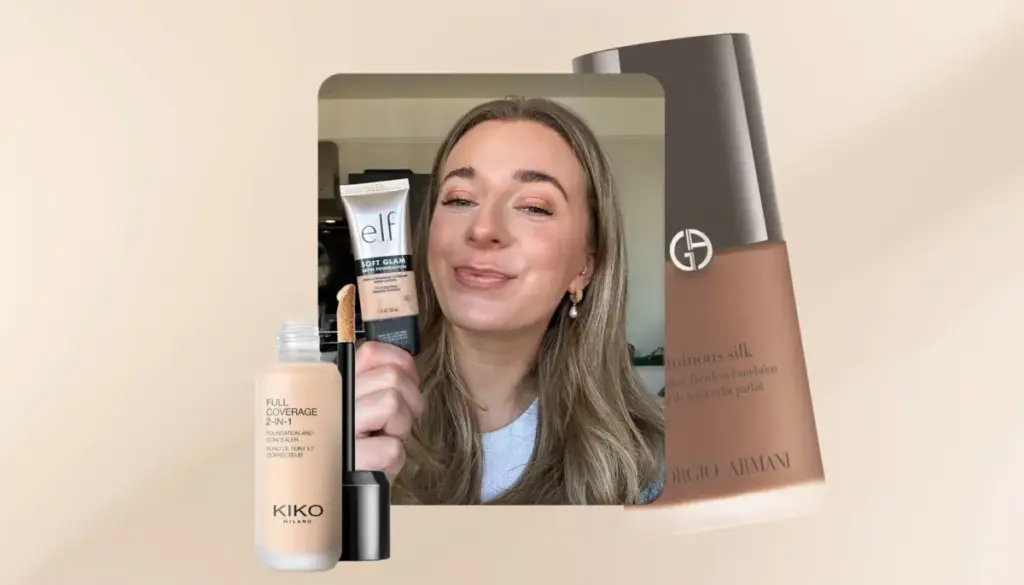
- For Bridal & Versatility: "My go-to foundation I use for my brides that creates a gorgeous glow and also has the long-lasting effect is Armani Beauty’s Luminous Silk Foundation. It is a must-have in any makeup artist’s kit. It’s buildable for the brides who want a more natural finish, but also can become a medium coverage for the brides who want a slightly heavier finish."
- For a Natural, "Skin-Like" Finish: "The most natural foundation in my kit that I love to use is the Charlotte Tilbury Beautiful Skin Foundation. It gives the most ‘skin-like’ finish in my opinion and really helps to blur the skin naturally. It’s extremely hydrating and helps the skin to look brighter and smoother. Key ingredients include Hyaluronic Acid and Rose Complex."
- For Ultra-High-Coverage Perfection: "I don’t always opt for a full-coverage foundation, but when I do, the best brand is by far Anastasia Beverly Hills. Their new Impeccable Blurring Second-Skin Matte Foundation is the newest addition to my kit and it’s perfect for my clients who are attending events that require their skin to become completely flawless with absolutely zero imperfections on show. It gives off a ‘filter-like’ finish as it blurs pores, fine lines, and wrinkles as well as blemishes!"
Practical Application: At-Home Shade Matching and Longevity Hacks
Mastering foundation application is as much about technique as it is about the product itself. Follow these professional steps to optimize your routine:
The "Stripe Testing" Technique
If testing foundations in-store, apply vertical stripes running from your jawline down your neck. The correct shade should disappear seamlessly into both areas without creating a harsh demarcation line. Furthermore, remember that seasonal shifts matter. As Sarah, industry expert and educator notes: "Nobody is the same shade all year round. And our complexion actually tends to change month to month as well. Be sure to keep fake tan use in mind by maintaining both a ‘tan’ shade and a ‘natural’ shade."
Pro-Tips for Bulletproof Foundation Longevity
- Meticulous Skin Prep: Never skip hydration. Apply a lightweight hydrating serum and moisturizer to plump fine lines and prevent makeup from clinging to dry patches.
- Strategic Priming: Utilize a gripping primer for all-day wear or a mattifying primer through the T-zone to lock down oils.
- The Reverse Powder Trick: According to Jamie Coombes, dusting a very light layer of translucent powder before applying liquid foundation seals in skincare and creates an optimal anchor for pigment adhesion. Apply your liquid product in thin, buildable layers rather than one heavy application.
- Lock with Setting Spray: Finish your routine with a high-performance, long-wear setting spray to prevent product separation and environmental breakdown.
Future Outlook: What Lies Ahead in Complexion Technology?
As we look toward the future of the beauty industry, innovation in foundation formulation is accelerating rapidly. We are moving past the era of standard liquid bases into an era of skincare-infused hybrids.
- Biotech and Customization: Emerging technologies are paving the way for hyper-personalized foundations formulated via digital color-scanning devices and AI-driven kiosks in retail spaces, blending exact pigment ratios on demand.
- Advanced Pollution Defense: Future formulations will increasingly incorporate blue-light filtering technology, urban anti-pollution shields, and microbiome-friendly prebiotics to actively improve skin health while worn.
- Sustainable Packaging: With environmental accountability becoming paramount, refillable glass pods, biodegradable components, and waterless formulations are set to become the industry standard for major cosmetic houses.
By combining an understanding of your unique skin type, precise undertone evaluation, and professional application techniques, achieving an immaculate, camera-ready complexion is no longer a matter of guesswork—it is a science you can master at home.