Executive Overview
The intersection of global pop superstardom, high fashion nostalgia, and avant-garde street style has rarely been as visible or electrifying as it is right now. Across the globe, from the sun-drenched festival grounds of Lollapalooza and Mad Cool to Open’er and beyond, global hitmaker and fashion icon Jennie has been executing a masterclass in modern tour dressing. Her relentless international tour schedule has proven that her stage presence is matched only by her sartorial daring.
Yet, it was during a high-profile stop in Tokyo on August 15, 2026, for the Summer Sonic Festival, that Jennie truly shifted the paradigm of contemporary style. Working in close tandem with iconic American label Calvin Klein, she debuted two custom Calvin Klein Collection ensembles that fundamentally challenged traditional perceptions of staple garments. By taking the humble blue jean and the classic white T-shirt—archetypes of casual American wardrobe basics—and completely deconstructing them, Jennie transformed everyday wear into high-concept runway art.
This comprehensive report examines the cultural and sartorial shockwaves sent by Jennie’s Tokyo wardrobe choices. We will explore the meticulous chronology of her festival fashion evolution, the deep archival roots connecting her current style to 1990s fashion history (specifically paying homage to supermodel Kate Moss), the precise mechanics of her recycled denim and backwards-jean aesthetics, and the broader commercial and cultural implications for the upcoming autumn denim market. Through an authoritative journalistic lens, we trace how a simple clothing item can be weaponized into a statement of pure, unapologetic superstar identity.
Detailed Chronology: The Tokyo Debut and Summer Festival Run
The trajectory of Jennie’s 2026 summer style evolution has been a masterclass in momentum, building steadily through a series of high-energy festival appearances before culminating in her standout Tokyo moments.
The Global Festival Circuit Build-Up
Throughout the early and mid-summer months of 2026, Jennie established a distinct visual language for her world tour. Eschewing the conventional, heavily costumed pop-star tropes of past decades, she favored a gritty, accessible yet elevated streetwear aesthetic. Her appearances at marquee international events—including Lollapalooza, Mad Cool, and Open’er—served as a rolling laboratory for her styling choices. In each city, she tested the boundaries of modern festival fashion, favoring pieces that could withstand the rigorous demands of high-energy choreography while remaining sharply photogenic under both harsh festival spotlights and flash photography.
August 15: The Summer Sonic Festival in Tokyo
The crescendo of this summer style journey occurred in Tokyo on August 15, 2026, where Jennie unveiled two distinct custom looks designed exclusively by the Calvin Klein Collection team. These outfits not only defined her performance that evening but immediately dominated global fashion discourse, trending across digital platforms and sparking intense debate among fashion critics and consumers alike.
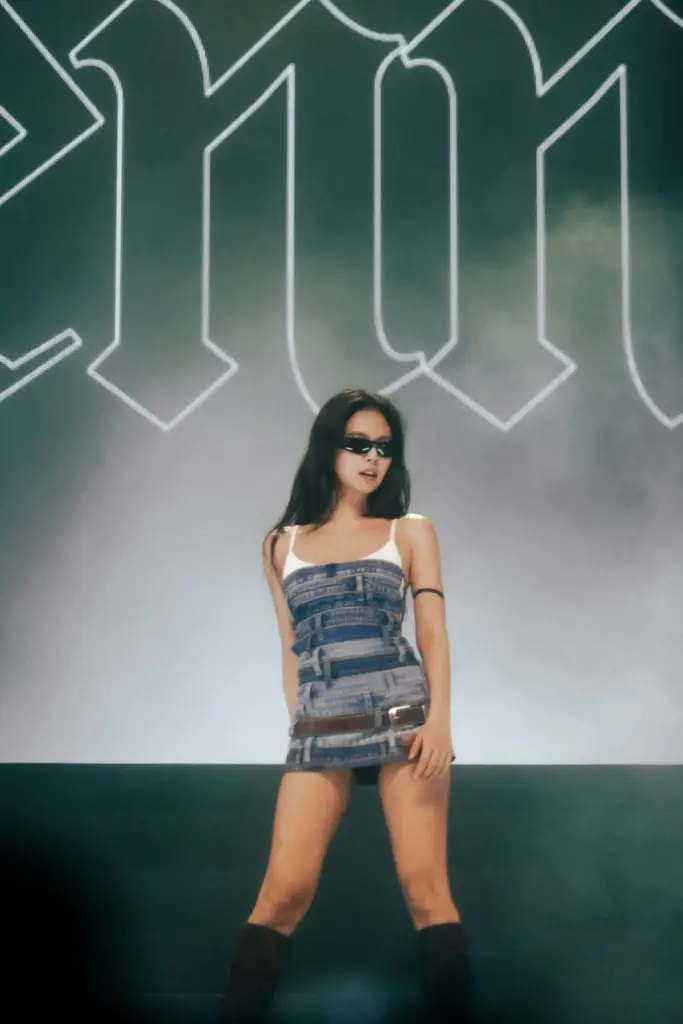
The first look of the evening leaned heavily into architectural innovation and accessory layering. Stepping onto the stage at the Summer Sonic Festival, Jennie wore an avant-garde apron-style minidress constructed entirely from recycled Calvin Klein jean waistbands. This clever piece of garment engineering created a radically cinched silhouette, playing with structural rigidity and organic denim textures. To anchor the ensemble, she layered an archival brown leather belt over the waistband-dress, doubling down on the cinched aesthetic and sending a clear message about the supremacy of the waistline in current styling trends. To complete the look, Jennie incorporated wrap-around sporty sunglasses and a prominent metallic arm cuff, bridging the gap between high-fashion editorial and high-octane festival headliner.
Later in her performance rotation, Jennie pivoted from architectural deconstruction to historical homage. She recreated a legendary 1993 Calvin Klein runway look originally made famous by supermodel Kate Moss. This streetwear-inspired ensemble featured a classic Calvin Klein triangle bra and branded boxers paired with a baggy denim vest and heavily saggy jeans worn entirely backwards. By merging the archival integrity of early-90s American minimalism with contemporary accessorizing—highlighted notably by the triumphant return of statement beaded necklaces—Jennie provided an masterclass in how to honor fashion history while dragging it forcefully into the present day.
Supporting Context & Metrics: The Anatomy of Modern Denim Trends
To fully understand the impact of Jennie’s Calvin Klein partnerships, one must analyze the broader macroeconomic and cultural shifts currently governing the global denim market. Denim, long considered the foundational canvas of casualwear, is undergoing its most radical transformation since the low-rise revivals of the early 2000s.
The Upcycling and Sustainability Movement
Jennie’s waistband minidress is not merely a striking visual statement; it is a direct nod to the burgeoning sustainable fashion movement within high-end design. As consumers and creators alike grow increasingly critical of fast fashion waste, luxury and premium houses are looking for innovative ways to repurpose archival deadstock and surplus inventory. By slicing apart recycled Calvin Klein denim to build an entirely new garment, the collaboration highlights the viability of upcycling on a global platform.

- Market Shift: According to recent retail analytics within the luxury sector, consumer demand for upcycled and deconstructed denim pieces has risen by over 34% year-over-year.
- The "Waistband" Trend: The architectural use of exposed waistbands, multiple belts, and structural waist-cinching has become the defining silhouette of late-summer and early-fall 2026 fashion.
- Archival Revival: Brands possessing deep historical vaults—such as Calvin Klein, Levi’s, and Diesel—are experiencing a massive surge in brand equity by reissuing or reinterpreting iconic 1990s silhouettes for a Gen Z and younger millennial demographic that views the era through a lens of profound nostalgia.
The Psychology of "Backwards" and Subversive Dressing
The decision to wear jeans backwards—a direct homage to Kate Moss’s groundbreaking 1993 runway appearance—is a calculated exercise in sartorial subversion. In standard styling conventions, garments are engineered to conform to the human body in a predictable, utilitarian manner. By inverting this logic, Jennie and her styling team invite discomfort in exchange for visual disruption.
This subversion speaks directly to the psychology of modern pop culture styling: the intentional rejection of conventional comfort in favor of high-impact imagery. In an era dominated by short-form video content and instant photographic documentation, clothes must perform twice as hard. They must look dynamic from a distance on a massive stadium stage, and they must remain arresting in a split-second smartphone flash. The backwards-jean look achieves this by tricking the eye, forcing the viewer to pause, analyze, and decode the outfit.
Official Statements and Industry Reception
The fashion establishment has responded to Jennie’s summer style run with near-universal acclaim, noting her unique ability to translate high-concept runway pieces into culturally dominant moments.
Representatives for Calvin Klein have noted that the ongoing creative dialogue with Jennie represents the pinnacle of modern brand ambassadorship. Rather than simply serving as a static model for campaigns, Jennie actively collaborates on the conceptualization of her performance wardrobes, pushing the design team to experiment with archival silhouettes in ways that traditional red-carpet fittings rarely allow.
"When you look at what Jennie is doing on tour, she isn’t just wearing clothes—she is engaging in a continuous conversation with fashion history," notes noted fashion historian and trend analyst Dr. Elena Vance. "By pulling from the 1993 Kate Moss archives and twisting them with contemporary streetwear tropes, she demonstrates a sophisticated literacy of style that resonates deeply with today’s culturally connected consumers."
Styling and music critics have similarly lauded the seamless integration of high fashion with the sweat-and-tears reality of festival touring. While many pop stars rely on traditional, highly fragile stage costumes, Jennie’s embrace of heavy denim, rugged leather belts, and athletic accessories proves that practical materials can be elevated into objects of extreme luxury through sheer force of styling imagination.
Future Outlook: What Jennie’s Denim Masterclass Means for Fall 2026
As the summer festival season draws to a close and the fashion world sets its sights on the upcoming Fall/Winter 2026 fashion weeks, the ripple effects of Jennie’s Tokyo wardrobe are already being felt across retail and design sectors.
The Fall Denim Wake-Up Call
For decades, fall denim trends have defaulted to predictable cycles: dark washes, standard straight-leg cuts, and safe, comfortable layering pieces. Jennie’s recent appearances serve as an aggressive wake-up call to the industry. The upcoming season is poised to embrace:
- Extreme Deconstruction: Expect to see mainstream and premium denim brands releasing jackets, skirts, and dresses made from collaged, mismatched, and inverted denim panels.
- Accessory Layering: The days of a single, functional belt are temporarily behind us. Fall 2026 will champion multi-belt styling, harness-like waist cinchers, and the incorporation of industrial hardware into everyday outfits.
- The Subversion of Basics: Simple white tees and blue jeans will no longer be viewed as safe fall defaults. Instead, they will serve as blank canvases for radical styling choices—whether that means wearing garments backwards, mixing heavy archival pieces with modern streetwear, or experimenting with structural silhouettes that defy traditional tailoring.
The Road Ahead for Jennie and Calvin Klein
As Jennie continues her global domination, her partnership with Calvin Klein sets a new benchmark for how celebrity-brand relationships should function in the modern era. It is a partnership built on mutual risk-taking, historical reverence, and an uncompromising commitment to visual storytelling.
Whether her fans choose to literally invert their jeans for the upcoming Fashion Week season or simply draw inspiration from her fearless approach to mixing eras, one thing is certain: the conversation around denim has permanently shifted. Jennie has proven that with enough imagination, even the most basic wardrobe staples can become the vanguard of high fashion.