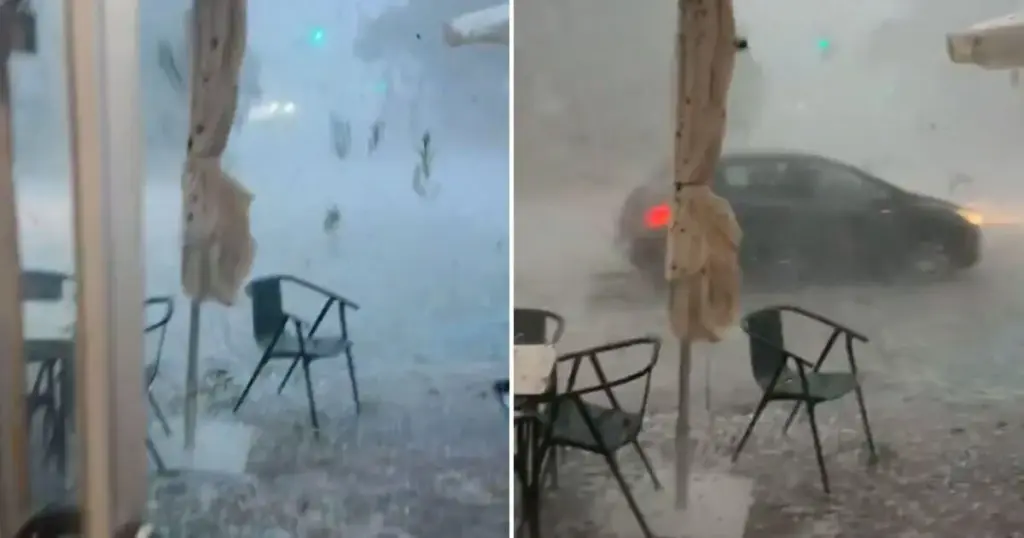
Summer holidays for thousands of British travelers and international tourists in Spain turned into scenes of dramatic chaos on Monday, August 25, 2026, as a ferocious combination of severe thunderstorms, torrential downpours, and colossal hailstones struck the northeastern region of Catalonia. The severe weather system, which bypassed typical seasonal patterns with terrifying intensity, concentrated its wrath heavily upon the Camp de Tarragona and surrounding municipalities, bringing transportation networks to a standstill and prompting an immediate emergency response.
Streets and prominent public squares swiftly transformed into raging torrents, while falling trees, downed power lines, and damaged infrastructure caused widespread material disruption. Local emergency services were inundated with hundreds of urgent distress calls in a matter of minutes as the storm system moved across the northeast, building upon a volatile week of severe weather that had already battered the Balearic Islands just days prior.
Despite the widespread destruction, the overturning of public transit, and the stark visibility of severe property damage, local authorities have confirmed that no serious personal injuries have been reported thus far. However, the psychological and infrastructural shockwaves of the event have left communities reeling, highlighting the growing volatility of Mediterranean weather patterns during peak tourist season.
Detailed Chronology: How the Storm Unfolded
The severe weather event did not materialize in a vacuum; it was the culmination of an advancing high-severity convective system that tracked across Catalonia through the early hours and into the peak of Monday morning.
Pre-Dawn Build-Up and Initial Impacts in Segrià
Long before the storm reached the densely populated coastal and transit hubs of Tarragona, initial atmospheric instability began manifesting further inland across several municipalities in the Segrià comarca. Early Monday morning, communities including Almenar, Corbins, Albatàrrec, and the city of Lleida found themselves suddenly enveloped in darkness as a heavy weather cell rapidly matured.
Without warning, the skies opened, releasing a barrage of oversized hailstones. Witnesses reported ice chunks measuring well over two centimeters in diameter slamming into the ground with concussive force. These frozen projectiles targeted local agriculture and horticulture, leaving widespread devastation across local crops just weeks before critical harvest windows.
The Mid-Morning Strike on Camp de Tarragona
As the storm cell tracked southeast toward the coast, its intensity amplified. By mid-morning on Monday, Camp de Tarragona bore the brunt of the atmospheric fury. Heavy rainfall combined with hurricane-force wind gusts and continuous hail to overwhelm urban drainage infrastructure.
Key thoroughfares and public spaces—including Carrer Joan Baptista Plana, Imperial Tàrraco, Carrer Vidal i Barraquer, Carrer d’Apodaca, and Avinguda Prat de la Riba—were submerged under rapidly rising floodwaters. Footage shared on social media and broadcast across local media outlets showed rivers of water rushing down downtown streets, sweeping up debris, and smashing violently against parked vehicles and pedestrian pathways.
Public transportation across the region collapsed almost instantaneously. Municipal bus services were forced to suspend operations as drivers confronted impassable, flooded roadways and blocked streets. Rail networks and localized commuting faced severe rolling delays as fallen timber fouled overhead electrical wires and obstructed tracks.
The emergency services experienced an unprecedented surge in demand. Firefighters and civil protection units reported receiving a staggering 129 emergency calls in just ninety minutes, with 107 of those frantic requests originating directly from within the Tarragona region. Teams raced from site to site to deal with fallen tree branches, secure precarious electrical cabling, and pump water out of subterranean basements and ground-floor properties.
Supporting Context & Metrics: Analyzing the Severity
The meteorological data associated with the August 25 storm underscores just how extreme the weather phenomenon was. The Meteorological Service of Catalonia (Servei Meteorològic de Catalunya) had previously raised alarms by issuing a severe six-out-of-six violent weather alert—the highest possible designation on their warning scale.
Key Meteorological Indicators and Metrics:
Hailstone Dimensions: Verified reports and meteorological tracking confirmed the presence of hailstones exceeding 2 centimeters in diameter, with some localized pockets reporting stones approaching the size of golf balls.
Emergency Response Volume: 129 emergency interventions logged by firefighters in a compressed 90-minute window, averaging nearly 1.5 calls every single minute.
Geographical Spread: The storm impacted multiple distinct regions, starting inland in Segrià (Almenar, Corbins, Albatàrrec, Lleida) before intensifying along the coast in Camp de Tarragona.
Preceding Weather Anomalies: Occurring merely days after hurricane-force winds struck the Balearic Islands (peaking at 121 km/h on Friday), indicating a broader, highly unstable regional weather pattern across Spain.
Environmental and Ecological Toll
Beyond structural and economic damage, the storm left a poignant ecological footprint. The sheer density and velocity of the hail, combined with torrential localized flooding, proved fatal for local wildlife. Disturbing video footage captured in the aftermath showed numerous urban pigeons and small birds killed by the heavy barrage of ice and rising waters, lying lifeless among the urban debris.
Furthermore, the agricultural sector in the Segrià region faces a complex recovery process. Fruit orchards, vegetable farms, and staple crops suffered severe physical battering from the ice, compounding financial pressures for local farmers who rely heavily on late-summer yields.
Official Statements & Government Response
In the immediate aftermath of the storm, local government bodies and civil protection agencies activated emergency protocols to mitigate further risk to human life and public safety.
Sonia Orts, the Councillor for Civil Protection and Mobility for Tarragona, addressed the media and the public to provide reassurance regarding the lack of casualties. Emphasizing the swift mobilization of municipal assets, Orts stated:
"Fortunately, there are no reports of personal injuries."
Despite the positive news on the casualty front, Orts and other municipal officials stressed that the danger had not entirely passed. Tarragona City Council immediately deployed specialized municipal cleanup crews, forestry workers, and structural engineers to tackle the backlog of uprooted and unstable trees. As a precautionary measure, all public parks, gardens, and municipal green spaces across Tarragona were ordered closed to the public due to the high risk of falling branches and compromised timber.
Civil protection agencies issued urgent warnings via local broadcast networks and digital channels, urging residents and the thousands of tourists currently vacationing in the region to remain indoors. Authorities strongly advised against all non-essential travel, particularly in low-lying coastal areas, zones prone to flash flooding, and beneath dense urban tree canopies.
A Broader Pattern of Extreme Weather in Spain
Monday’s catastrophic storm in Catalonia does not exist in isolation. It represents the continuation of a deeply turbulent weather week across Spanish holiday hotspots, raising renewed discussions around shifting climate dynamics in the western Mediterranean.
Just days prior to the Catalonia deluge, a sudden and violent atmospheric depression slammed into the Balearic Islands—including Mallorca, Menorca, Ibiza, and Formentera. This system unleashed hurricane-force winds that peaked at an astonishing 121 kilometers per hour (approximately 75 miles per hour) during the early hours of Friday morning.
Tourists and permanent residents across the archipelago woke to scenes of absolute devastation: splintered pine trees, scattered architectural debris, severely flooded coastal promenades, and beach facilities torn apart. Several popular beaches were forced to close their doors to the public as local councils scrambled to clear dangerous hazards.
The compounding nature of these weather events—shifting rapidly from hurricane-force coastal gales in the Balearics to colossal, destructive hailstones and flash floods in inland and coastal Catalonia—underscores the increasing volatility of late-summer meteorology in Spain.
Future Outlook and Recommendations for Travelers
As cleanup operations continue at a fever pitch across Camp de Tarragona, Lleida, and the wider Catalan region, meteorologists are closely monitoring atmospheric conditions for secondary waves of instability. While the primary violent convective cell has begun to track eastward and dissipate over the Mediterranean Sea, lingering atmospheric moisture and unstable heat gradients mean that localized thunderstorms cannot be entirely ruled out over the coming days.
Advisory for Tourists and Expatriates:
Monitor Official Channels: Travelers currently in Spain, particularly along the eastern coast and island territories, are advised to monitor real-time updates from the Spanish State Meteorological Agency (AEMET) and local civil protection authorities (Protecció Civil).
Exercise Caution with Public Transit: While major transport links are gradually being restored, sporadic delays, localized bus cancellations, and rail maintenance work are expected to persist as infrastructure repairs are finalized.
Avoid High-Risk Zones: Tourists should continue to steer clear of closed municipal parks, forested trails, and coastal promenades where wave action or structural instability remains a hazard.
Insurance providers and travel agencies are bracing for a surge in claims related to delayed flights, damaged rental cars, and canceled excursions. As Spain navigates the remainder of the peak summer season, local authorities remain on high alert, balancing the economic imperatives of tourism with the paramount necessity of public safety in an era of increasingly erratic weather.