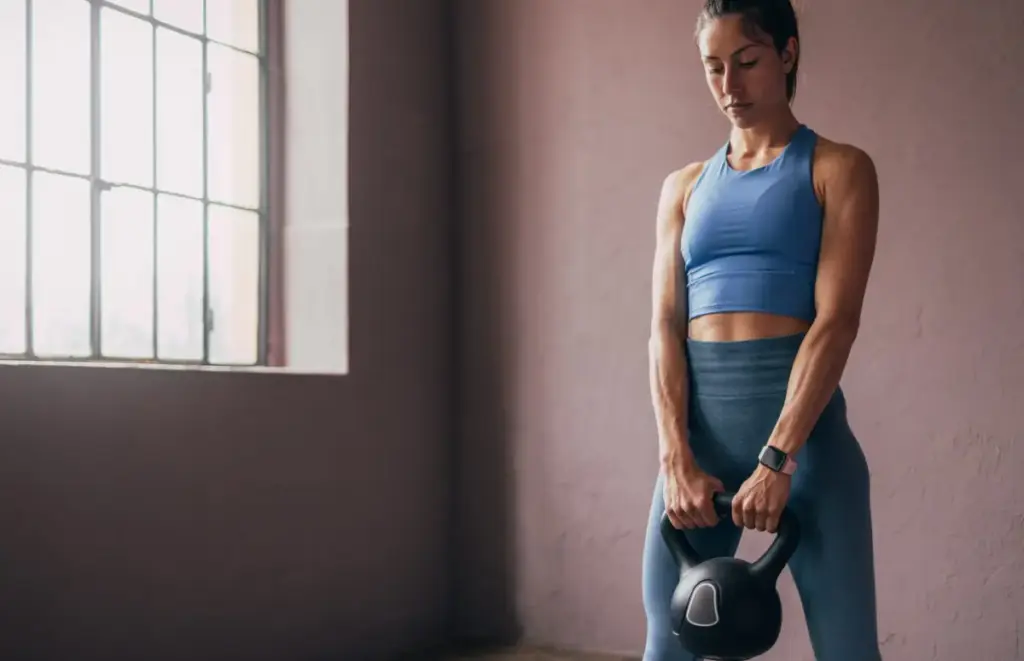
For many regular gym-goers, the dumbbell rack is a familiar sanctuary. Bicep curls, lunges, and squats performed with classic dumbbells represent the bedrock of standard strength training routines. Yet, just a few feet away sits an implement that frequently inspires hesitation: the kettlebell. With its distinct cannonball-and-handle design, shifting center of mass, and reputation for explosive, ballistic movements, the kettlebell often gets overlooked or actively avoided.
However, fitness experts and physical conditioning specialists agree that avoiding the kettlebell means leaving serious functional adaptation, muscular endurance, and athletic power on the table. Far from being an intimidating piece of specialized equipment reserved exclusively for elite athletes or hardcore cross-training boxes, the kettlebell is a masterclass in training efficiency.

According to Jacqueline Kasen, CPT, a Miami-based coach, master trainer, and creator of the Kasen Method with a StrongFirst Kettlebell certification, integrating kettlebells into a regimen unlocks broad physiological benefits. "Kettlebells allow you to increase your strength, power output, muscular endurance, muscle size, and bone density," Kasen explains.
Because the center of gravity falls well below the handle—unlike a dumbbell, where the weight is evenly distributed around the hand—kettlebells create dynamic destabilization. This physical characteristic demands rigorous core stabilization, enhances proprioception, and recruits stabilizing muscles that standard linear weight training often bypasses. Furthermore, kettlebell training requires minimal space and equipment, making it an exceptionally high-yield investment for home gyms or minimalist fitness setups.

This comprehensive guide breaks down the science of kettlebell training, evaluates why beginners often stumble, details 12 foundational movements designed to build a bulletproof physique, and outlines expert-approved strategies for selecting the correct weight and mastering pristine technique.
Detailed Chronology & Evolution: From Ancient Counterbalance to Modern Fitness Staple
To fully appreciate the utility of the kettlebell, it helps to understand its origins and how it evolved into a cornerstone of modern functional fitness.

The Historical Roots
The kettlebell—known in Russian as the girya—has centuries-old roots. Originally utilized in 18th-century Russia as a counterweight for measuring dry goods on grain scales, marketplace merchants soon realized that lifting these heavy, handle-fitted iron masses built remarkable physical prowess. By the late 19th century, Russian strongmen and physicians championed the girya for physical culture, conditioning, and rehabilitation. Dr. Vladislav Kraevsky established the first athletic circle in St. Petersburg in 1885, cementing the kettlebell as a premier tool for developing systemic power and resilience.
The Modern Resurgence
For decades, kettlebell training remained somewhat sequestered within Eastern European weightlifting circles and specialized strongman communities. However, the early 2000s catalyzed a global fitness renaissance. Propelled by certified kettlebell pioneers—such as Pavel Tsatsouline, who popularized Russian systems like the Russian Kettlebell Challenge (RKC) and StrongFirst—the Western fitness industry began to recognize the immense value of ballistic, multi-planar training.

Today, kettlebells are a ubiquitous feature in mainstream commercial gyms, boutique studios, and athletic training facilities alike. As modern fitness shifts away from isolated, single-joint bodybuilding movements toward functional movement patterns that mimic real-life physical demands, the kettlebell has emerged as an indispensable instrument for longevity, metabolic conditioning, and structural integrity.
Supporting Context & Metrics: Why Kettlebell Training Delivers Superior ROI
When evaluating return on investment (ROI) in strength training—measured by time spent versus physiological adaptation achieved—few tools rival the kettlebell. Taylor Beebe, CPT, an RKC-certified personal trainer and member of the WH Strength In Diversity initiative in California, emphasizes its unmatched versatility.

"If you’re someone who maybe doesn’t have access to a gym or you’re just looking to start investing in equipment, you get the most bang for your buck when you are able to utilize kettlebells," Beebe notes.
Physiological Metrics and Adaptations
- Metabolic Demand: Ballistic movements like the kettlebell swing elevate heart rate faster and higher than traditional steady-state lifting or even traditional cardio modalities, delivering a potent fusion of aerobic conditioning and anaerobic power. Studies examining high-intensity interval training (HIIT) protocols utilizing kettlebell swings have noted caloric expenditures comparable to running a six-minute mile pace, all while maintaining constant muscular tension.
- Bone Mineral Density: The explosive, weight-bearing nature of kettlebell cleans, snatches, and swings places high-impact mechanical stress on skeletal structures. This stimulates osteoblast activity, making kettlebells a powerful tool for preserving and building bone mineral density—a critical metric for lifelong health and injury prevention.
- Grip Strength and Longevity: Because the handle forces the hand and forearm to constantly fight against an off-center load, kettlebell training rapidly upgrades grip strength. Longitudinal health studies consistently correlate robust grip strength with lower all-cause mortality and enhanced functional independence in later life.
Official Statements & Expert Guidance: Mastering the Learning Curve
Because the kettlebell’s mass sits outside the hand, it introduces a distinct learning curve. Mastering this tool requires respecting structural mechanics, postural alignment, and progression pathways. Leading practitioners offer critical insights to guide beginners safely through the process.

1. Shed the Shoes
One of the most common mistakes beginners make is training in heavily cushioned running shoes. According to Jacqueline Kasen, "You need to be one with the floor" during all strength work, but particularly when using kettlebells. Thick, squishy sneaker soles compromise proprioceptive feedback and make it easy for toes or heels to lift during ballistic movements like swings. Training barefoot or in minimalist, flat-soled shoes encourages active foot engagement, improves tactile stability, and allows power to transfer cleanly from the ground up.
2. Demystify the Rack Position and Grip
Holding a kettlebell in the front rack position can initially cause minor forearm discomfort as the soft tissue adapts to the load. Taylor Beebe stresses the importance of wrist neutrality: "Keep your wrist neutral with your knuckles stacked right above your wrist and not cocked to the side." Kasen adds that while bruising or soreness may occur early on, consistency resolves the issue: "The more often you use it, the more comfortable it gets, and it won’t be as sore over a period of time."

3. Strategic Placement and Whole-Body Engagement
Where you pick up a kettlebell depends entirely on the trajectory of the exercise. For vertical movements—such as cleans, presses, and thrusters—the bell should sit directly between the heels. For horizontal, ballistic movements like swings, the bell should be hiked outward in front of the lifter. Once lifted, the entire body engages. Beebe describes the core’s role during a kettlebell swing or front rack hold as acting like a "can of soup," distributing force uniformly around the perimeter to create a rigid, unyielding vertical plank.
4. Ground Force and Weight Distribution
Power does not originate in the arms when working with kettlebells; it emanates from the floor. "You’re not going to be on the toes of your feet, you’re not going to be on your heels," Kasen notes. Whether executing a deadlift, clean, jerk, or row, the cue remains consistent: push feet through the ground. This activates the quads, hamstrings, glutes, core, and upper body in a synchronized kinetic chain.

5. Start Small, Build a Foundation
Eager beginners often gravitate toward advanced, highly technical movements like single-arm snatches and jerks seen on social media. Kasen advises patience: "Build a strong foundation." Start with stabilization drills, such as balancing on one leg with a kettlebell in the front rack position while holding the opposite leg in a tabletop stance for 30 seconds. Developing this structural baseline ensures that when more complex power movements are introduced, execution remains safe and powerful.
6. Selecting the Correct Weight
Many novices make the mistake of choosing a kettlebell that is far too light, which compromises form and reduces effectiveness. Kasen outlines the ideal starter inventory:

- Light Bell: Reserved for overhead pressing and skill development.
- Medium Bell: Ideal for foundational movements like goblet squats and bent-over rows.
- Heavier Bell: Tailored for lower-body power exercises, including deadlifts, swings, and loaded carries.
Beebe recommends a starter pack of 12-, 16-, and 24-kilogram bells. For those investing in a single bell, a 16-kg (approx. 35-pound) kettlebell serves as the gold standard for foundational two-handed and single-arm work. Signs that your weight is too light include wrists flopping around or relying purely on arm strength rather than explosive hip drive during swings.
The 12 Best Kettlebell Exercises for Beginners
To bridge the gap between theory and execution, Kasen designed a beginner-friendly, full-body circuit.

- Workout Parameters:
- Time: 20 minutes
- Frequency: Complete the full circuit 2 to 3 times total.
- Instructions: Choose 5 to 6 exercises from the list below. Perform 8 to 12 repetitions per exercise (or 30 to 45 seconds for carries). Move from one movement to the next with minimal rest. Rest for 60 to 90 seconds upon completing the sequence before repeating.
1. Kettlebell Deadlift
- How to: Stand with feet slightly wider than shoulder-width apart, the kettlebell positioned on the floor between your arches. Hinge at the hips, maintain a flat back, and grip the handle firmly. Drive through your mid-foot, extend your hips and knees simultaneously, and stand tall, squeezing your glutes at the top. Reverse the motion to lower the bell under control.
- Why it works: Builds posterior chain strength while teaching the foundational hip hinge pattern essential for advanced kettlebell mechanics.
2. Goblet Squat
- How to: Hold a kettlebell vertically by the horns (the sides of the handle) close to your chest, elbows tucked down. Keeping your chest proud and core braced, drop your hips back and down into a deep squat, ensuring your knees track in line with your toes. Drive through your mid-foot to return to the starting position.
- Why it works: Strengthens the quadriceps and glutes while reinforcing upright torso mechanics and core stability.
3. Two-Hand Kettlebell Swing
- How to: Stand with feet shoulder-width apart, kettlebell resting on the floor a foot in front of you. Hinge at the hips, grasp the handle with both hands, and hike the bell back between your legs like a football snap. Explosively drive your hips forward, squeezing your glutes to propel the bell outward to chest height, allowing it to float momentarily before guiding it back into the hinge.
- Why it works: Enhances explosive power, muscular endurance, and cardiovascular conditioning while taxing the glutes, hamstrings, and core.
4. Single-Arm Kettlebell Swing
- How to: Execute the same mechanics as the two-hand swing, but grip the handle with one hand only, keeping the free arm actively engaged at your side or floating for balance. Alternate arms each set.
- Why it works: Challenges unilateral strength, grip endurance, rotational stability, and coordination.
5. Single-Arm Dead Clean
- How to: Start with a kettlebell on the floor outside one foot. Hinge down, grip the handle with one hand, and explosively pull and rotate the bell upward, guiding it smoothly around your wrist into the front rack position as you stand. Return the bell safely to the floor.
- Why it works: Develops foundational coordination, pulling power, and dynamic entry into the rack position.
6. Single-Arm Clean
- How to: Similar to the dead clean, but initiated from a swinging motion (like a single-arm swing) rather than a dead stop on the floor.
- Why it works: Refines explosive upper-body stability, timing, and fluid power transfer from the hips.
7. Two-Hand Clean
- How to: Using a wider stance or a double-handle grip (or two kettlebells), hinge and explosively drive the hips to pull the weight upward into a double-rack position.
- Why it works: Maximizes total-body power output and reinforces aggressive, simultaneous hip drive.
8. Clean to Overhead Press
- How to: Perform a single-arm clean to bring the kettlebell into the front rack position. From a stable, braced stance, press the bell directly overhead until your arm is fully locked out. Lower the bell back to the rack position with control.
- Why it works: Combines lower-body power generation with upper-body pressing strength into a seamless, highly efficient compound movement.
9. Push Press
- How to: With the kettlebell in the front rack position, dip slightly at the knees and hips (a mini-squat) and immediately drive upward, using leg momentum to assist in launching the kettlebell overhead.
- Why it works: Allows lifters to move heavier loads overhead by leveraging lower-body power assistance.
10. Single-Arm Bent-Over Row
- How to: Place your left knee and left hand on a stable bench, right foot planted firmly on the floor, holding a kettlebell in your right hand with a neutral spine. Pull the kettlebell toward your hip, keeping your elbow tucked close to your torso, then lower with control.
- Why it works: Isolates the upper back, lats, and biceps while enhancing posture and unilateral pulling strength.
11. Lateral Lunge
- How to: Hold a kettlebell in the goblet position against your chest. Take a large step out to the right, sitting your hips back and bending your right knee while keeping your left leg straight. Push off your right foot to return to the center.
- Why it works: Targets the glutes and adductors while building multi-planar agility, balance, and hip mobility.
12. Unilateral Farmer’s Carry
- How to: Hold a heavy kettlebell in one hand at your side with your posture tall, shoulders level, and core braced. Walk forward with slow, controlled strides for 30 to 45 seconds without letting your torso lean to the weighted side.
- Why it works: Maximizes grip strength, unilateral core stability, postural alignment, and functional endurance.
Future Outlook: Embracing the Beginner’s Mindset
Stepping outside one’s comfort zone in a commercial gym setting can feel daunting. However, embracing unfamiliar equipment offers profound psychological and cognitive dividends. Citing clinical research published in scientific literature regarding lifelong learning and brain health, experts underscore that acquiring novel physical skills stimulates neuroplasticity.
"Something that is very undervalued in the fitness world is being a beginner at something," Taylor Beebe reflects.

Approaching kettlebell training with patience, an open mindset, and an appreciation for technical mastery transforms an intimidating corner of the gym into an exciting frontier of personal growth. By investing time in proper technique, sourcing professional coaching when needed, and selecting appropriate loads, gym-goers can unlock a new echelon of physical capability, muscular resilience, and athletic longevity. Take a chance on the kettlebell rack—you may just discover your favorite new training tool.