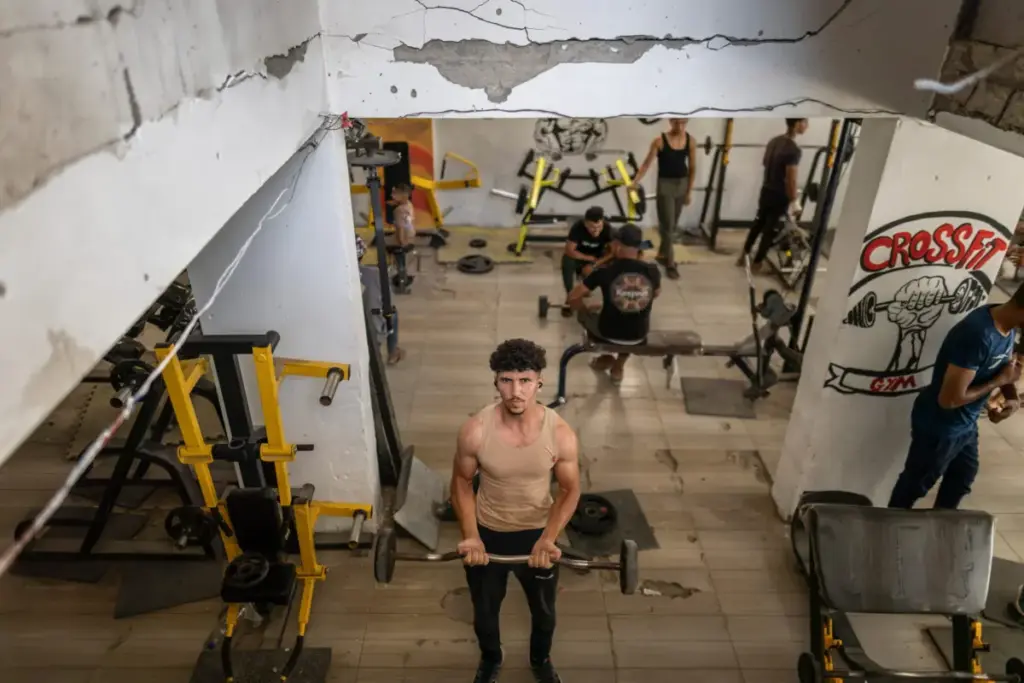
For the residents of Khan Younis in the Gaza Strip, the approach to the Champions Factory Gym requires navigating a sobering landscape. The journey takes visitors through jagged blocks of concrete, skeletal building frames, and warped rebar. Yet, the stairs leading down to the basement doors remain remarkably clear. Above, the building—once a bustling three-story structure—stands heavily damaged from nearly three years of unrelenting conflict. Deprived of reliable electricity, the facility relies entirely on daylight, its members lifting weights while natural light streams through massive structural breaches in the walls.
Despite operating under catastrophic conditions, the Champions Factory Gym has emerged as an improbable sanctuary. Owned and operated by Captain Mohamed Ziad al-Biss, a powerhouse trainer renowned for his 419-pound bench press, the gym has filled to capacity with local residents. Plumbers, tailors, electricians, construction workers, and cart drivers train side by side amid cracked walls and makeshift repairs.
Far from being a frivolous pursuit, physical fitness in Gaza has transformed into a profound act of psychological survival and community resilience. In an environment stripped of standard infrastructure, employment opportunities, and reliable nutrition, these athletes view heavy lifting not as a luxury, but as a vital lifeline. Through the lens of documentary photographer Mahmoud Abu Hamda and reporting by Men’s Health, this feature explores how a ruined basement in Khan Younis became a crucible for human dignity, mental preservation, and physical endurance.
Detailed Chronology: From Pre-War Pride to Wartime Resilience
The Pre-War Era: Cultivating Strength and Ambition
Before the outbreak of the war, the fitness culture in Khan Younis mirrored that of communities worldwide. Gyms like the Champions Factory were hubs of social interaction, athletic ambition, and personal development. Young men spent years honing their physiques, competing in regional bodybuilding championships across the Gaza Strip, and establishing regular fitness routines. For individuals like Mohammed Walid Al-Salami, a 26-year-old tailor and electrical appliance repairman, bodybuilding was a cherished hobby that provided structure and personal fulfillment outside of work.
The Shock of Conflict and the Halt of Routine
The escalation of the war abruptly shattered this normalcy. Air strikes battered the commercial and residential fabric of Khan Younis, reducing shops, neighborhoods, and training facilities to rubble. For months, athletic pursuits ground to a complete halt. The psychological and physical toll of continuous displacement, food insecurity, and widespread destruction left residents unable to muster the energy for physical exertion. As Al-Salami noted, the collective trauma of the community meant that bodies and minds could simply not handle anything beyond basic survival.
The Rebirth of Champions Factory
As months turned into years, a collective realization began to take root among the youth of Khan Younis: total paralysis was a slow psychological death. Driven by an urgent need to reclaim agency over their lives, local men began returning to the remnants of the Champions Factory Gym.
Captain Mohamed Ziad al-Biss documented the initial steps of this revival in May 2024, sharing footage of his bench press reps surrounded by structural debris. In the months that followed, members pitched in to clear the floor of rubble, even as the walls remained scarred and fractured. By establishing an affordable monthly fee of approximately 40 ILS (roughly $13 USD)—making it one of the most accessible fitness clubs in the region—Al-Biss ensured that economic destitution would not bar anyone from entry. Today, the gym operates entirely during daylight hours, serving as a dynamic gathering space where the community works together to rebuild both their physical strength and mental well-being.
Supporting Context & Metrics: The Reality of Training in Gaza
Training under blockade and active conflict conditions introduces extreme logistical challenges that test the limits of human perseverance. An examination of the metrics, daily obstacles, and socioeconomic realities facing the members of Champions Factory highlights the sheer magnitude of their endeavor:
Nutritional Deficits: Proper athletic nutrition—a cornerstone of bodybuilding and strength training—is virtually nonexistent. Protein sources such as chicken breast, traditionally considered budget-friendly staples in the fitness world, are financially and logistically out of reach for many. Members report making do with whatever food is intermittently available at home, alternating between meager portions of meat, fish, or basic pantry items. Specialized nutritional supplements are entirely absent from the local market.
Economic Stagnation: With standard employment largely evaporated across the Gaza Strip, the men who frequent the gym work odd jobs—tailoring, electrical repair, plumbing, cart driving, and construction—whenever work materializes. Gym memberships are kept purposely low to accommodate widespread poverty.
Physical Infrastructure: The gym operates without municipal electricity, restricting operating hours strictly to daylight. Ventilation depends on the massive structural holes blown into the building’s exterior walls during prior bombings. Equipment consists of resilient, old-school weight racks, barbells, stationary bikes, and dumbbells that have endured years of wear, tear, and exposure to the elements.
Psychological Impact: Mental health professionals globally recognize exercise as a potent regulator of cortisol and endorphins. In Khan Younis, where residents face constant displacement and the threat of famine, the gym serves as a rare therapeutic outlet. As 17-year-old cart driver Nassim Khattab succinctly put it: "Coming here is better than staying at home and suffocating. We have fun, we work out, we move our bodies."
Voices from the Gym Floor: Personal Testimonies
The true spirit of the Champions Factory Gym is best captured through the words of the men who walk through its doors every week. Their testimonies reveal a shared philosophy: physical movement is an absolute prerequisite for mental endurance.
Mohammed Walid Al-Salami, 26 (Tailor and Electrical Appliance Repairman)
"I did bodybuilding for two years before the war. It was almost my only hobby. The war took everything from us… It took the shop where I used to work, and it took the neighborhood where we used to train. We stopped doing sports for a long time, because our bodies and minds couldn’t handle anything more than that. When we started to feel a small sense of hope, we went back to the gym. I train four times a week because my tailoring work takes up a lot of time, and I need to cover my household expenses. Food isn’t always available, but I try to eat whatever is there, and I don’t let that stop me from training. Sports are not a luxury in Gaza, they are a necessity. They are the only way for us to release our negative energy and rebuild ourselves."
Abdullah Ahmed Khalil Al-Farra, 24
"Right now, one of the most important things in Gaza is that—whether it’s football, weightlifting, or parkour—you need to release your energy. There’s no work, no trips with friends, no places to go. The Gaza Strip is finished. We spend the entire day at home. There’s no source of income. Food is extremely difficult to obtain. Even chicken breast—the cheapest option—is still beyond the reach of many people. Without the coach supporting us here, many of us would not be able to continue exercising because he helps make things a little easier. When it comes to exercise, my advice to people is to strive. If you have nothing to do today, come and train. Maybe God will open a new door and you’ll get a job opportunity. When that opportunity comes, you’ll need to be physically capable of doing the work."
Ibrahim Amer, 29 (Plumber)
"The war devastated our lives and made us forget what weightlifting even was. We returned to it after a long period of hardship. Once our mental health began to improve, we came back. My advice to all young people who love sports and have lost hope is this: Don’t make excuses by saying that exercising is pointless these days because there isn’t enough food or water. These are not valid reasons to give up. The most important thing for a person is their health. Keep training and keep going. And put your trust in God."
"I work in construction, and I exercise to maintain my physical strength and keep my body healthy. The war has affected every part of my life. Displacement, the lack of food, and the famine have made it much harder to care for our health or follow a regular training routine. Even under these conditions, I try to continue with a range of exercises whenever I can. My message to young people is to keep moving and take care of their bodies. Exercise is one of the few positive things that can help us protect both our physical health and our mental well-being."
Ibrahim Tamim Al-Lahham, 40
"My training includes weightlifting and cardio exercises. Exercise gives me focus and energy. It helps me deal with the pressure and prepare my body for the demands of everyday life in Gaza. We are a people who deserve life, and exercise is one way of holding on to it. My advice to young people is to care for your body, your health, your focus, and your energy. Go to the gym, because exercise is life."
Future Outlook: Ambitions Beyond the Blockade
Despite the daily struggle for sustenance and the physical scars visible across Khan Younis, the leadership and members of the Champions Factory Gym maintain a forward-looking perspective.
For Captain Mohamed Ziad al-Biss, personal athletic ambition remains high. Having previously competed successfully at the Gaza Strip level, he continues to prepare himself for international bodybuilding competitions. However, his immediate aspirations are hindered by geopolitical realities: the border crossings remain firmly closed, preventing local athletes from traveling abroad to showcase their talents on global stages.
Locally, the demand for fitness spaces is surging. Across Khan Younis, several makeshift gyms have managed to reopen, driven by a community-wide recognition that mental health support is as critical as humanitarian aid. Al-Biss continues to champion this cause, encouraging young people to step away from isolation and utilize sports clubs to alleviate psychological distress.
Looking ahead, the primary hurdle for the Champions Factory Gym is structural restoration. While members have cleared the immediate workspace, the facility urgently requires comprehensive repairs to ensure long-term safety and operational stability. Al-Biss has turned to international solidarity networks, looking toward public donations and crowdfunding initiatives—such as campaigns established to support his recovery and gym rebuild—to secure the materials needed to fully restore the basement facility.
Until those resources materialize, the men of Khan Younis will continue to descend the open-air concrete stairs each morning. Amid the cracked masonry and the unfiltered sunlight, they will load their barbells, spot one another through heavy sets, and prove that human determination cannot be easily dismantled.