Executive Overview
In the hyper-fragmented landscape of modern digital commerce, acquiring customers has evolved into an increasingly expensive, high-stakes game. Traditional acquisition channels—saturated social media feeds, escalating paid-search bids, and transient algorithmic trends—frequently yield fleeting loyalty and compressed profit margins. For direct-to-consumer (DTC) and legacy lifestyle brands alike, the search for high-intent, emotionally invested consumer communities has never been more urgent.
Enter the modern collegiate licensing market. No longer confined to the dusty shelves of campus bookstores or generic screen-printed sweatshirts, university branding has emerged as one of the most potent customer acquisition tools in the retail sector. Leading this charge is accessories powerhouse BaubleBar. Founded in 2011, the privately held company has experienced explosive growth within its collegiate division, boasting a year-to-date revenue surge of over 50% following its strategic category launch in February 2025.
What began as a modest bet on 12 universities has rapidly blossomed into a robust operation spanning 25 prominent institutions—including Pennsylvania State University, the University of Michigan, the University of Florida, the University of Tennessee, and the University of Texas. More importantly, BaubleBar’s trajectory signals a structural shift in how brands view licensing. Rather than treating collegiate merchandise as a seasonal, August-only "back-to-school" spike, forward-thinking fashion and lifestyle players are recognizing that institutional pride is a year-round economic engine spanning football tailgates, basketball tournaments, homecomings, and graduations.
This comprehensive report examines BaubleBar’s strategic evolution, dissects the macroeconomic and cultural shifts driving the collegiate merchandising boom, and explores how brands across the retail spectrum—from independent fashion labels like Parke to activewear giants like Fabletics—are capitalizing on hyper-engaged consumer communities to fuel long-term growth and lifetime customer value.
Detailed Chronology: From Disney and NFL to the Modern Campus
To understand BaubleBar’s current dominance in the collegiate space, one must trace the company’s methodical maturation within the broader world of intellectual property (IP) licensing. For years, BaubleBar carved out a distinct niche in the fashion accessories market by blending playful, trend-forward design with accessible luxury pricing. However, co-founder Daniella Yacobovsky and her team quickly recognized that partnering with established cultural ecosystems could bypass the friction of organic brand discovery.
The Licensing Blueprint: 2020–2024
BaubleBar’s formal foray into high-profile licensing commenced in 2020 with a landmark collection in collaboration with Disney. The partnership proved that the brand’s signature beaded aesthetic, whimsical charm bracelets, and statement earrings could successfully intersect with globally recognized intellectual property. By leveraging Disney’s devoted fan base, BaubleBar discovered an invaluable retail truth: consumers were eager to wear their passions quite literally on their sleeves—or, in this case, on their wrists and earlobes.
Buoyed by the success of its Disney collaborations, the company systematically expanded its licensing playbook. Over the subsequent years, BaubleBar secured partnerships with major sports leagues, including the National Football League (NFL) and Major League Baseball (MLB). These ventures refined the brand’s operational capabilities, teaching executives how to navigate the complex compliance standards, approval processes, and seasonal cadence of sports merchandise.
Critically, these partnerships established a core thesis for Yacobovsky and her leadership team: licensing grants a brand immediate access to consumers who are "proactively raising a hand and saying, ‘I care about this thing.’" In practice, intellectual property licensing grants companies legal permission to utilize protected logos, brand assets, and institutional colors in exchange for agreed-upon royalties. Yet, as Yacobovsky frequently emphasizes, access alone does not translate to commerce.
The 2025 Collegiate Expansion
Building upon its sports league success, BaubleBar officially launched its dedicated collegiate category in February 2025, rolling out an initial collection across 12 universities. The timing was calculated to capture the tail end of the winter basketball season and build momentum ahead of spring graduations.
The expansion has been swift and aggressive. By late 2025, the brand’s institutional roster had more than doubled to 25 schools. Recent months have seen further geographic and cultural expansion, with the brand onboarding institutions such as Virginia Tech, Florida State University, and Missouri State University. Today, BaubleBar’s collegiate assortment reaches consumers through a robust omnichannel footprint, distributing products across more than 300 wholesale doors nationwide while maintaining a rapidly scaling digital presence.
Supporting Context & Metrics: Decoding the Collegiate Economy
The renaissance of collegiate merchandise is underpinned by shifting consumer demographics and sophisticated retail distribution models. To evaluate the true scale of BaubleBar’s impact, industry analysts look closely at the quantitative metrics and structural mechanics driving the brand’s success.
Financial Privacy and Market Estimation
As a privately held entity, BaubleBar has historically guarded its annual financial metrics. However, retail analysts and industry publications have long tracked the brand’s impressive footprint. Forbes famously estimated BaubleBar’s annual sales at approximately $75 million as far back as 2015. With the explosive post-pandemic growth of its direct-to-consumer operations and the explosive acceleration of its licensed divisions—particularly the collegiate segment, which is up over 50% year-to-date—current industry estimates place the brand on an entirely new financial tier.
Omnichannel Distribution and the Wholesale Ecosystem
Unlike many digital-native brands that stubbornly resist physical wholesale partnerships, BaubleBar has embraced a balanced distribution model. Roughly half of the brand’s collegiate revenue is generated through wholesale channels, positioning the company directly inside the specialized retail universe inhabited by college sports fans.
BaubleBar’s wholesale partners span a diverse spectrum of physical and digital retail touchpoints:
- Campus Bookstores: Capturing high-intent foot traffic directly from students, visiting parents, and alumni.
- Specialty Fan Retailers: Partnerships with industry giants such as Fanatics, Rally House, and Alumni Hall.
- Sporting Goods and Lifestyle Stores: Placement within Dick’s Sporting Goods, Palmetto Moon, and trend-setting fashion platforms like Revolve.
This diversified retail strategy creates a mutually reinforcing ecosystem. According to Yacobovsky, physical distribution in regional markets directly bolsters BaubleBar’s online traffic and digital conversion rates within those same geographic areas, proving that physical and digital retail are no longer mutually exclusive, but rather symbiotically linked.
Product Innovation: Beyond the Basic Logo
A critical pillar of BaubleBar’s collegiate strategy is its deliberate rejection of lazy merchandising. As Yacobovsky bluntly notes, success in modern licensing requires significantly more effort than simply taking a university logo, printing it on a standard blank, and pushing it to market.
BaubleBar invests heavily in consumer research to capture the nuanced identity of each individual campus community. The product development team conducts qualitative interviews with employees, friends, and family members connected to specific schools, while simultaneously deploying social listening tools and customer surveys.
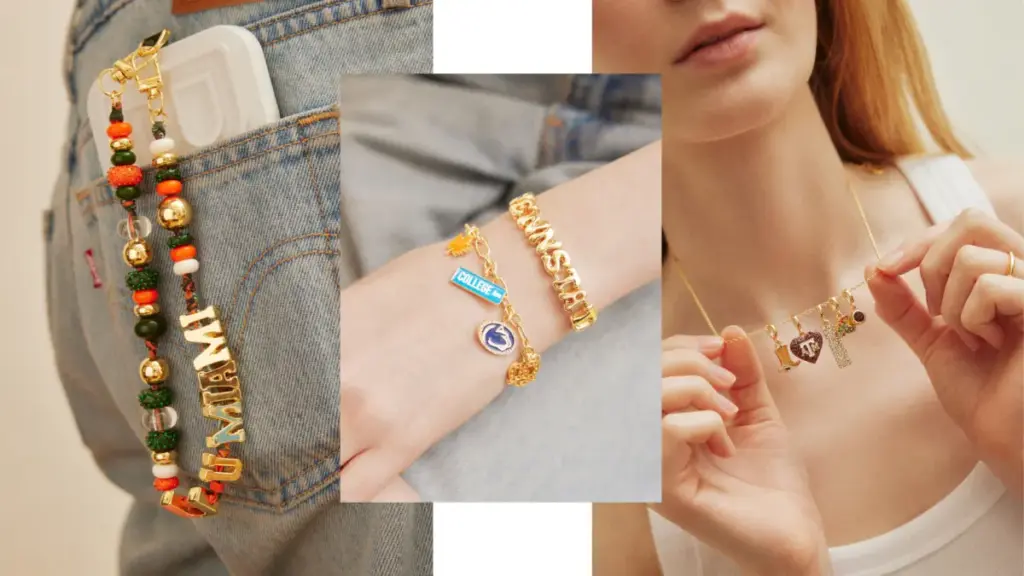
The results are evident in the product assortment. Moving far beyond traditional, block-letter apparel, BaubleBar’s collection includes school-specific charm bracelets, necklaces, earrings, hair clips, phone straps, and bag charms. A prime example is the brand’s $38 University of Michigan Pisa Bracelet. The piece artfully combines signature gold-plated beads with custom motifs, including the university’s classic block M, the geographical outline of the state of Michigan, playful cherries, and collegiate mittens. This elevated design approach transforms generic institutional merchandise into coveted lifestyle accessories.
Official Statements and Industry Insights
To grasp the strategic imperatives guiding BaubleBar and its market peers, one must examine the insights articulated by leadership figures across the retail landscape.
The Power of Built-In Identity
Reflecting on the psychological mechanics of licensed merchandise, Daniella Yacobovsky emphasizes the unique emotional resonance that institutional and fandom-based products command in a crowded marketplace.
"It does give you access to a group of people that really identify with something," Yacobovsky explains. "Whether it is a school, whether it is an entertainment IP, a sports team, whatever it is, they really identify."
In an era where digital ad costs on platforms like Meta and Google continue to escalate, acquiring cold traffic is increasingly inefficient. Collegiate licensing bypasses the grueling initial stages of brand indoctrination by plugging directly into an identity that consumers have already adopted as a core component of their personal self-image.
Granular Analytics and the Customer Journey
BaubleBar’s sophistication extends far beyond product design into the realm of advanced data analytics. Recognizing that a collegiate purchase is rarely an isolated transaction, the company has spent the past year restructuring its digital backend to track customer lifetime value (LTV).
In July, BaubleBar completed a major overhaul of its website backend, integrating sophisticated data and analytics tools designed to trace the exact customer journey. The company now meticulously tracks whether a shopper who enters the brand ecosystem via a University of Michigan or Penn State charm bracelet subsequently goes on to browse and purchase from other core categories, such as everyday fine jewelry, custom phone cases, or the brand’s signature seasonal beaded collections.
With its collegiate business now operating with over 18 months of historical data, Yacobovsky notes that the brand has graduated from making educated guesses to executing precision-targeted marketing strategies:
"Last year, when we had sub-12 months of data, you have to really make a lot of assumptions. Now that we’re at the past 18-month mark, we have so much more to go off of."
Early metrics indicate that customers acquired via collegiate partnerships exhibit retention and spending patterns that equal or exceed BaubleBar’s overall baseline. This confirms that college fans are not merely one-off novelty buyers, but highly valuable entry points into the broader brand ecosystem.
Mobilizing the "Groundswell" via Affiliate Networks
To amplify its product drops without relying solely on traditional paid advertising, BaubleBar activates a massive, highly curated affiliate network comprising approximately 5,000 micro-influencers, students, and alumni.
Yacobovsky underscores the necessity of this community-driven approach, noting that the ultimate goal is to generate an organic "groundswell" of real people wearing the collegiate assortment across campus quads, stadium tailgates, and digital feeds. By placing products directly into the hands of authentic campus ambassadors, BaubleBar converts passive viewers into active brand advocates.
Future Outlook: The Maturation of the Collegiate Lifestyle Market
BaubleBar is by no means operating in a vacuum. The broader fashion and activewear industries have rapidly recognized the untapped potential of collegiate licensing, signaling a permanent evolution in how campus merchandise is designed, marketed, and retailed.
Competitor Movements: Parke and Fabletics
The competitive landscape is heating up with sophisticated new entrants. New York-based fashion brand Parke recently launched its inaugural licensed collegiate collection through a high-profile collaboration with sports lifestyle brand ’47—an institution renowned for its premium licensed headwear and apparel. Spanning nine elite universities, including the University of Michigan, the University of Alabama, the University of Texas, and the University of Georgia, Parke’s collection reinterprets traditional campus staples—such as mock-neck sweatshirts, relaxed sweatpants, and vintage caps—through a distinctly contemporary, fashion-forward lens.
Concurrently, activewear giant Fabletics has dramatically scaled its retail footprint in the space. According to recent retail reports, Fabletics doubled the size of its digital "College Shop" from roughly 100 universities in the spring to 200 by late summer. Furthermore, the brand is actively testing dedicated collegiate merchandise displays across 14 physical retail locations situated in close proximity to major university campuses. Fabletics President Meera Bhatia noted that the expansion is designed not only to delight existing brand loyalists, but to aggressively attract net-new customers into the Fabletics ecosystem.
Redefining the Retail Calendar
As BaubleBar, Parke, and Fabletics continue to refine their respective playbooks, the most profound takeaway for the retail industry is the death of the traditional collegiate sales calendar.
For decades, retail executives treated university merchandise as a short-term sprint confined strictly to the month of August. Today, that narrow perspective has been thoroughly dismantled. Football season, autumn homecomings, winter basketball tournaments, spring Greek-life events, and summer alumni reunions provide an uninterrupted, 365-day calendar of recurring consumer demand.
As Daniella Yacobovsky aptly summarizes:
"There is this assumption that collegiate means I am a college student that goes to the school. But really it doesn’t begin and end with physically being in college."
For BaubleBar, the future of accessories does not lie in inventing entirely new trends from scratch, but in deeply understanding the enduring, passionate communities that already exist. By marrying rigorous consumer research, elevated design sensibilities, sophisticated data tracking, and a year-round merchandising cadence, BaubleBar has transformed school spirit into a scalable, highly profitable masterclass in modern brand building.