Executive Overview
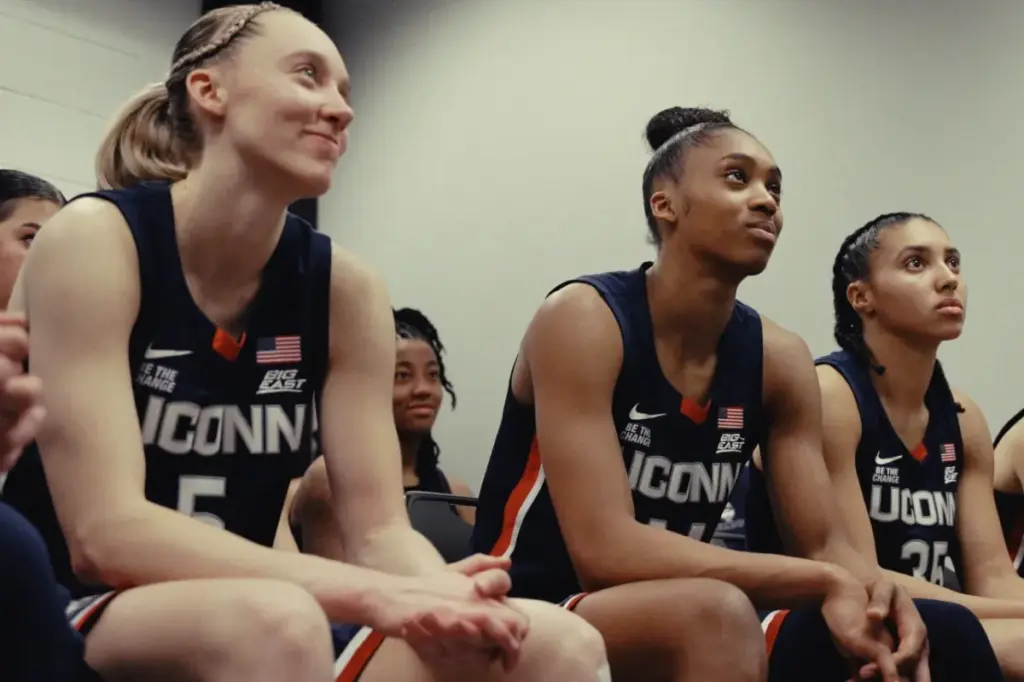
For over four decades, the University of Connecticut women’s basketball program has stood as the gold standard of collegiate athletics. Under the fiery, unyielding leadership of head coach Geno Auriemma, the Huskies have transformed from a regional afterthought into an absolute powerhouse, securing 12 national championships since 1995. Now, Apple TV’s new three-part docuseries, The Dynasty: UConn Huskies—directed by Matthew Hamachek and Erica Sashin—pulls back the curtain on this legendary program.
Serving as the second installment in Apple TV’s The Dynasty franchise (following The Dynasty: New England Patriots), the series captures the grit, glory, and intense psychological pressure that fueled one of the most dominant runs in sports history. Spanning Auriemma’s humble beginnings in 1985 to the program’s triumphant 2025 NCAA Championship victory over South Carolina, the series offers a raw, unfiltered look at the cost of winning. While the documentary’s condensed three-episode format leaves some historical nuances unexplored, it refuses to gloss over the friction, volatile tempers, and relentless demands that defined Auriemma’s legendary tenure.
Detailed Chronology: From Cinderella Roots to Modern Supremacy
1985–1995: The Unlikely Birth of a Contender
The genesis of the UConn dynasty is a story of improbable beginnings. In 1985, a 31-year-old Geno Auriemma took over a women’s basketball program that had virtually no pedigree, zero national footprint, and very little institutional backing. As Auriemma recounts in the series, coaching women was not his initial career ambition. However, a profound realization changed his perspective: he discovered that female athletes possessed the exact same competitive fire, tactical intelligence, and coachability as anyone else.
Rejecting the notion that women required a gentler, more delicate coaching style, Auriemma implemented a rigorous, uncompromising regimen. This philosophy forged an unbreakable internal culture, anchored by the program’s first major superstar, Rebecca Lobo. During her sophomore season, Lobo came dangerously close to walking away from the team, pushed to her absolute breaking point by Auriemma’s blistering standards. Yet, that very toughness catalyzed a historic breakthrough.
The culmination of this foundational era arrived during the 1995 NCAA National Championship game against the University of Tennessee and its legendary coach, Pat Summitt. Entering the matchup as heavy underdogs, Auriemma’s "Cinderella" Huskies engineered a stunning comeback victory to complete a flawless, undefeated season—instantly etching their names into basketball immortality and signaling a seismic shift in the landscape of women’s college athletics.
The Decades of Dominance (2000–2016)
Following their 1995 watershed moment, the Huskies evolved from surprise victors into an entrenched juggernaut. The series highlights the program’s subsequent golden eras, driven by a continuous pipeline of generational talents. Names like Sue Bird and Diana Taurasi—architects of the dominant 2000 championship squad—paved the way for an unprecedented era of sustained excellence.
Between 2009 and 2016 alone, UConn captured an astonishing six national championships. This era cemented the program’s reputation not just for winning, but for winning with suffocating defensive intensity and relentless offensive execution. However, this period of unparalleled triumph also cast a long shadow over the rest of the sport, sparking nationwide conversations about parity in women’s college basketball while establishing a culture where anything short of a banner was viewed as a catastrophic failure.
The Drought and the 2025 Redemption
One of the most compelling narrative arcs in the docuseries bridges the past with the present, focusing on the team’s journey toward the 2025 NCAA Women’s Basketball Championship. Prior to this victory, the program had experienced an uncharacteristically long national title drought—its longest since the 1990s.
The series opens dynamically in the locker room during the halftime of the 2025 final against the powerhouse University of South Carolina. True to form, a visibly furious Auriemma is captured dropping f-bombs while reviewing sloppy first-half footage, restrained only by his longtime head assistant coach, Chris Dailey. The Huskies ultimately rallied, securing an 82–59 victory to claim their first national championship in nine years. This modern triumph provides a satisfying narrative bookend, proving that while generations of players had changed, the core DNA of the program remained stubbornly, successfully intact.
Supporting Context & Metrics: The Anatomy of a Dynasty
To truly understand the weight of Apple TV’s documentary, one must examine the staggering statistical architecture of the UConn program:
- Total National Championships: 12 titles under Auriemma (1995, 2000, 2002, 2003, 2004, 2009, 2010, 2013, 2014, 2015, 2016, and 2025).
- The Dynasty Span: Over 41 years of continuous leadership by Geno Auriemma, making him one of the longest-tenured and most successful coaches in the history of American team sports.
- The Tennessee Rivalry: A cornerstone of the series is Auriemma’s intense, highly publicized rivalry with Pat Summitt’s Lady Vols. Following UConn’s 1995 upset, Tennessee responded by rattling off three consecutive national titles (1996, 1997, 1998), fueling a fierce competitive animosity that pushed both programs to unprecedented heights.
- Intra-Campus Dynamics: The documentary briefly touches upon Auriemma’s complicated relationship with legendary men’s basketball coach Jim Calhoun (who led the UConn men from 1986 to 2012), highlighting the internal competitive ecosystem of a university operating as a dual basketball mecca.
Official Perspectives and Critical Analysis
Hamachek and Sashin’s direction successfully resists the temptation to create a blind hagiography. Instead, The Dynasty: UConn Huskies presents a nuanced, multifaceted portrait of its central figure.
The Cost of Excellence
Auriemma does not hide behind PR-friendly soundbites, nor do the filmmakers sugarcoat his methods. Throughout the three episodes, viewers are confronted with the darker side of absolute dominance: high-stress environments, emotional exhaustion, and psychological strain. In a striking montage during the first episode, former players reflect on their time in Storrs with complicated emotions—acknowledging that while the lessons shaped their professional and personal lives, reaching the end of their eligibility brought an undeniable sense of relief.
"Rebecca Lobo is brutally honest about her time with Auriemma, even if it ultimately got her a national championship and launched her career as one of the first megastars in the WNBA."
Structural Limitations
At just three 40-minute episodes, critics note that the series occasionally bites off more than it can chew. Condensing 31 years of basketball history—along with the massive cultural shifts, conference realignments, and individual controversies that accompanied it—into such a brief runtime means some complex topics receive only a surface-level glance. For instance, while the documentary touches on the immense internal pressure cooker of the program, it leaves room for a deeper investigation into broader gender dynamics within collegiate coaching ranks.
Nevertheless, the anchor performances—particularly Auriemma’s unfiltered commentary and Chris Dailey serving as his vital emotional anchor—carry the narrative forward with undeniable momentum.
Future Outlook: Legacy and Cultural Impact
As women’s college basketball experiences an unprecedented golden age in terms of media rights, mainstream popularity, and audience viewership, The Dynasty: UConn Huskies arrives at a critical cultural juncture. The modern landscape of the sport—featuring superstars like Caitlin Clark, Angel Reese, and the formidable South Carolina squads built by Dawn Staley—owes a monumental debt of gratitude to the trail was blazed by Auriemma, Lobo, Bird, and Taurasi.
Apple TV’s docuseries ensures that the historical foundation of this modern boom is neither forgotten nor romanticized beyond recognition. It presents the UConn dynasty not as a fairy tale, but as an industrial-grade machine forged through sweat, tears, ego, and an unyielding refusal to accept anything less than perfection.
Our Final Verdict: Stream It. Despite its brisk pacing, The Dynasty: UConn Huskies delivers an unvarnished, gripping look at the complexities of sports greatness, cementing its place as essential viewing for basketball fans and documentary enthusiasts alike.