For decades, the Star Trek franchise has pushed the boundaries of television through high-concept science fiction, daring moral allegories, and pioneering visual effects. From time loops and courtroom dramas to alternate realities and full-blown Broadway-style musical episodes, the crew of the USS Enterprise has rarely shied away from stylistic reinvention. Yet, when Paramount+ dropped Season 4, Episode 5 of Star Trek: Strange New Worlds—titled "Level Five Transporter Accident"—it delivered a creative masterstroke that few fans could have ever anticipated: a full-fledged, live-action puppet episode brought to life in collaboration with the legendary Jim Henson’s Creature Shop.
First teased to an ecstatic audience at San Diego Comic-Con in 2025, the episode has officially arrived on the streaming platform, instantly cementing its place in television history. Blending classic Star Trek tropes—such as rogue Orion pirates, experimental transporter technology, and deep-seated emotional introspection—with the chaotic, handcrafted charm of traditional puppetry, "Level Five Transporter Accident" offers an unforgettable viewing experience.
Behind the laughter, high-concept visual gags, and frantic zero-G action sequences lies a meticulous production feat. Directed by Jordan Canning, whose previous work on the Apple TV+ reboot of Fraggle Rock positioned her uniquely for the assignment, the episode required unprecedented logistical problem-solving. From the design booths of the Creature Shop to the restricted, human-scaled sets of the Enterprise, this cinematic venture challenged actors, writers, and puppeteers alike. This comprehensive report explores the genesis, mechanical wizardry, on-set execution, and overarching significance of television’s most unexpected crossover between space exploration and world-class puppetry.
Detailed Chronology: How the Enterprise Crew Became Felt and Foam
The narrative framework of "Level Five Transporter Accident" cleverly bridges classic Star Trek technobabble with absurd comedic styling, providing the ideal catalyst for its radical shift in visual medium.
The trouble begins when Commander Spock (Ethan Peck) assists Chief Engineer Montgomery "Scotty" Scott (Martin Quinn) with an ambitious scientific endeavor. Scotty aims to shatter inter-vessel transporter records by beaming an object across an unprecedented distance. Driven by a lingering petty grudge from his Starfleet Academy days, Scotty selects a terrifyingly eccentric puppet—an artifact his brothers used to torment him during childhood—as his payload. His intent is to beam the relic directly into the private quarters of a former rival stationed on a neighboring starship.
Simultaneously, Spock grapples with deep personal turmoil. Following a painful breakup with La’an Noonien-Singh (Christina Chong) and lingering emotional trauma from earlier season arcs, the half-Vulcan officer seeks emotional grounding and logical clarity. Operating near his homeworld, he reaches out to T’Pring (Gia Sandhu), requesting her philosophical guidance under one strict condition: absolute freedom from distractions or hijinks.
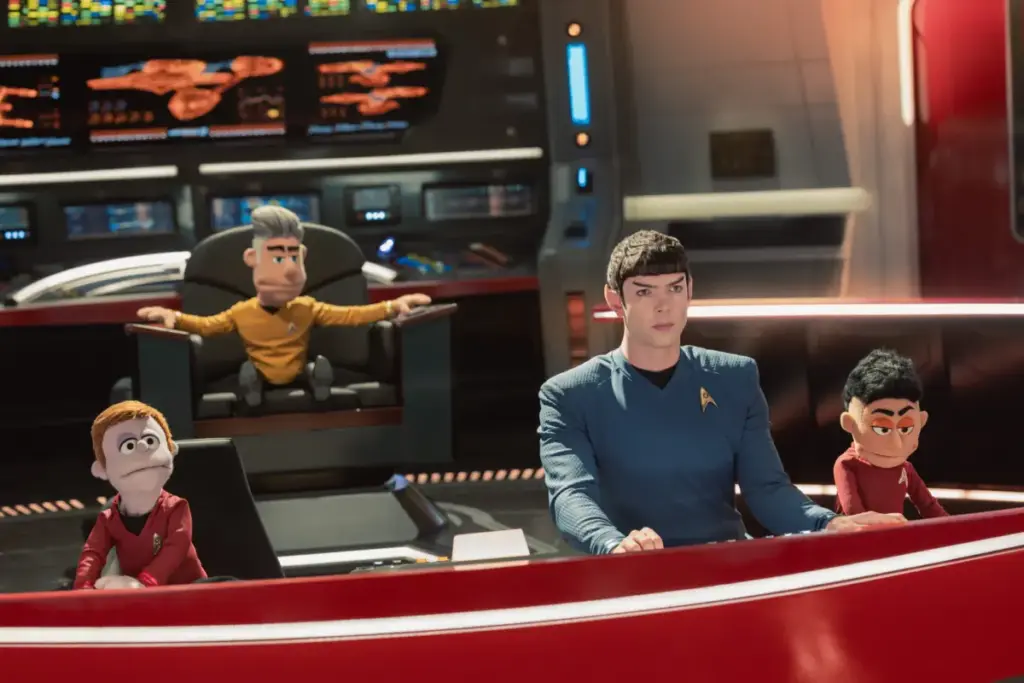
To support the experiment, Spock departs the Enterprise in a shuttlecraft to position signal-boosting equipment in deep space. Back on the ship, Scotty initiates the transporter sequence with the childhood puppet locked into the coordinates. The resulting malfunction—the titular level five transporter accident—catastrophically rewrites the molecular integrity of everyone aboard. In an instant, Captain Christopher Pike, Commander Pelia, and the rest of the active duty crew are transformed into sentient, mobile puppets.
What follows is a delightfully surreal crisis. Spock, remaining remarkably human-adjacent and free of the transformation, finds himself the sole caretaker of a ship full of felt-and-foam command officers. Compounding the situation, a opportunistic band of Orion pirates seizes the moment to launch a boarding action, hoping to capture the crippled Enterprise. Spock and his newly miniaturized, structurally challenged crew must repel the invaders, navigate the frustrating physical limitations of their new puppet bodies, and save the ship before reality sets back in.
Supporting Context & Metrics: Engineering the Impossible
Transitioning an expensive, prestige sci-fi drama into a live-action puppet showcase required a staggering degree of inter-studio cooperation and physical engineering. The production relied heavily on the institutional knowledge of Jim Henson’s Creature Shop, whose creative supervisor, Jason Weber, spearheaded the physical realization of the Enterprise bridge crew.
The Anatomy of Starfleet Puppetry
Weber’s team began the process with meticulous 3D digital renderings before translating them into physical materials. The overarching design philosophy centered on exaggerating the most distinct physical characteristics of the actors:
Captain Pike (Anson Mount): Sculpted with an emphasis on his signature, impeccably styled coiffure and broad, authoritative shoulders.
Commander Pelia (Carol Kane): Widely voted the favorite by the production crew, Pelia’s puppet required an entirely bespoke manufacturing process. The Creature Shop fabricated synthetic horsehair tubing, wrapped it around a spiraled form, and boiled it in place to achieve an eccentric, spring-like curl that matched Kane’s distinct live-action aesthetic.
Navigating Human-Scale Sets
Directing the episode presented an enormous spatial challenge. As director Jordan Canning noted, sets like the Enterprise bridge, sickbay, and corridors were meticulously engineered for human actors, completely devoid of the under-floor drop zones standard in classic puppet shows like The Muppet Show or Fraggle Rock.
Consequently, the production design and art departments worked hand-in-hand with the puppeteers to identify ingenious hiding spots. Puppeteers utilized consoles, tactical partitions, and angled camera framing to conceal themselves during wide shots. More complex sequences required unconventional positioning; for instance, a scene featuring Spock walking alongside T’Pring’s puppet required puppeteer Donna Kimball to lie completely flat on her back, propelling herself forward with her feet while simultaneously executing dialogue and balancing a prop stack of phasers.
Action Sequences and Stunt Mechanics
Translating high-octane Starfleet action into puppet choreography pushed the crew to its absolute limits. Puppets possess virtually no intrinsic skeletal mechanism, meaning everyday actions required external rigging:
Prop Handling: Because puppets cannot organically grip objects, production wranglers manually wired props into tiny felt hands between cuts.
The Trench Coat Gag: A sequence featuring three distinct crew puppets operating inside a single trench coat to combat an Orion pirate required the synchronized efforts of eight separate puppeteers.
Pike in Flight: For a cinematic, slow-motion point-of-view shot of Captain Pike flying through the air to tackle an intruder, the Creature Shop utilized a rigid metal armature. Puppeteer Frank operated the wired puppet in a full green-screen suit, blending physical wirework with digital compositing to create the illusion of airborne captaincy.
Official Statements and Behind-the-Scenes Insights
The cast and crew have shared extensive reflections on the surreal experience of bringing "Level Five Transporter Accident" to life.
Ethan Peck, who played the straight man to an entire ship of hand-operated characters, admitted to initial hesitation when he first read the script:
"We’ve gotten a few episodes over the years where I’m like, ‘Really? Are you sure? Are you serious?’ And this is definitely one of those," Peck told Variety. "And then the puppets showed up on set, and it became very real."
Despite missing out on a physical transformation, Peck found a unique advantage to remaining human throughout the shoot:
"I guess I was a little bit disappointed, but also I was the one that got to act with all of them. No one else got to act with the puppets."
Maintaining dramatic momentum during heavy emotional exchanges proved to be a formidable test of professional discipline. Spock’s deeply serious heart-to-hearts with T’Pring’s puppet required intense concentration.
"The challenge is not looking at the puppet and thinking, ‘I’m looking at someone’s hand inside of a sock, like an elaborate sock,’" Peck explained. "It’s very easy to be kind of pulled out by like, ‘I’m acting with a puppet right now,’ and I’m doing something really serious and heavy, and so I had to be really careful not to let any of those thoughts infect my work."
Director Jordan Canning commended the cast’s composure, noting that Peck maintained his professional facade nearly the entire shoot, breaking character only once during an extended take where Pike’s puppet repeatedly and futilely swiped its tiny hand against the command chair.
From the Jim Henson Company perspective, Jason Weber expressed deep gratitude for the crossover:
"There’s quite a Henson presence at Dragon Con, Comic-Con, all of these things, and of course Star Trek is there too," Weber said. "So there’s always been this mutual admiration between our cultures, if you will. To be able to finally jump in and work with them was an amazing experience. We had a blast."
Future Outlook: The Legacy of Experimental Television
While the narrative resolution of "Level Five Transporter Accident" ultimately reveals the harrowing ordeal to be a vivid dream sequence experienced by Spock, the cultural footprint of the episode extends far beyond a simple narrative gag.
In an era where streaming television often leans heavily into serialized grit, high-stakes serialization, and dark dramatic tones, Star Trek: Strange New Worlds has consistently championed the episodic, high-concept flexibility of classic 20th-century television. By leaning into absurdity without sacrificing the emotional core and character continuity of its principal players, the creative team has validated the ongoing viability of creative risk-taking within major intellectual properties.
The seamless integration of Jim Henson’s Creature Shop mechanics into a modern prestige science fiction drama proves that practical effects and tactile artistry retain immense power to captivate audiences. As Strange New Worlds continues its run on Paramount+, "Level Five Transporter Accident" will undoubtedly be studied, re-watched, and celebrated as a high-water mark for television comedy and collaborative artistry. And while the crew of the Enterprise has safely returned to flesh and blood, fans can only hope that this won’t be the final time the final frontier welcomes a little bit of felt, foam, and Henson magic.