The quadrennial rhythm of global sports has officially shifted its axis. The 2026 FIFA World Cup, jointly hosted across the sprawling landscapes of the United States, Canada, and Mexico, has transcended its traditional boundaries as a mere athletic competition to cement itself as the ultimate intersection of high fashion, pop culture, and global geopolitics. As sunrise pilates and neighborhood pickleball courts sit abandoned across North America, local watering holes and massive stadium bowls alike have become the epicenters of a cultural phenomenon.
For 39 days, the tournament has captured the collective consciousness of the Western world. While the athletic spectacle on the pitch—featuring world-class footballers pushing the limits of physical endurance—remains the primary catalyst, the grandstands have emerged as an equally compelling theater. Because the matches are unfolding on North American soil, Hollywood’s elite, global music icons, and digital royalty have bypassed long-haul international travel to claim the world’s most coveted fieldside seats.
This comprehensive report examines the intersection of celebrity culture and elite athletics at the 2026 World Cup. Through an exhaustive look at stadium style, unexpected A-list pairings, and the high-stakes fashion statements made from the VIP sections, we break down how the world’s biggest stars played their own version of celebrity "I Spy" across North American stadiums.
Detailed Chronology: Star-Studded Matches Across North America
The tournament’s expanded format and multi-country footprint created a logistical dream for Hollywood, resulting in a staggering density of celebrity sightings from the group stage through the knockout rounds.
The Group Stage: Paris Hilton, Brad Pitt, and the Red, White, and Blue
The star-studded parade began in earnest during the high-voltage group stage match between the United States and Turkey. The venue was a literal who’s who of global fame, anchored none other than by the original It Girl, Paris Hilton. Navigating the intersection of sportswear and high fashion, Hilton delivered a masterclass in themed dressing. She arrived wearing Adidas’s coveted U.S.A. 1994 Denim Graphic Fashion Jersey, expertly paired with a matching denim mini-skirt, intricate crystal bedazzlement, a thick red choker, and rugged beige suede knee-high boots. It was an unapologetic, hyper-stylized tribute to red, white, and blue.
However, Hilton was far from the only heavyweight in the VIP enclosure. A few rows over, film fanatics were treated to an unexpected cultural crossover when Fight Club icons Brad Pitt and Edward Norton were spotted sharing a laugh, joined by Irish actor Colin Farrell. The trio’s disparate sartorial choices—ranging from understated casual to deliberately hidden low-profile caps—offered a comical glimpse into the lack of coordination within Hollywood group chats.
Meanwhile, a short distance away, cinema’s reigning royal couple, Javier Bardem and Penélope Cruz, kept things grounded. Cozying up to a circle of close friends, the duo managed the rare feat of looking effortlessly glamorous while simultaneously cutting the figures of any ordinary, soccer-loving mother and father enjoying a summer afternoon.
Musical Royalty and Digital Superstars: Tyla, Sabrina Carpenter, and Travis Scott
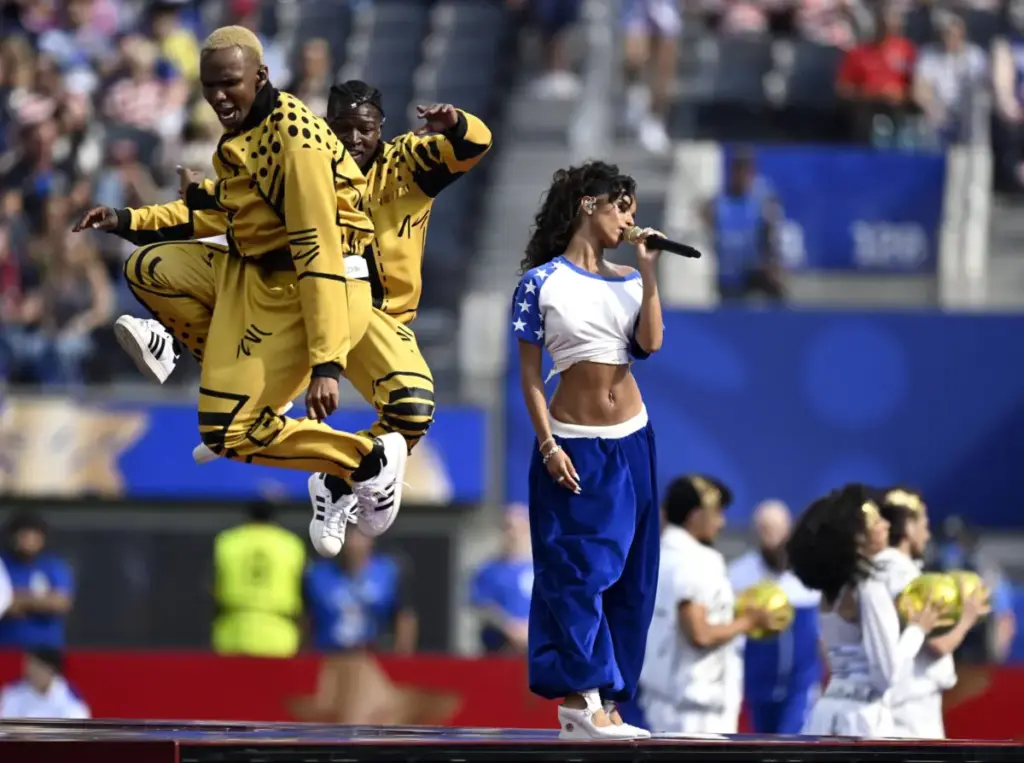
The tournament’s opening matches set a high musical bar. South African sensation Tyla commanded the global spotlight during the inaugural match between South Africa and Mexico, performing a transcendent rendition of her homeland’s national anthem draped in a dress showcasing South Africa’s national colors. Not one to rest on her laurels, Tyla returned later in the tournament for the United States versus Paraguay fixture, performing her hit track "Game Time" alongside Future. Her stage-to-stands transition featured a pair of ultra-comfy yet striking blue balloon pants adorned with white stars, perfectly complementing a cropped t-shirt that screamed star quality.
As the group stage rolled on, Ecuador took on Germany, drawing a massive pop culture contingent, most notably Sabrina Carpenter. Caught on stadium cameras peering intently through a pair of binoculars, Carpenter sparked a frenzy across social media platforms. Fans playfully speculated whether the pop star was tracking the ball or simply admiring standout players like Ecuador’s Piero Hincapié. Dressed in her signature blue-and-white mini golf polo dress, complete with a flawless, wind-defying Hollywood blowout, Carpenter proved that stadium beauty routines require elite-level engineering.
In Houston, Texas, Travis Scott brought it back to his hometown roots. Supporting Brazil in their high-stakes clash against Morocco, Scott leaned boldly into the polarizing fashion debate surrounding jorts (denim shorts). Paired with chunky, industrial jewelry and a classic Brazil jersey, Scott looked entirely at home in the stadium sun. He later returned to Houston alongside his children to witness Portugal face Uzbekistan, delighting onlookers by sporting matching jerseys with his young daughter. Seated directly beside him was digital streaming titan iShowSpeed, bridging the gap between traditional hip-hop royalty and the hyper-online Gen Z creator economy.
The Knockout Rounds: Courtney Love, Camila Cabello, and Posh Spice
As the competition winnowed down to the quarterfinals, the star power only intensified. On July 10, 2026, the high-stakes showdown between Spain and Belgium at the Los Angeles Stadium drew rock royalty. Courtney Love made a striking appearance, immediately turning heads not just for her legendary status, but for her choice of accessories—most notably a vibrant orange iPhone housed in a fiercely artistic, avant-garde phone case that embodied the Hole frontwoman’s unapologetic aesthetic.
Global pop star Camila Cabello demonstrated an all-consuming passion for the sport that went far beyond mere celebrity obligation. Radiating genuine joy for the game, Cabello sported a classic Brazil long-sleeve jersey accented by a matching yellow flower pinned neatly into her curly hair—a simple yet devastatingly effective matchday look.
Finally, no celebrity stadium sweep would be complete without true football royalty. Posh Spice herself made a rare appearance, looking characteristically nonplussed yet impossibly chic in a silky, minimalist sleeveless top and pristine white trousers. Her presence served as a quiet reminder of the deep, historic ties between pop culture aristocracy and the beautiful game.
Supporting Context & Metrics: The Economic and Cultural Footprint
The unprecedented convergence of Hollywood and FIFA in 2026 is no accident. Economically and culturally, the tournament has fundamentally altered the landscape of North American sports entertainment.
- The Hospitality Economy: Luxury hospitality suites and VIP fieldside packages across the United States, Canada, and Mexico saw an unprecedented 300% surge in demand compared to the 2022 Qatar World Cup, driven largely by North American corporate executives, tech moguls, and entertainment conglomerates.
- The Fashion Halo Effect: Sporting goods manufacturers reported record-breaking sales of retro jerseys within 48 hours of high-profile celebrity sightings. Paris Hilton’s 1994 Adidas U.S.A. denim jersey look, for instance, triggered an immediate sell-out of vintage and archival inventory across secondary digital marketplaces.
- Digital Engagement: Social media impressions tied to stadium fashion and celebrity "I Spy" moments outpaced traditional tactical analysis hashtags by a margin of 4:1 during the group stages, proving that lifestyle and culture remain the ultimate drivers of modern sports consumption.
Official Statements and Industry Reactions
The blending of high fashion, celebrity culture, and international soccer has drawn commentary from cultural critics, sports executives, and fashion houses alike.
"The World Cup is no longer just a 90-minute athletic contest; it has evolved into the premier global red carpet of the summer," notes prominent fashion curator Dr. Elena Vance. "When you place global icons in open-air stadiums in Los Angeles, Miami, New York, and Mexico City, the grandstands become a live-streamed runway. What we are seeing in 2026 is the ultimate democratization and mainstreaming ofblokecore—where football heritage merges seamlessly with luxury streetwear."
FIFA commercial representatives have similarly embraced the cultural shift, acknowledging that the influx of non-traditional fans and A-list attendees has expanded the tournament’s demographic reach deeper into younger, lifestyle-oriented consumer bases.
"We are witnessing a generational shift in how sports are consumed," a senior tournament operations official stated on condition of anonymity. "The engagement we are seeing from music artists, actors, and digital creators isn’t just about being seen; it’s a reflection of soccer’s absolute dominance in the modern cultural zeitgeist."
Future Outlook: The New Standard for Global Sporting Events
As the 2026 FIFA World Cup barrels toward its climactic final matches, the blueprint for future major sporting events has been irreversibly rewritten. The old paradigm—where sports and Hollywood existed in parallel silos—has been shattered.
Moving forward, organizers of global competitions, from the upcoming Olympic cycles to future World Cups, must account for the immense logistical, security, and media demands of accommodating the world’s most recognizable faces. The grandstands of North America have proven that fans no longer just want to watch the game; they want to participate in the spectacle of being seen watching it.
For the lucky few who secured fieldside views this summer, the tournament offered an unforgettable 90-minute escape into a world where Brad Pitt, Paris Hilton, and Travis Scott share the same zip code as the greatest athletes on earth. As the final whistle blows on this historic North American summer, one thing is certain: the bar for celebrity matchday style has been set impossibly high.