Executive Overview
Two and a half decades after burning rubber into the cultural consciousness, Universal Pictures’ high-octane monolith The Fast and the Furious remains an unmatched phenomenon in modern cinematic history. What began in 2001 as a gritty, localized crime thriller centered on underground street-racing subculture in Los Angeles has since transformed into a globe-trotting, multibillion-dollar action empire.
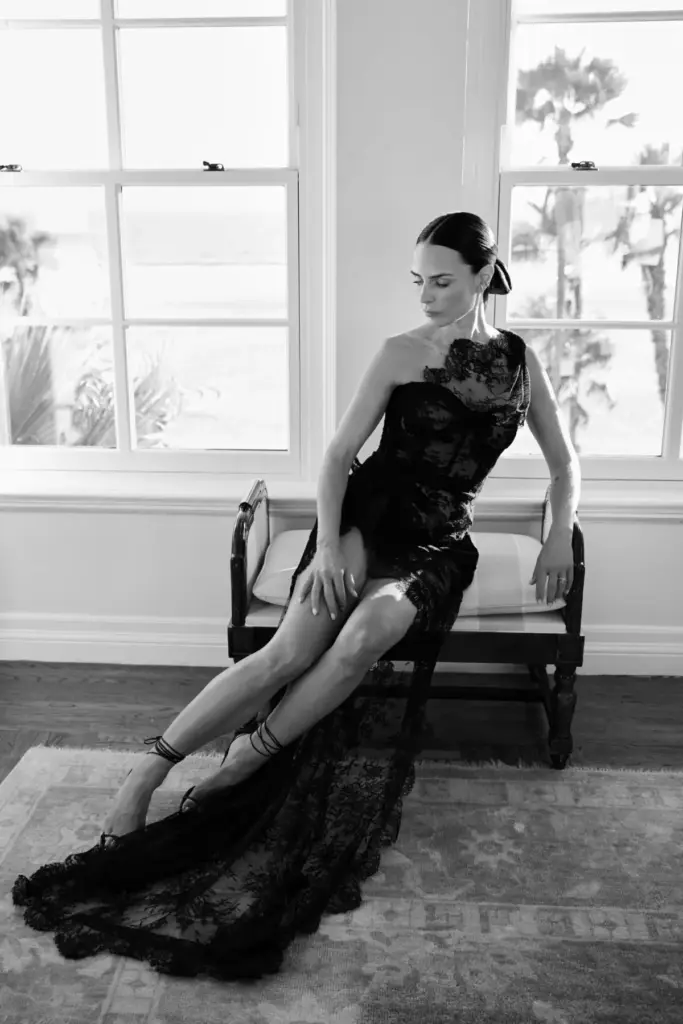
To mark the milestone 25th anniversary of the film that started it all, the original Fast family reconvened in Los Angeles for a special screening that bridged past nostalgia with contemporary Hollywood glamour. Among the returning cast members was Jordana Brewster, whose foundational portrayal of Mia Toretto has anchored the emotional core of the franchise across generational shifts. Trading the character’s signature understated tank-top-and-denim aesthetic for high fashion, Brewster stepped onto the red carpet in a striking, sheer black lace Monse gown.
Reflecting on the quarter-century journey, Brewster offered a poignant look back at her evolution from a newcomer clutching her mother’s Fendi baguette bag at the original Westwood premiere to a seasoned industry veteran sharing the cinematic milestone with her children. Beyond the fashion and the red-carpet reunions, the anniversary serves as a strategic inflection point for Hollywood: a moment to evaluate how a mid-budget sleeper hit evolved into one of the most resilient intellectual properties in studio history, setting the stage for its eventual cinematic conclusion with Fast Forever.
Detailed Chronology: From Westwood to a Global Empire
The trajectory of The Fast and the Furious is a masterclass in cinematic longevity, accidental franchise building, and organic adaptation. To understand the magnitude of the 25th-anniversary gathering, one must trace the timeline of how a modest summer release reshaped the Hollywood landscape.
2001: The Genesis in Westwood
In June 2001, the original premiere of The Fast and the Furious took place in Westwood, California. Directed by Rob Cohen and loosely inspired by a 1998 Vibe magazine article about New York City street racing, the film was released with modest expectations by Universal Pictures. Starring Paul Walker, Vin Diesel, Michelle Rodriguez, and a then-rising young actress named Jordana Brewster, the film relied on nitro-boosted car chases, tactile practical stunts, and a surprisingly resonant dynamic of found-family loyalty.
Brewster has frequently recounted the stark contrast between that initial bow and the reality of the franchise today. "Twenty-five years ago, I went to the Westwood premiere of The Fast and the Furious," Brewster recalled in an interview with ELLE. "I wore my mom’s Fendi baguette bag and did my own makeup—blue eyeshadow and tanning beds were in." At the time, the film was viewed simply as a contemporary update of Point Break with imported Japanese sports cars; few could have predicted that it would spawn a multi-decade cinematic universe.
The Mid-2000s: Near-Misses and the Pivot to Ensemble Action
The path to franchise status was not linear. Following the sequel 2 Fast Furious (2003)—which notably omitted Diesel and Brewster—and The Fast and the Furious: Tokyo Drift (2006), which shifted focus to an entirely new cast in Japan, the brand faced creative fatigue.
The turning point arrived in 2009 with Fast & Furious. Director Justin Lin reunited the original core quartet—Diesel, Walker, Rodriguez, and Brewster—reinvigorating the narrative stakes and transforming the series from a revolving-door exploitation franchise into a serialized character-driven epic. This pivot laid the groundwork for Fast Five (2011), widely credited as the creative apex that converted the property into a heist-driven action juggernaut characterized by gravity-defying set pieces and massive ensemble casts.
The Present Day: The 25th-Anniversary Milestone
Fast-forward to the present-day anniversary screening in Los Angeles. The reunion brought together key architects of the franchise, including Vin Diesel, Michelle Rodriguez, and Tyrese Gibson, alongside Brewster. Walking the red carpet alongside her children, Brewster marked a literal and figurative full-circle moment.
"Last night, I walked the same carpet with my kids (I definitely did not do my own makeup) and showed them the film that started it all," Brewster noted. The event underscored the generational handoff of the franchise, as millions of fans who grew up watching the 2001 original now introduce the films to their own families.
Supporting Context & Metrics: The Anatomy of a Monolith
The survival and expansion of The Fast and the Furious franchise over 25 years place it in an elite tier of intellectual property, rivaling traditional comic-book cinematic universes in terms of global box office performance and cultural penetration.
Box Office Dominance and Financial Scale
Since its inception, the franchise has grossed over $7 billion worldwide across ten main installments, plus the 2019 spin-off Hobbs & Shaw. What began as a $38 million production in 2001 expanded into a series where individual entries regularly cross the $1 billion threshold globally—most notably Furious 7 (2015), which grossed over $1.5 billion, driven in part by emotional tributes to the late Paul Walker.
The Cultural and Geopolitical Footprint
While domestic audiences have fueled much of the initial box office, the franchise’s true financial engine lies in its international markets. The series recognized the globalization of cinema earlier and more aggressively than many of its contemporary Hollywood peers.

Brewster highlights her home country of Brazil as a critical epicenter of this global fervor, pointing directly to the cultural pivot achieved in Fast Five, which was largely set in Rio de Janeiro. "The love for these films is around the globe, but especially in Brazil, my home, and the heart of the franchise," Brewster said. "Fast changed my life and set me on my path—I am forever grateful."
The Sartorial and Aesthetic Metamorphosis
The 25th-anniversary screening also highlighted a stark evolution in how the cast engages with the public eye. Mia Toretto’s cinematic wardrobe is defined by utilitarianism: white tank tops, cargo pants, and leather jackets designed for mechanics and getaway drivers. In sharp contrast, Brewster’s anniversary ensemble celebrated high fashion.
Styled by Katie Bofshever, Brewster wore an asymmetrical Monse gown constructed from delicate black lace, featuring a sheer skirt and a dramatic train. The look was elevated by jewelry from Nak Armstrong and Savannah Friedkin, paired with strappy heels from Paris Texas. Makeup artist Mélanie Inglessis opted for modern, luminous glam—deliberately omitting the millennial blue eyeshadow of 2001—while hairstylist Renato Campora shaped her hair into a sleek, statement-making low ponytail. The transformation from cinematic mechanic to red-carpet fixture mirrors the franchise’s own trajectory from street racing to global luxury status.
Official Statements & Industry Perspectives
The longevity of the Fast universe is sustained by a deeply ingrained ethos of camaraderie among its cast members, many of whom have worked together for over two decades.
Vin Diesel, who serves as both star and lead producer of the franchise, has frequently emphasized that the concept of "family" is not merely a marketing tagline for the films, but a lived reality behind the scenes. The reunion screening served as a public manifestation of this philosophy, as the cast celebrated not just a corporate milestone, but personal histories forged on dusty Southern California asphalt and international soundstages.
Jordana Brewster’s reflections capture the duality of growing up alongside a global enterprise. Having spent more than half of her life portraying Mia Toretto, Brewster has witnessed the industry transform around her. From the pre-social-media era of the early 2000s—when promotion relied heavily on print magazines, television spots, and red-carpet appearances with personal styling—to the hyper-connected digital landscape of today, her journey mirrors the professional maturation required to sustain a career in a volatile entertainment ecosystem.
Industry analysts note that maintaining a cohesive ensemble cast across 25 years without major structural fractures is nearly unprecedented in modern franchise filmmaking. The ability of Universal Pictures to retain core players like Brewster, Diesel, Rodriguez, and Gibson has provided the narrative glue necessary to keep audiences emotionally invested, even as the action sequences escalated from street-level heists to orbital maneuvers.
Future Outlook: Navigating Toward Fast Forever
As the celebrations for the 25th anniversary wind down, the franchise’s leadership and cast are already looking toward the horizon. The primary focus of the studio and its creative team is the culmination of the overarching narrative arc, widely anticipated under working titles and references pointing toward Fast Forever or the final numbered installments designed to bring the saga to a definitive close.
Crafting a Definitive Conclusion
Ending a cinematic universe that has generated billions of dollars and sustained multiple generations of fans is a high-stakes logistical challenge. Unlike traditional trilogies or episodic superhero franchises, the Fast series has relied heavily on the personal histories of its characters. For Brewster’s Mia Toretto, any final installment must successfully balance fan service, emotional closure regarding the absence of Brian O’Conner (honorarily preserved through CGI and narrative framing following Paul Walker’s passing), and the high-octane spectacle expected by global audiences.
The Legacy of Practical and Digital Integration
As the industry shifts further toward virtual production and heavily digitized environments, the Fast franchise has maintained a reputation for combining CGI with large-scale practical stunt work. The upcoming finale will likely face the challenge of outdoing past spectacles—ranging from vault-dragging chases through Rio to cars launched into space—while remaining grounded in the interpersonal dynamics that made the 2001 original a classic.
Brewster’s Continuing Evolution
For Jordana Brewster, the conclusion of the core saga does not represent an end to her cinematic footprint, but rather a milestone in a career defined by resilience. Having navigated the transition from teen-thriller ingenue to action royalty, Brewster remains an integral symbol of the franchise’s soul.
As she noted while adjusting her Monse gown and preparing to walk the anniversary carpet alongside her children, the journey that began in Westwood a quarter of a century ago has fundamentally altered her life’s trajectory. With Fast Forever waiting on the horizon, Brewster and the rest of the crew have not quite crossed the finish line—proving that in the world of high-speed cinema, some engines simply refuse to die.