Executive Overview
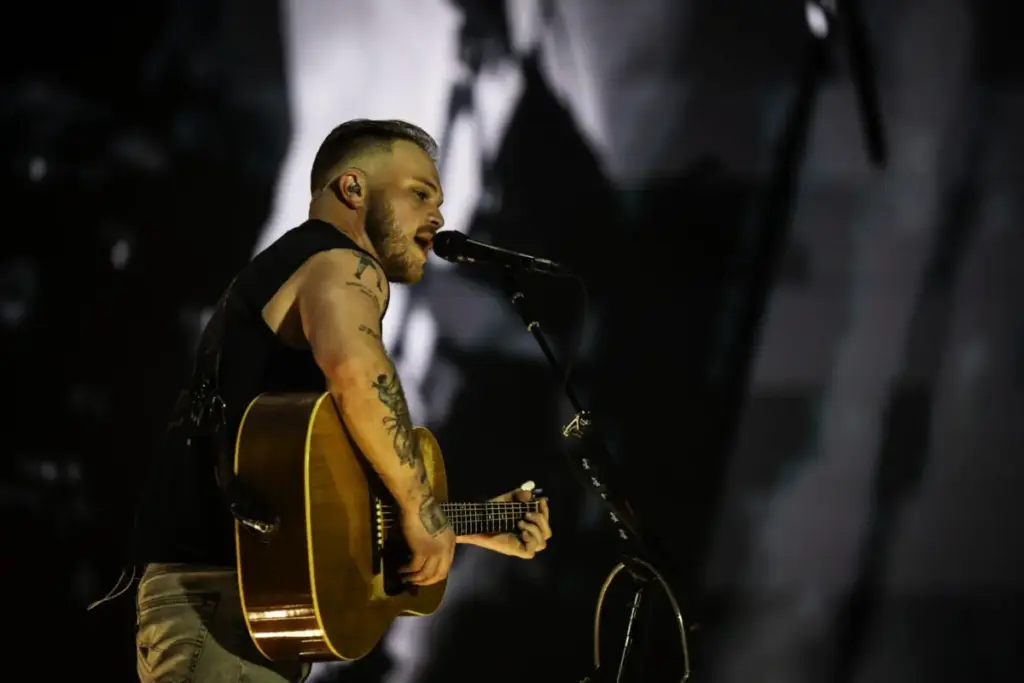
The intersection of live entertainment and geopolitical activism reached a dramatic new crescendo on Friday, October 2, when Grammy-winning country-rock superstar Zach Bryan took the stage at Gillette Stadium wearing a plain black T-shirt emblazoned with the words “Free Palestine.” Accompanied by members of his touring band clad in identical attire, Bryan’s sartorial statement during the opening night of his Foxborough, Massachusetts stand was far more than a routine wardrobe choice. It was a calculated, high-stakes collision between independent musical artistry and the entrenched corporate power structures that govern modern stadium infrastructure.
The staging of this protest at Foxborough’s Gillette Stadium carried profound symbolic weight. The venue is owned by the Kraft Group, spearheaded by billionaire New England Patriots owner Robert Kraft—a figure who, just weeks prior, played an instrumental role in the expulsion of rapper Macklemore from the remaining U.S. legs of Ed Sheeran’s Loop Tour. Macklemore’s offense, in the eyes of tour promoters and venue stakeholders, was voicing pro-Palestinian sentiments and performing his protest track “Hind’s Hall” during live sets.
By utilizing a venue deeply tied to one of the primary architects of that blacklisting, Bryan has dramatically escalated an ongoing industry-wide culture war over free expression. This event underscores a broader, increasingly volatile tension within the global music business: as artists increasingly use global platforms to voice dissenting political viewpoints, festival organizers, corporate promoters, and stadium magnates are increasingly flexing their economic leverage to police speech. This investigative feature examines the chronology of the Macklemore fallout, analyzes Zach Bryan’s history of courting political friction, evaluates the institutional fallout within the touring industry, and explores the long-term ramifications for artistic freedom on the global stage.
Detailed Chronology: From MetLife to Foxborough
To understand the explosive resonance of Zach Bryan’s Gillette Stadium appearance, one must trace the timeline of events that set the live music industry on edge through the late summer and early autumn of 2026.
September 4–5: The Catalyst at MetLife Stadium
The current storm began during the opening nights of Ed Sheeran’s Loop Tour at MetLife Stadium in East Rutherford, New Jersey. Macklemore, serving as a high-profile supporting act, used his platform to address the ongoing humanitarian crisis in Gaza. Before a stadium crowd numbering in the tens of thousands, Macklemore explicitly declared “Free Palestine” and performed his politically charged 2024 single “Hind’s Hall,” a song written in tribute to student protesters at Columbia University and dedicated to Hind Rajab, a six-year-old Palestinian girl killed in Gaza.
Crucially, on the second evening, Macklemore attempted to preempt accusations of antisemitism. He spoke directly to Jewish fans in attendance, emphasizing that his vocal condemnation of the Israeli government’s military campaign was distinct from bigotry against Jewish people. Despite these nuanced efforts, the backlash was immediate.
September 14: The Ouster and Corporate Intervention
The Israeli-American Council quickly mobilized, launching a high-profile petition demanding Macklemore’s immediate removal from the tour. Behind closed doors, corporate mechanisms moved with even greater speed. According to industry reports, multiple NFL stadium owners—whose venues form the backbone of major stadium tours—threatened to pull their facilities out of hosting arrangements if Macklemore remained on the bill.
Faced with the prospect of catastrophic routing cancellations, tour promoter Messina Touring Group officially announced on September 14 that Macklemore would no longer appear on the remaining U.S. dates of the tour. The decision sent shockwaves through the touring industry, exposing the fragile ecosystem of multi-venue contracts where corporate venue magnates hold veto power over artist expression.
September 14–16: The Domino Effect of Solidarity
Robert Kraft publicly confirmed his active role in the decision later that day. In a carefully worded statement, Kraft argued that he felt an inescapable moral responsibility to intervene when he believed a line regarding antisemitism had been crossed, while simultaneously acknowledging the profound suffering of Palestinian civilians. Ed Sheeran released a separate statement the following day, clarifying that the removal was executed by the promoter rather than at his personal behest, and noting that he had engaged in direct dialogues with Kraft in a futile effort to broker a compromise.
The industry fallout was swift and multifaceted. Demonstrating solidarity with Macklemore, fellow tour openers Finneas, Aaron Rowe, and Lukas Graham abruptly exited the Loop Tour, alongside the celebrated Irish folk outfit Beoga. Macklemore responded with an extensive public statement via Instagram, detailing the severe financial toll his advocacy had exacted, including canceled brand partnerships, lost festival appearances, and forfeited private show revenue. Pivoting immediately, Macklemore pledged $1 million of his remaining touring proceeds to Palestinian humanitarian aid organizations and announced a rapid-fire European run titled the Free Palestine Tour, which subsequently sold out instantly across Dublin, Paris, and London.
Ironically, the tour that bowed to venue pressures to excise political dissent ultimately suffered a total operational collapse at the exact venue that sparked the controversy. Ed Sheeran’s scheduled Gillette Stadium dates were completely canceled due to severe weather conditions, meaning the tour sacrificed artistic integrity to appease venue owners only to lose the dates to Mother Nature anyway.
October 2: Zach Bryan Draws the Line
Into this charged vacuum stepped Zach Bryan. Unbound by the corporate co-promotions of major pop tours and operating via his own massive, independent-leaning touring apparatus, Bryan strode onto the Gillette Stadium stage wearing his unambiguous message. Accompanied by his band members in matching attire, Bryan bypassed spoken-word rhetoric, letting the bold block letters of his T-shirt communicate the sentiment directly to the stadium’s corporate ownership tier.

Supporting Context & Metrics: The Economics of Dissent
The clash between Zach Bryan and the Kraft Group highlights an emerging economic reality within the contemporary music business: political expression carries a quantifiable, often exorbitant price tag, yet authenticity has become an invaluable currency for modern roots and alternative artists.
| Event / Milestone | Date | Key Stakeholders | Financial / Operational Impact |
|---|---|---|---|
| MetLife Stadium Performances | Sept 4–5, 2026 | Macklemore, Ed Sheeran, Tour Promoters | Public performance of "Hind’s Hall"; instigation of industry-wide debate. |
| IAC Petition & Venue Threats | Sept 6–13, 2026 | Israeli-American Council, NFL Stadium Owners | Confidential ultimatums issued to promoters regarding venue availability. |
| Macklemore Removal Announced | Sept 14, 2026 | Messina Touring Group, Robert Kraft | Official removal of Macklemore from remaining U.S. tour dates. |
| Artist Solidarity Boycotts | Mid-Sept 2026 | Finneas, Aaron Rowe, Lukas Graham, Beoga | Voluntary exit of multiple supporting acts in protest of censorship. |
| Macklemore Aid Pledge & Tour | Late Sept 2026 | Macklemore, European Promoters | $1M pledged to Palestinian relief; immediate sell-out of European dates. |
| Zach Bryan Gillette Protest | Oct 2, 2026 | Zach Bryan, Kraft Group | "Free Palestine" T-shirt worn at Robert Kraft’s home venue. |
The Independent Leverage Model
Zach Bryan’s ability to execute a silent, defiant protest within a venue controlled by one of the most powerful corporate sports and entertainment magnates in the United States is anchored in his unique commercial positioning. Unlike pop acts whose tour routing relies heavily on major promoter-driven packages, corporate sponsorships, and mainstream radio integration, Bryan has built an empire on raw, direct-to-fan engagement, relentless touring, and a working-class ethos.
This is not Bryan’s first brush with institutional pushback. In October 2025, a teaser release of his politically volatile track “Bad News”—which addressed Immigration and Customs Enforcement (ICE) raids—provoked direct, public reprimands from the White House and Department of Homeland Security Secretary Kristi Noem. Rather than backing down, Bryan defended the song’s nuanced narrative, subsequently releasing it on his chart-topping album With Heaven on Top in January 2026.
By repeatedly challenging entrenched power structures—from federal immigration authorities to multi-billion-dollar sports stadium owners—Bryan reinforces a brand identity predicated on anti-establishment integrity. For his core demographic, this friction does not alienate; it validates his authenticity as an artist willing to risk institutional disfavor for his personal convictions.
Official Statements and Institutional Responses
The silence from the Kraft Group following Friday night’s concert has been deafening, contrasting sharply with the proactive, assertive stance Robert Kraft took during the Macklemore controversy in September.
- Robert Kraft’s September Stance: In justifying his intervention against Macklemore, Kraft’s representatives emphasized a zero-tolerance framework regarding rhetoric perceived as crossing the line into antisemitism. Kraft stated: "While we recognize the profound and legitimate grief surrounding Palestinian suffering, public stages managed by our enterprises will not become vectors for rhetoric that exacerbates community divisions or threatens our core values of inclusion and safety."
- Ed Sheeran’s Distance: Seeking to insulate his global brand from the fallout, Sheeran released a clarifying statement noting: "The decision to alter the lineup was made by the promoter and venue stakeholders. I have spent the last 48 hours speaking directly with Robert [Kraft] and our management team to see if a middle ground could be found, but ultimately, the touring parameters were beyond my control."
- Macklemore’s Retaliation: Reflecting on the systemic financial punishment meted out by the industry, Macklemore wrote in an extended social media address: "They can pull me from a stage, they can cancel brand deals, and they can try to starve out independent streams of income, but they cannot erase the human cost of what is happening in Gaza. Every dollar lost is a minor price compared to the lives being shattered overseas."
As of Saturday afternoon, representatives for Robert Kraft and the Kraft Group have declined multiple media requests for comment regarding Zach Bryan’s demonstration, leaving industry analysts to speculate whether further disciplinary or contractual ramifications will follow for subsequent tour stops.
Future Outlook: The Chilling Effect vs. The Rise of Unfiltered Artistry
The confrontation at Gillette Stadium marks a watershed moment for the live entertainment sector, setting a dangerous precedent for venue censorship while simultaneously galvanizing artists to assert their First Amendment rights with renewed vigor.
The Threat to Tour Routing
As stadium ownership groups—increasingly concentrated in the hands of major sports team owners, private equity firms, and corporate hospitality conglomerates—exert tighter quality and ideological control over their properties, touring artists face a chilling effect. Promoters are growing hyper-vigilant, vetting setlists, lyrical content, and stage banter to protect multi-million-dollar venue contracts from sudden cancellations. For mid-tier and developing acts, this corporate gatekeeping threatens to enforce a homogenized, sanitized standard of performance where controversial political discourse is entirely priced out of major venues.
The Decentralization of Protest
Conversely, the fallout from the Macklemore expulsion and Zach Bryan’s silent defiance demonstrates that institutional censorship often backfires, generating exponentially more media visibility for the suppressed message. Macklemore’s rapid pivot to a sold-out European run and his multi-million-dollar charitable contributions illustrate that independent audiences are increasingly willing to financially support artists who reject corporate sanitization.
When Zach Bryan steps back onto the Gillette Stadium stage for the second night of his Foxborough residency, all eyes in the music industry will be locked on his wardrobe, his band, and his microphone. More importantly, industry executives will be scrutinizing the boardrooms of major stadium conglomerates to see whether penalizing an artist of Bryan’s immense commercial magnitude is economically feasible.
Ultimately, the events of October 2 have permanently altered the calculus of stadium performance. The stage is no longer viewed merely as a venue for musical escapism, but as a contested political arena where the battlelines between corporate compliance and artistic free expression are being drawn in real-time.