By Sarah Hooper
Live News Reporter
Published: October 1, 2026
Executive Overview
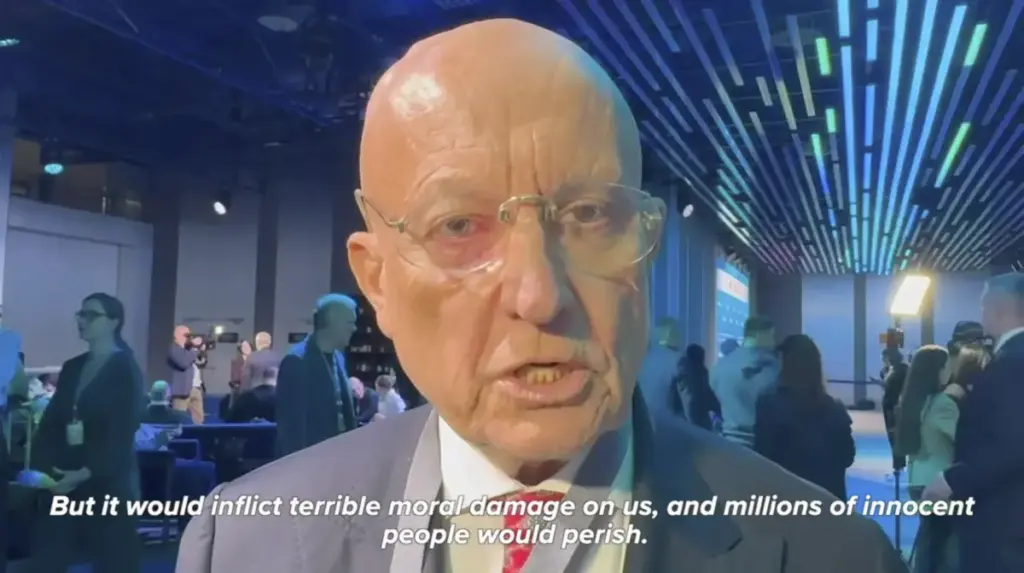
As geopolitical fault lines deepen across Eastern Europe, Vladimir Putin’s inner circle has once again raised the specter of a catastrophic atomic conflict. In a chilling and calculated interview, Sergei Karaganov—a prominent Russian foreign policy architect widely dubbed "Professor Doomsday"—warned that millions of innocent lives across Europe face total obliteration if Western nations cross Moscow’s declared red lines.
Karaganov, 74, who serves as the Honorary Chairman of the Presidium of Russia’s Council on Foreign and Defence Policy, asserted that the Kremlin would be left with no choice but to launch a nuclear strike if NATO deploys military personnel directly into Ukraine or if direct threats are posed to the heavily militarized Russian exclave of Kaliningrad.
While smiling during portions of the exchange, Karaganov maintained a starkly uncompromising stance, echoing rhetoric that has increasingly migrated from the fringes of Russian nationalist commentary into mainstream official discourse. The remarks arrive amid an escalating spiral of mutual deterrence, mounting economic militarization within Russia, and stern rebukes from Western military alliances. NATO has formally condemned the latest wave of what it terms "irresponsible nuclear rhetoric," emphasizing its defensive posture and dismissing Moscow’s grievances as entirely ungrounded.

Detailed Chronology of Escalation
The latest verbal escalation does not occur in a vacuum; it is the culmination of months of deteriorating diplomatic channels and incremental military posturing between the Russian Federation and Western powers.
The Warning from Moscow
In his recent statements, Karaganov outlined the precise triggers that would force the Kremlin’s hand. According to the senior advisor, the deployment of any NATO or Western European boots on Ukrainian sovereign soil, or any tangible military aggression directed at the Baltic Sea exclave of Kaliningrad, would serve as the catalyst for nuclear deployment.
"I hope it does not come to that, but Russia would be forced to launch a nuclear strike if NATO countries deployed troops to Ukrainian territory or if there were a direct threat to Russian territory," Karaganov stated. With an unsettling composure, he added, "It is absolutely clear that such a war would be nuclear. I do not want that, and I am actively working to prevent such a scenario."
When pressed by the interviewer regarding his previously published proposals advocating for a "preemptive nuclear strike" to cow the West, Karaganov did not back down, coolly replying, "It’s not too late." He further expressed satisfaction that top Russian officials, including President Vladimir Putin and Foreign Minister Sergei Lavrov, have begun emphasizing that any prospective war with the West would be exceptionally brief.

NATO’s Firm Rebuttal
The response from the North Atlantic Treaty Organization was swift and unequivocal. Recognizing the gravity of the implied threats, a NATO spokesperson issued a stern declaration denouncing the use of force and nuclear posturing.
"We strongly denounce the threat of force, including any irresponsible nuclear rhetoric," the alliance stated. "We have sent a response, noting that NATO is a defensive Alliance and none of our activities or exercises pose a risk to any part of Russia."
Despite these diplomatic assurances, Moscow continues to view NATO’s routine exercises, maritime patrols, and defensive enhancements along its eastern flank as existential security hazards. The friction surrounding Kaliningrad—sandwiched between Poland and Lithuania—remains a particularly volatile flashpoint, as its strategic importance to Russia’s Baltic Fleet makes it a central focus of regional defense planning.
Supporting Context & Metrics
The inflammatory remarks by Kremlin ideologues are mirrored by concrete structural shifts within the Russian state apparatus, signaling a long-term economic and societal pivot toward total militarization.

Record Military Spending
Just hours before Karaganov’s interview made headlines, reports confirmed that Moscow is drastically increasing its defense budget. Russia is set to boost its military spending by a staggering 27% next year, pushing national defense expenditure to a record-breaking £150 billion.
This monumental financial injection underscores the Kremlin’s commitment to sustaining its protracted military campaigns and rebuilding its conventional and strategic arsenals despite severe international sanctions. Financial analysts note that this level of expenditure redirects vital state funds away from domestic infrastructure, healthcare, and education, cementing a war-economy framework designed to outlast Western support for Kyiv.
The Anatomy of ‘Professor Doomsday’
Sergei Karaganov is no marginal internet commentator. As a long-standing advisor to top Russian leadership and a foundational figure in formulating post-Soviet foreign policy doctrine, his pronouncements are widely viewed by intelligence analysts as trial balloons for official Kremlin policy. By floating extreme tactical and strategic concepts—such as limited nuclear exchanges designed to "sober up" the West—Karaganov has earned his ominous moniker. His public assertions that a nuclear war in Europe could be "easily won" by Moscow, despite the accompanying "terrible moral damage" and the loss of millions of innocent lives, reflect a calculated campaign of psychological intimidation aimed at fracturing Western political resolve.
Official Statements and International Fallout
The international community’s reaction to Moscow’s recurrent nuclear sabre-rattling highlights a deepening global divide. While Western capitals emphasize deterrence, diplomatic unity, and adherence to international law, Russian state-aligned voices continue to frame the conflict as an existential struggle against a hostile coalition.

- NATO Position: The alliance maintains that its posture is strictly defensive. Officials have repeatedly stressed that European security architecture is designed to protect member states, not to threaten Russian territorial integrity. Western leaders argue that the true threat to European stability stems entirely from the Kremlin’s unprovoked invasion of Ukraine and its subsequent nuclear threats.
- The Kremlin’s Narrative: Moscow counters that the eastward expansion of NATO and the increasing flow of advanced weaponry, intelligence, and potential military personnel to Ukraine represent an intolerable security deficit. Russian officials maintain that their nuclear doctrine is purely retaliatory in design, though critics argue that definitions of "threats to territorial integrity" have been intentionally broadened to include contested regions and strategic exclaves like Kaliningrad.
Future Outlook: Navigating the Nuclear Precipice
As the conflict in Eastern Europe grinds through its protracted phases, the risk of miscalculation remains an ever-present danger. The convergence of record-high military spending, stalled diplomatic channels, and uninhibited nuclear rhetoric from figures like Sergei Karaganov creates an exceptionally volatile security environment.
Military strategists and arms control experts warn that the erosion of traditional nuclear taboos increases the likelihood of dangerous escalations. When senior geopolitical advisors speak casually of millions perishing and frame nuclear exchanges as winnable, the psychological threshold for actual deployment is dangerously lowered.
For European and North American policymakers, the immediate challenge lies in maintaining robust deterrence—supporting Ukraine’s defense capabilities—while simultaneously avoiding actions that could trigger a catastrophic, uncontrolled spiral into atomic warfare. As NATO reinforces its eastern borders and Russia pours unprecedented financial resources into its war machine, the margin for error has evaporated, leaving global security hanging in a precarious balance.