Executive Overview
When audiences hear the word "Frankenstein," images of industrial decay, stark monochrome laboratories, and grotesque physical constructions immediately come to mind. Yet, in Yorgos Lanthimos’s cinematic triumph Poor Things—adapted from Alasdair Gray’s seminal 1992 postmodern novel—the timeless Gothic horror trope is radically subverted. Rather than wallowing in Victorian squalor and darkness, the film bursts forth in a candy-colored, hyper-imaginative pastiche of the late 19th century. At the absolute center of this visual revolution is the costume design of Holly Waddington, whose work transforms Emma Stone’s protagonist, Bella Baxter, into a living canvas of unbridled female autonomy, psychological evolution, and sartorial rebellion.
Waddington’s task was as monumental as the narrative itself: to chart the trajectory of a woman brought back to life via an unorthodox brain-transplantation experiment, moving from an infantile state of raw impulse to an enlightened, self-actualized woman liberated from patriarchal constraints. Eschewing strict historical accuracy for emotional and visceral resonance, Waddington crafted silhouettes that feel simultaneously archaic and startlingly modern. The resulting wardrobe is not merely decorative; it is a critical narrative engine that externalizes Bella’s internal awakening, her encounters with class disparity, and her eventual defiance of 19th-century societal norms.
This in-depth feature explores the intricate mechanics of Poor Things’ costume design, examining how Waddington manipulated 19th-century silhouettes, textures, and color palettes to mirror Bella’s psychological journey. From the stark, restrained tailoring of Willem Dafoe’s Godwin Baxter to the chaotic, street-style-inspired ensembles of Bella’s continental travels, and finally to the grounded simplicity of her self-actualization, we dissect the sartorial blueprint of one of the most visually arresting films of the decade.
Detailed Chronology: The Sartorial Evolution of Bella Baxter
The wardrobe of Bella Baxter cannot be understood as a static collection of period-accurate garments; instead, it operates as a dynamic, evolving psychological diary. As Bella’s mind expands through exploration, trauma, and education, her clothing shifts in tandem, charting her passage from a captive experiment to an autonomous intellectual.
1. The Genesis of Innocence: Voluminous Beginnings
We are introduced to Bella Baxter in a state of arrested development. Following a tragic suicide attempt and subsequent resuscitation by the unorthodox surgeon Godwin Baxter (Willem Dafoe)—whom she affectionately calls "God"—Bella possesses the physical form of an adult woman coupled with the brain of an infant.
To visually articulate this jarring dichotomy, Waddington bypassed traditional historical accuracy. "Lanthimos did not want me to stay strictly historically faithful with the costumes," Waddington explains. She began her extensive research by analyzing the distinct silhouettes of the 1890s—notably the era’s fascination with exaggerated, oversized sleeves—before forcefully bending those historical templates to fit the fantastical, dreamlike logic of the film’s universe.
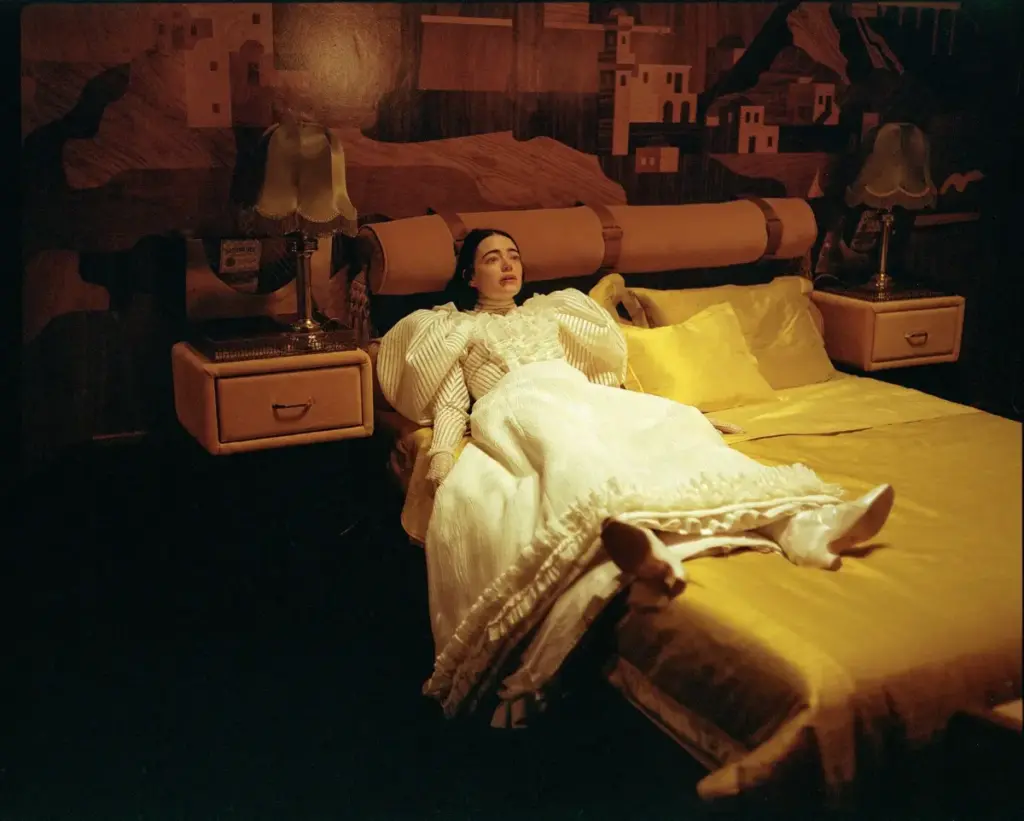
Bella’s early ensembles consist of dramatic, voluminous tops paired with childlike bloomer-style trousers. These pieces are loose, unrestrictive, and inherently impulsive. They reflect a mind entirely untethered from the rigid behavioral expectations of Victorian society. Because Bella has spent years sequestered from the outside world and subjected to experimental conditioning, her early looks convey a sense of effortless, uncalculated chaos.
2. The Explosion of Modernity: Continental Travel and Street-Style Sensibility
As Bella breaks free from the only home she has ever known, embarking on a transformative odyssey across Europe alongside the hedonistic lawyer Duncan Wedderburn (Mark Ruffalo), her wardrobe explodes into an eclectic riot of vivid hues and exaggerated proportions.
In these middle acts of the film, Waddington’s designs actively challenge period conventions, frequently crossing the boundary into contemporary high fashion. Several ensembles look as though they have been lifted directly from the digital lookbooks of modern fashion bloggers during London Fashion Week.
- The Rüched Ensemble: In one striking sequence, Bella is outfitted in a crisp white ruffled top paired with sunflower-yellow shorts, accented by miniature black sunglasses, a cropped cobalt blue jacket, and sleek leather ankle boots.
- The Transparent Pink Dynamic: Another memorable look pairs a similar white ruffled bodice with a flowing, translucent magenta skirt that catches the light with every erratic, uninhibited movement.
These outfits are physical manifestations of Bella’s insatiable curiosity and boundless imagination. Crucially, as Bella navigates new territories and is exposed to the harsh realities of the world—such as her first staggering encounter with systemic poverty—her clothes begin to register her shifting social consciousness. Confronted with the stark disparity between her insulated upbringing and the suffering of the lower classes, her awareness of her own upper-class status crystallizes, ironically mirrored in the stark, structured elegance of a Victorian dress featuring immaculate white puff sleeves.
3. The Iron Cage: Confronting Patriarchal Confinement
Later in the narrative, the film confronts the dark reality of Bella’s past life before the experiment—an existence suffocated by the rigid, patriarchal conventions of the era. To visually represent the psychological claustrophobia and entrapment Bella feels in these flashbacks, Waddington pivoted away from the playful irreverence of her travel wardrobe.
Drawing deep inspiration from 19th-century photography, Waddington enveloped Emma Stone in severe, imposing silhouettes. These included a striking, deeply saturated blue gown paired with a traditional, heavy winter coat, as well as a mesmerizing, armor-like copper dress accented with intricate golden filigree.
"I wanted a sharp visual contrast to the looks she wears post-experiment," Waddington notes. These garments are engineered to be imposing, undeniably beautiful, intensely serious, and heavy with symbolic weight. They act as literal and figurative armor, boxing Bella into the narrow societal roles prescribed to women of wealth and status during the late Victorian epoch.
4. Ultimate Self-Actualization: Shedding the Costume
Despite the labyrinthine twists, surrealist world-building, and psychological vertigo that define Poor Things, the film grounds its climax in profound emotional clarity. When Bella finally breaks away from the lingering expectations, demands, and manipulations of the men in her life—fully stepping into her identity as an independent thinker, medical student, and free spirit—her wardrobe undergoes its final, most radical transformation.
In the closing sequences, all theatricality, historical pastiche, and structural artifice are stripped away. Bella wears a simple, understated cremefcolored knit pullover paired with a rugged, copper-toned maxi skirt.
"At that specific juncture in the narrative, those are simply clothes," Waddington reflects on the final look. "I deliberately wanted her outfit to convey that she has finally found herself—as though she now possesses absolute, unwavering clarity about who she is and what she stands for."
Supporting Context & Metrics: The Production Design Ecosystem
To fully appreciate Holly Waddington’s achievement in Poor Things, one must contextualize the film’s broader aesthetic ecosystem. Directed by Yorgos Lanthimos—known for his meticulously controlled, highly stylized cinematic universes (The Favourite, The Lobster, The Killing of a Sacred Deer)—Poor Things required a production design and costume department capable of matching his singular vision.
- The Collaborative Process: Waddington worked in close tandem with production designers James Price and Shona Heath to ensure that Bella’s wardrobe harmonized with the film’s fantastical, hand-crafted soundstage environments—from the sterile, surgical chambers of London to the expressionist, pastel-drenched alleyways of Alexandria and Paris.
- Textural Philosophy: Eschewing synthetic shortcuts, Waddington emphasized tactile, organic textiles. Velvets, heavy silks, raw cottons, and custom-molded plastics were manipulated to look "wild, chaotic, and organic," mirroring the biological and psychological rebirth at the heart of Gray’s source material.
- The Male Counterpoint: While Bella’s wardrobe undergoes a radical evolution, the male characters in her orbit—most notably Willem Dafoe’s Dr. Godwin Baxter and Mark Ruffalo’s Duncan Wedderburn—wear garments that ground the film in a more recognizable, albeit slightly warped, late-19th-century reality. Godwin Baxter’s sober, neutral-toned tailoring and scarred aesthetic act as a static anchor, emphasizing Bella’s dynamic, volatile trajectory.
Official Statements & Design Insights
The creative philosophy driving Poor Things was defined by a deliberate rejection of historical pedantry in favor of emotional authenticity. In interviews regarding her design process, Holly Waddington elaborated on the specific challenges of costuming Emma Stone through her multi-staged transformation:
“[Lanthimos] explicitly did not want me to remain historically zeitgetreu with the costumes. I began my research by examining the core silhouettes of the 1890s—such as the massive sleeve trends—before adapting those foundations to fit the whimsical, surreal narrative of the film. I utilized traditional Victorian structural frameworks, but aggressively sought out methods to reinterpret those textures. For me, every stitch needed to feel wild, chaotic, and organic.”
Reflecting on the iconic wedding sequence—where Bella walks down the aisle in a voluminous white gown while wearing a traditional bridal veil pulled tightly across the lower half of her face—Waddington revealed the collaborative nature of the fittings:
“I debated for days whether Bella should wear a veil at all, precisely because it is such a hyper-traditional, conventional garment. Ultimately, I decided to wrap the veil directly around Stone’s face and mouth. That unconventional placement ended up becoming Emma’s absolute favorite look in the entire production.”
On the transition from the chaotic, highly decorative garments of Bella’s mid-film journey to the stripped-back minimalism of the finale, Waddington noted:
“She has spent years cut off from the real world and subjected to intense psychological conditioning. That gives her an inherent, untamed impulsivity. I loved the idea of dressing her in looks that appeared effortless, right up until the moment she steps into her true power. By the end, the clothes stop playing a character; they are just clothes, signifying that she has finally arrived at her true self.”
Future Outlook: The Enduring Legacy of Poor Things on Cinematic Fashion
As Poor Things completes its theatrical run and cements its status as a defining cultural touchstone of the 2020s, the ripple effects of Holly Waddington’s costume design are already being felt across the broader intersection of film and high fashion.
By proving that historical source material can be aggressively re-imagined through a contemporary, feminist lens without losing its narrative punch, Waddington has set a new benchmark for period filmmaking. The fusion of 19th-century structural silhouettes with modern streetwear sensibilities has opened creative doors for upcoming costume designers, encouraging them to prioritize psychological storytelling over rigid historical reenactment.
Furthermore, Bella Baxter’s sartorial journey—from the clumsy, oversized bloomers of her infancy to the unadorned knitwear of her self-actualization—has resonated deeply with audiences navigating modern questions of identity, bodily autonomy, and liberation. Poor Things demonstrates that fashion in cinema is never merely about looking good on screen; in the hands of masters like Lanthimos and Waddington, clothing is armor, weapon, diary, and liberation manifesto all at once.