Executive Overview
Automotive history is paved with moments of engineering ambition, but few have achieved the cultural permanence of Top Gear’s legendary 2003 mission to destroy a Toyota Hilux. For decades, the phrase "indestructible" has been inextricably linked to the Japanese marque’s rugged pickup truck, largely thanks to Jeremy Clarkson, James May, and Richard Hammond subjecting the vehicle to an unrelenting gauntlet of structural and environmental torture. From salt-water immersion and sledgehammer beatdowns to being caught in the catastrophic demolition of a 23-storey residential tower block, the original diesel Hilux refused to die.
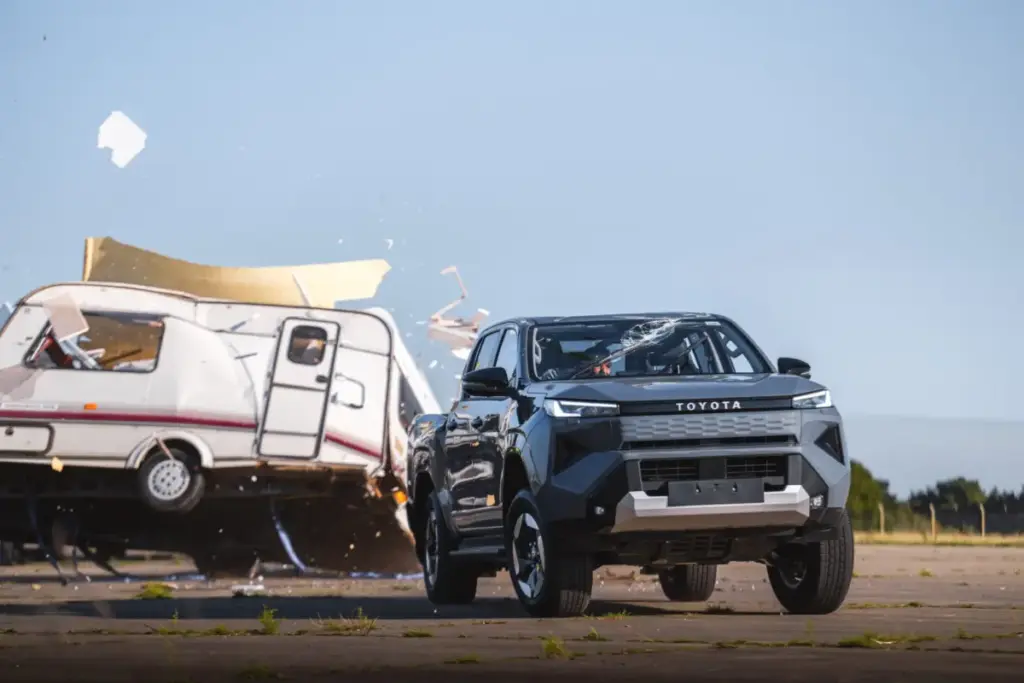
Now, more than twenty years later, Toyota is revisiting its most celebrated piece of folklore. To mark the introduction of the ninth-generation model—which features an all-new electric powertrain alongside traditional diesel options—the manufacturer has recreated the ultimate test from that famous broadcast: dropping a three-quarter-tonne caravan directly onto the cab from a crane.
The stunt, executed following a public vote hosted across various UK Reddit communities, took place at the historic Bentwaters Airfield in Suffolk. Emerging from a cloud of splintered wood, crushed aluminum, and shattered glass with little more than superficial bodywork scars, the modern electric Hilux powered up instantly and drove away silently. This high-stakes demonstration bridges the nostalgic heritage of classic automotive television with the cutting-edge demands of zero-emission mobility, proving that electrification has done nothing to dilute the pickup’s ironclad DNA.
Detailed Chronology: From Telemetry to Tent Shrapnel at Bentwaters Airfield
The genesis of this modern-day automotive resurrection began in the digital town square. Rather than deciding behind closed doors how to torture-test their latest flagship vehicle, Toyota’s marketing and engineering teams turned to Reddit. British subreddits were given a stark choice regarding the fate of the ninth-generation Hilux: face repeated blows from a heavy, one-tonne industrial wrecking ball, or undergo a recreation of the infamous 2003 caravan drop.

By an overwhelming margin, the internet voted for the caravan. The public’s appetite for nostalgia—and sheer vehicular sadism—demanded the heavier, more chaotic spectacle.
Preparations shifted to the sprawling tarmac of Bentwaters Airfield in Suffolk, a former Royal Air Force and United States Air Force station rich in aviation history. The stage was set under strict safety protocols, ensuring that both the crew and the structural integrity of the test environment were managed with professional precision.
[Phase 1: Public Consensus]
   └── UK Reddit Communities vote for the iconic Caravan Drop via a landslide.

[Phase 2: Rigging & Elevation]
   └── A traditional caravan, weighing over 750kg, is hoisted 30 feet into the air via heavy-duty crane at Bentwaters Airfield, Suffolk.

[Phase 3: The Drop]
   └── The crane's release mechanism is triggered, sending the caravan plummeting directly onto the cab of the ninth-generation electric Hilux.

[Phase 4: The Inspection & Driveaway]
   └── Engineers clear the debris field; the truck sustains cosmetic cab damage but powers on immediately, driving away under its own silent electric power.
At the center of the airfield sat the pristine, ninth-generation electric Hilux. Above it, suspended from the jaws of a heavy industrial crane, hung a standard touring caravan weighing more than three-quarters of a tonne (750kg). Elevated to a height of 30 feet, the caravan was positioned directly over the driver’s side of the cab.
When the release mechanism was triggered, gravity took hold. The caravan accelerated downward, striking the roof of the Hilux with catastrophic force. The kinetic energy of the falling trailer instantly obliterated its own frame, sending a shockwave of splintered cabinetry, fiberglass siding, and shattered windows cascading across the tarmac in a dense cloud of white dust and debris.

As the smoke cleared, an expectant hush fell over the engineering team. Standard passenger vehicles subjected to such vertical trauma would typically experience severe chassis buckling, crushed A-pillars, and catastrophic cabin intrusion. Yet, as the ground crew approached the wreckage, the structural reality of the Hilux became immediately apparent.
While the roof panel bore the unmistakable, concave imprint of the caravan’s chassis and the windshield was reduced to a web of safety glass, the underlying cab structure held firm. More importantly, when the ignition sequence was engaged, the electric powertrain hummed to life without hesitation. The truck rolled forward off the testing pad under its own power, offering a silent, zero-emission testament to its enduring heritage.
Supporting Context & Metrics: Engineering the Next Generation of Tough
While the caravan drop served as an explosive public spectacle, it represents only the visible tip of an exhaustive development and validation program. Transforming the world’s toughest pickup into an electrified vehicle without compromising its legendary utility required a radical reimagining of chassis engineering, battery architecture, and thermal management.
During the ninth-generation Hilux’s gestation period, engineers subjected pre-production prototypes to environments far more hostile than a Suffolk airfield. The testing regime included:

- Deep-Water Fording: Submerging vehicle frames and battery packs in chemically treated water basins to test high-voltage insulation integrity.
- Torsion-Twist Trials: Navigating brutal, boulder-strewn off-road courses designed to stress-test frame rigidity under maximum payload conditions.
- Thermal Extremes: Operating in sub-zero Scandinavian ice fields and blistering desert dunes to ensure thermal throttling does not impede performance.
Despite the integration of heavy battery-electric components, the ninth-generation Hilux refuses to compromise on traditional utility metrics.
| Metric Category | Specification Performance |
|---|---|
| Maximum Payload Capacity | Up to 1,065 kg (depending on powertrain configuration) |
| Maximum Towing Capacity | Up to 3.5 tonnes (braked trailer) |
| Powertrain Options | Battery-Electric (BEV) and Advanced Diesel 48V Mild-Hybrid |
| Cabin Architecture | Double-cab layout featuring fully digital instrumentation and advanced multimedia suite |
These specifications highlight a crucial evolution in the utility market. Historically, buyers transitioning to electric or hybrid commercial vehicles feared a reduction in load-lugging capability. Toyota’s engineering data proves otherwise, showing that the integration of electrification enhances low-end torque delivery—ideal for low-speed off-road crawling and heavy trailer launching—while preserving the traditional payload thresholds demanded by trade professionals, construction firms, and agricultural operators.
Official Statements and Industry Perspective
The deliberate nod to the past is more than just a clever marketing gimmick; it is a calculated statement of intent from Toyota’s executive leadership regarding the reliability of their new technological frontier.
Chris Hayes, Director of the Products & Services Division at Toyota, emphasized the cultural and engineering significance of the stunt during the post-test debrief.

"Hilux has earned its reputation as the world’s toughest pick-up," Hayes stated. "Following on from our launch of the ninth-generation model earlier this year, we wanted to honour that legacy and demonstrate how Hilux is still as impressive as it was decades ago, even when it’s powered by electricity."
Reflecting on the dramatic centerpiece of the campaign, Hayes added:
"Dropping a caravan on it wasn’t just about repeating the famous TV stunt; it was our way of showing how Hilux’s core toughness remains intact. The automotive landscape is shifting toward electrification, but our customers’ need for unyielding durability remains absolute."
Automotive analysts have noted that the campaign successfully bridges a vital demographic divide. Older generations of motorists who fondly remember Clarkson, May, and Hammond laughing over the indestructible diesel Hilux are instantly engaged by the visual parallel. Simultaneously, younger digital natives discovering the stunt through YouTube and Reddit are introduced to the brand’s core resilience through modern, highly shareable media formats.

Future Outlook: The Road Ahead for the Electric Workhorse
With the Bentwaters airfield stunt successfully concluded, the electric Hilux’s journey has only just begun. Toyota has officially handed the keys of the newly battered, yet entirely functional, prototype over to the Top Gear YouTube channel team. This handoff signals that the vehicle’s trials are far from over; digital audiences can anticipate even more severe, unconventional durability tests as independent automotive presenters look to push the ninth-generation platform to absolute breaking point.
Beyond the viral marketing stunts, the commercial rollout of the ninth-generation Hilux arrives at a critical juncture for the global commercial vehicle market. As governments across Europe and the UK tighten urban emission regulations and introduce zero-emission zones (ZEZs), tradespeople and utility fleets face mounting pressure to transition away from traditional internal combustion engines.
By proving that an electric pickup can endure a three-quarter-tonne overhead impact and immediately drive away, Toyota is directly addressing the primary psychological barrier holding back EV adoption in the commercial sector: anxiety over structural fragility and reliability in harsh work environments.
The message from Suffolk is clear: the powertrain may have evolved from fossil fuels to electrons, but the indestructible spirit of the Hilux remains entirely uncompromised. As the truck embarks on its commercial life across global markets, it carries with it not just the weight of a legendary reputation, but the promise that true toughness is timeless.