Executive Overview
For decades, addressing deep wrinkles, dynamic expression lines, and structural volume loss was a venture strictly reserved for the dermatologist’s office. Patients seeking to restore a youthful contour to the face faced a binary choice: invasive surgical facelifts or minimally invasive clinical interventions utilizing hypodermic needles, syringes, and clinical-grade dermal fillers. While these modalities remain the gold standard for structural facial volume restoration, they are not without drawbacks. Bruising, localized swelling, vascular complications, significant financial costs, and the inevitable discomfort of clinical procedures have historically deterred a segment of the skincare demographic.
Enter the modern era of topical wrinkle fillers—advanced cosmetic formulations engineered to bridge the gap between daily skincare and clinical procedures. According to board-certified dermatologists and Mohs surgeons, these serums, gels, and targeted creams do not replicate the mechanical action of injectable hyaluronic acid or calcium hydroxylapatite. Instead of physically lifting tissue from beneath the dermal layer, topical solutions utilize sophisticated networks of humectants, bioavailable peptides, silicones, and advanced delivery systems to deeply hydrate the stratum corneum, optically blur surface imperfections, and stimulate long-term collagen synthesis.
This comprehensive market and clinical review examines the top-rated topical wrinkle fillers vetted by dermatological experts and rigorously tested by industry panels. By dissecting their active ingredient profiles, immediate versus cumulative mechanisms of action, and targeted applications, this report provides an authoritative guide for consumers navigating the crowded landscape of non-invasive anti-aging skincare.
Detailed Chronology: The Shift From Clinical Needles to Topical Innovation
The trajectory of anti-aging skincare has undergone a profound paradigm shift over the last twenty years, driven by advancements in molecular biology, chemical synthesis, and consumer demand for efficacious, needle-free alternatives.
Phase One: The Era of Basic Hydration (Late 1990s–Early 2010s)
In the early days of commercial anti-aging products, over-the-counter moisturizers relied primarily on occlusal agents like petrolatum and basic humectants like glycerin to trap surface moisture. While these formulations improved skin softness, their impact on fine lines was ephemeral and strictly superficial. Consumers seeking genuine remediation for etched nasolabial folds or crow’s feet found little recourse outside of clinical practices offering early-generation collagen injections and nascent botulinum toxin treatments.
Phase Two: The Bio-Active Revolution (2010s–2020)
The introduction of low-molecular-weight hyaluronic acid, stabilized retinoids, and foundational peptide complexes marked a turning point in cosmetic chemistry. Formulators began recognizing that topical agents could influence cellular signaling. Products marketed as "plumping serums" emerged, leveraging moisture-binding polymers to create temporary surface tension that visually minimized dehydration lines. However, these formulations frequently suffered from poor skin penetration, limiting their efficacy to the outermost layers of the epidermis.

Phase Three: Advanced Delivery Systems and Targeted Treatments (2020–Present)
The contemporary landscape is defined by precision engineering. Modern topical fillers utilize encapsulated actives, multi-weight hyaluronic acid complexes, and collagen amino acids capable of penetrating deeper epidermal layers. Recent clinical breakthroughs—such as the 2026 debut of bio-rejuvenating serums featuring bioavailable peptides and glutathione—represent a convergence of clinical science and cosmetic elegance. Today’s topical fillers are no longer simple occlusive barriers; they are active biological modulators designed to work synergistically with or as sophisticated maintenance tools for in-office procedures.
Supporting Context & Metrics: How Topical Fillers Function
To understand the efficacy of over-the-counter wrinkle fillers, one must first deconstruct the biological mechanics of skin aging. As human skin matures, intrinsic factors—such as chronological cellular senescence and declining hormone levels—interact with extrinsic factors, notably ultraviolet radiation and oxidative stress. This results in the degradation of the extracellular matrix, characterized by the fragmentation of collagen fibers, loss of elastin resilience, and depletion of endogenous hyaluronic acid.
[Extrinsic & Intrinsic Aging Factors]
       │
       ▼
[Degradation of Extracellular Matrix (Collagen/Elastin Breakdown)]
       │
       ▼
[Loss of Dermal Density & Transepidermal Water Loss]
       │
       ▼
[Clinical Intervention Needed]
  ├── Clinical Route: Injectable Dermal Fillers (Structural Volume)
  └── Topical Route: Advanced Serums & Creams (Hydration, Blurring, & Peptide Signaling)
The Mechanism of Immediate Plumping vs. Long-Term Remodeling
Dermatologists emphasize a clear distinction between immediate cosmetic smoothing and long-term dermal restructuring:
- Immediate Surface Effects (Minutes to Hours): Driven by high-molecular-weight humectants (sodium hyaluronate, glycerin) and optical blurring agents (silicones, silica). These ingredients bind ambient moisture to the epidermis, instantly swelling micro-crevices and scattering light to reduce the visual depth of fine lines.
- Cumulative Structural Benefits (Weeks to Months): Driven by signaling peptides, collagen amino acids, retinoid alternatives (such as bakuchiol), and antioxidants. These compounds stimulate fibroblasts to synthesize new collagen and elastin fibrils, gradually improving skin density and structural integrity over a 10-to-12-week window.
Official Statements & Dermatological Evaluations
Leading dermatological experts have provided rigorous clinical assessments regarding the viability, expectations, and safety profiles of topical wrinkle fillers.
"Topical wrinkle fillers are skin care products designed to temporarily plump and smooth the appearance of fine lines and wrinkles. They are very different from injectable dermal fillers. Instead of adding volume beneath the skin, these topical creams and serums hydrate the surface of the skin to create a fuller, more supple appearance."
— Dr. Whitney Hovenic, MD, Board-Certified Dermatologist, Mohs Surgeon, and Cofounder of Spooge.
Dr. Hovenic notes that these formulations are exceptionally well-suited for individuals noticing early signs of aging or those wishing to soften superficial dehydration lines around the periorbital (eyes), perioral (mouth), and forehead regions. Furthermore, their textural smoothing properties make them ideal priming bases for foundation and makeup application.
.png)
Supporting this perspective, Dr. Alexandra Haskin, MD, a board-certified dermatologist based in New York City, highlights the importance of multi-action ingredient decks:
"The most effective topical wrinkle fillers contain ingredients that stimulate immediate plumping while also promoting long-term collagen production. Silicone and silica-containing ingredients are also exceptional for improving surface texture and reducing the appearance of crepey skin."
Addressing consumer skepticism regarding product efficacy, Dr. Daniel Belkin, MD, a board-certified dermatologist and dermatologic surgeon, offers a nuanced technical breakdown:
"With anything in skincare, you have to be so careful of marketing terms. If you hydrate the epidermis really well, you will get a plumping effect. If you moisturize the skin with a really good humectant to prevent transepidermal water loss on top of it, the result is a reduction in the look of wrinkles and plumper-looking skin."
Product Spotlight: Dermatologist-Recommended Top-Tier Formulations
A rigorous evaluation of clinical testing panels, expert commentary, and user metrics reveals the definitive topical wrinkle fillers categorized by skin concern and specific anatomical zones.
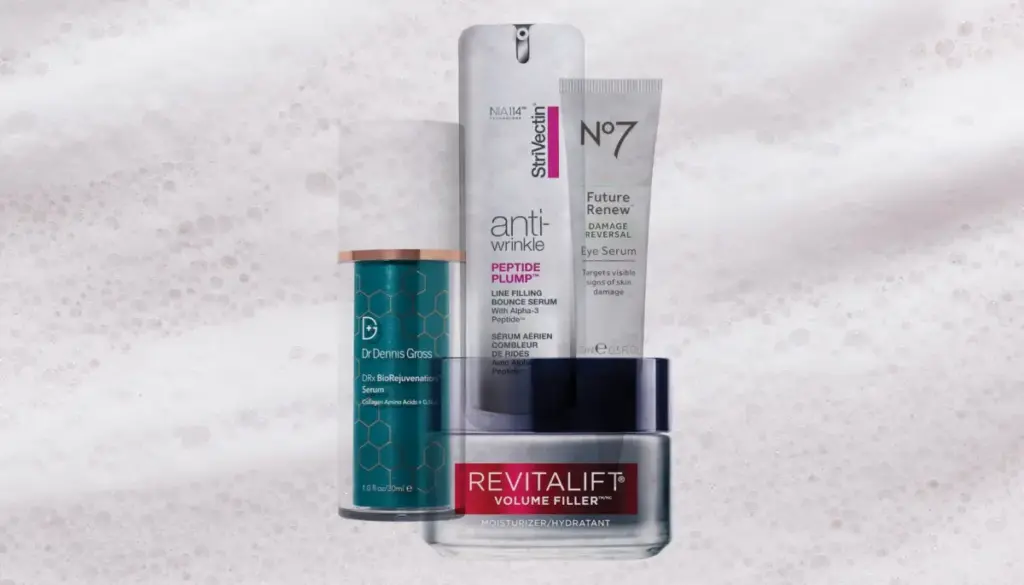
1. Best Overall: Dr. Dennis Gross DRx BioRejuvenation Serum
- Primary Actives: Collagen amino acids, glutathione, niacinamide, and adenosine.
- Mechanism: Diverging from traditional temporary plumpers, this advanced formula utilizes absorbable collagen amino acids to supply the epidermis with the fundamental building blocks necessary for endogenous collagen synthesis. The inclusion of bioavailable antioxidants and skin-restorative vitamins supports repair processes across areas prone to structural sagging, including nasolabial folds, jowls, and the jawline.
- Clinical Feedback: Testers noted a luxurious, milky lotion texture that imparts an immediate glassy luminosity while delivering clinically observable tightening over a standard 10-week protocol.
2. Best for Deep Wrinkles: StriVectin Anti-Wrinkle Peptide Plump Line Filling Bounce Serum
- Primary Actives: Proprietary peptide complex, multi-action humectants, silicone/silica derivatives.
- Mechanism: Engineered explicitly for stubborn, deeply etched lines, this serum pairs instant structural blurring agents with long-chain peptides. The formulation targets both immediate surface bounce and cumulative dermal density.
- Clinical Feedback: Dermatologists praise its dual-action approach, noting significant improvement in forehead lines and textural resilience after consistent daily application.
3. Best for Instant Results: L’Oréal Revitalift Volume Filler Daily Volumizing Moisturizer
- Primary Actives: Sodium hyaluronate, glycerin, dimethicone.
- Mechanism: Capitalizes on high concentrations of water-attracting humectants combined with smoothing silicones to instantly swell dehydrated surface cells, diffusing the appearance of fine lines within minutes.
- Clinical Feedback: Testers reported an immediate, bouncy, dewy finish that acts as an exceptional baseline beneath liquid foundations without feeling excessively heavy or occlusive.
4. Best for Eyes: No.7 Future Renew Damage Reversal Eye Serum
- Primary Actives: Exclusive peptide blend, hyaluronic acid, glycerin, shea butter, niacinamide.
- Mechanism: Specifically formulated for the delicate periorbital tissue, which is notoriously thin and prone to moisture depletion. The peptide complex encourages cellular repair and collagen generation, while niacinamide addresses concomitant concerns regarding micro-pigmentation and texture.
- Clinical Feedback: Highly recommended by dermatologists as a budget-friendly adjunct to clinical eye-rejuvenation regimens, prized for its lightweight, non-migrating texture.
5. Best for Lips: Alastin HA Immerse Serum
- Primary Actives: Multiple molecular weights of hyaluronic acid.
- Mechanism: Designed to penetrate deep into mucosal and perioral skin structures, dramatically elevating moisture retention capacity. Because the lips lack sebaceous glands, they are exceptionally vulnerable to transepidermal water loss; this serum binds water to soften vertical lip lines.
- Clinical Feedback: Highly favored by dermatologists for nighttime application on the lips and entire face, as well as for soothing post-procedural skin following ablative laser resurfacing.
6. Best for Sensitive Skin: Andalou Naturals Deep Wrinkle Dermal Filler
- Primary Actives: Bakuchiol, aloe vera, allantoin, sodium hyaluronate.
- Mechanism: Employs bakuchiol—a well-tolerated botanical alternative to traditional retinoids—to stimulate anti-aging cellular turnover without the scaling, stinging, or erythema frequently associated with retinol use in sensitive cohorts.
- Clinical Feedback: Dermatologists recommend this formulation for patients seeking retinol-like regenerative benefits, though they advise a preliminary patch test due to the presence of fragrance.
Frequently Asked Questions (FAQ)
Do topical wrinkle fillers actually replace clinical injections?
No. While topical fillers provide temporary surface-level plumping and cumulative textural improvements through hydration and peptide signaling, they cannot replicate the structural volume restoration or muscular relaxation achieved by clinical injectables like neurotoxins (Botox) and dermal fillers (Juvéderm, Restylane). Dermatologists view them as complementary maintenance tools rather than clinical replacements.
.png)
How long do the results of a topical wrinkle filler last?
Immediate surface-smoothing and plumping effects driven by humectants and silicones typically last between six to eight hours. Conversely, cumulative anti-aging benefits derived from peptides, growth factors, and retinoid alternatives require consistent daily application over 10 to 12 weeks to become visually apparent and will regress if product usage is discontinued.
Can topical wrinkle fillers be safely combined with Botox?
Yes. Dermatologists strongly endorse combining topical wrinkle fillers with neurotoxins. While Botox targets underlying facial musculature to inhibit dynamic folding, topical fillers refine and smooth superficial epidermal texture, creating a comprehensive anti-aging strategy.
Future Outlook
The future of topical skincare is poised at the intersection of biotechnology and personalized dermatology. As encapsulation technologies and transdermal delivery mechanisms continue to evolve, the molecular weight barrier that has historically limited topical efficacy is steadily dissolving. Future iterations of wrinkle fillers will likely feature bio-engineered growth factors, hyper-targeted peptide sequences, and microbiome-supportive complexes capable of delivering clinical-grade results directly from a consumer cosmetic bottle.
For the discerning consumer, the modern market offers unprecedented agency: sophisticated, needle-free formulations that not only provide instant gratification through optical blurring and deep hydration but also foster long-term dermal health.