Self-styled "patriot patrols" operating under the banner of far-right agitators have sparked widespread concern across communities in the United Kingdom following a series of aggressive, vigilante-style confrontations. In a particularly glaring incident captured on video in Thornton village green, Lancashire, members of a group aligned with the so-called "Patriot Patrols"—frequently linked to activist Daniel Thomas, better known as Danny Tommo—approached a Black man who was sitting quietly on a public bench, minding his own business, and demanded that he move.
The footage, emblazoned with the caption "God wills it," underscores a worrying escalation in localized intimidation. Under the guise of community defense and protecting "women and children," these patrols are increasingly targeting individuals based purely on racial profiling and xenophobic assumptions. Operating in broad daylight, the vigilantes confronted a cyclist who was simply checking his phone, telling him that local families "don’t feel safe with foreign men sitting staring at them."
This disturbing event is not an isolated occurrence but part of a broader, highly coordinated effort by far-right actors attempting to establish a presence in local neighborhoods through digital intimidation, AI-generated propaganda, and direct street-level harassment. As civil liberties groups sound the alarm over the normalization of street-level racial profiling, law enforcement agencies face mounting pressure to address the phenomenon before it leads to widespread public disorder.
Detailed Chronology: The Thornton Village Green Incident
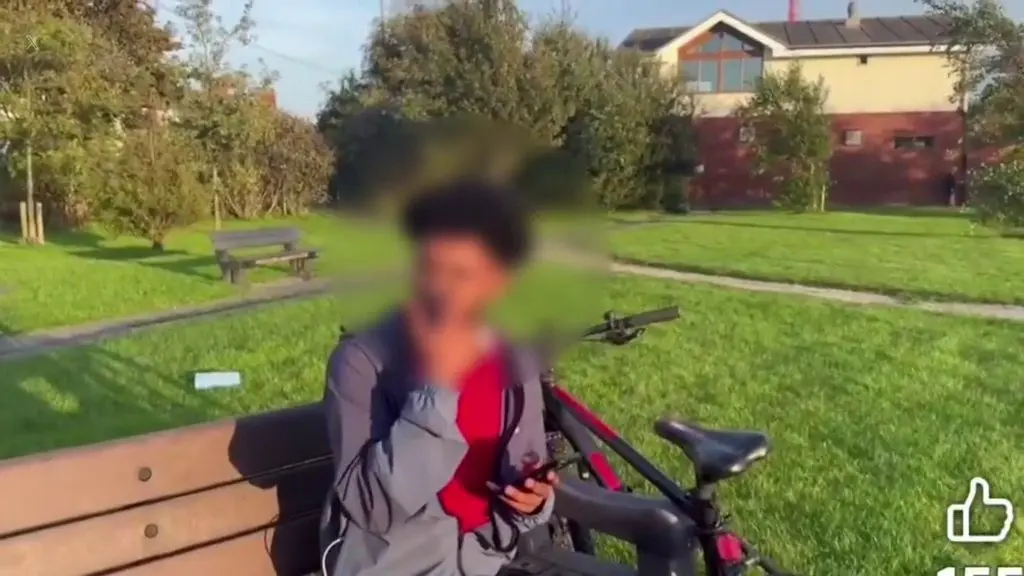
The confrontation in Thornton village green unfolded on a sunny Friday afternoon, capturing the casual yet insidious nature of modern street-level vigilantism. The victim, a young Black man, was seated alone on a public bench next to his bicycle, engaged with his mobile phone. The location was detached from any direct proximity to the children’s play area, and at no point was the man engaged in any suspicious or disruptive behavior.
The Approach and Confrontation
Two men, carrying cans of Red Bull and actively filming the interaction for social media, approached the lone cyclist. The primary agitator, acting as the cameraman, announced his target to online followers before walking directly up to the bench.
"You can’t sit here where the women and children are, mate," the man stated. "Can you just go round there, please? There are women and children on the park. They don’t feel safe at the minute, that’s all. They don’t feel safe with foreign men sitting staring at them unimpeded."

When the cyclist calmly questioned whether he was being singled out—asking, "Because of me?"—the patroller attempted to deflect accountability while maintaining the coercive atmosphere. "We’re not saying you, but other people have been sitting there making them feel uncomfortable. We’re not blaming you, just other people."
Faced with an aggressive camera crew and an implicit threat of escalation, the cyclist quietly gathered his bicycle and moved on, choosing to avoid confrontation.
The Digital Echo Chamber
Shortly after the incident, a digital footprint of the encounter was published and subsequently deleted by the Blackpool Patriot Platform. The accompanying caption provided a sanitized, self-justifying narrative of the event:
"A few of the Blackpool patriots were out and about yesterday on peaceful patrol around some of the areas that have been highlighted as problem areas by the public. One male was found sat on the park watching over at the children’s play area and was ask politely to move on… If you see any migrants hanging round your local areas please message the page and we will peacefully patrol these areas."
This dynamic—where routine public presence by Black and minority ethnic individuals is reframed as a security threat to justify harassment—has become the standard operating procedure for these groups.
Supporting Context & Metrics: The Rise of Digital Vigilantism
The events in Thornton do not occur in a vacuum; they represent the physical manifestation of online radicalization and coordinated far-right mobilization.

The Network of "Patriot Patrols"
The groups invoking the "Patriot Patrol" moniker are closely tied to the orbit of Daniel Thomas (Danny Tommo), a prominent far-right figure who has previously served as a close associate of Tommy Robinson. Tommo’s network has increasingly pivoted toward direct-action campaigns, ranging from attempting to blockade maritime ports in Dover to disrupt migrant crossings, to street-level harassment campaigns in towns across Northern England.
Intelligence gathered from these groups’ online channels reveals a sophisticated playbook:
- Crowdsourced Profiling: Local pages encourage residents to report the presence of individuals they perceive as "migrants" or "foreigners" in public spaces, parks, and high streets.
- Geographic Targeting: Coastal towns and economically vulnerable areas, such as Blackpool and surrounding Lancashire districts, have been specifically targeted for the establishment of local branches.
- Dehumanizing Rhetoric: Social media posts consistently weaponize terms like "protecting women and children" to cloak xenophobic harassment in the language of civic duty.
Propaganda and Radicalization Tactics
To maintain momentum and attract recruits, these groups utilize an array of modern digital media strategies:
- AI-Generated Imagery: Prominent channels have circulated AI-generated posters and videos depicting members as medieval "Crusader-era knights" marching through landmarks like Blackpool Tower. This romanticized, martial imagery is explicitly designed to frame ordinary demographic changes as an existential civilizational battle.
- Escalating Tactics: Beyond benign harassment on park benches, the groups’ public channels have celebrated more violent altercations, including publishing footage of a dazed individual lying on a pavement after being accused of anti-social behavior near a church.
- Exploitation of Alternative Platforms: Following strict moderation policies on mainstream platforms like Meta and X (formerly Twitter), these networks frequently migrate to encrypted messaging apps and fringe video-sharing sites to coordinate patrols and shield their activities from rapid law enforcement intervention.
Official Statements and Legal Frameworks
The emergence of self-appointed street patrols has triggered urgent responses from legal experts, civil rights campaigners, and public officials.
Law Enforcement Response
Lancashire Police confirmed they are reviewing the footage circulating from Thornton village green and have been formally approached for comment regarding the actions of the Blackpool Patriot Platform. Civil liberties organizations are pressing the force to treat these incidents not merely as neighborhood disputes, but as targeted hate incidents and potential violations of public order legislation.
Legal scholars note that individuals who approach members of the public, demand they vacate public property based on their race or perceived immigration status, and film them without consent may be committing offenses under several legal statutes:

- Public Order Act 1986: Actions intended, or likely, to cause harassment, alarm, or distress, particularly when aggravated by racial hostility, can attract severe criminal penalties.
- Harassment, Alarm or Distress (Section 5): Using threatening or abusive words or behavior within the hearing or sight of a person likely to be caused harassment, alarm, or distress.
The Legal Troubles of Key Figures
The umbrella movement underpinning these patrols is currently dealing with significant internal and legal pressures. Daniel Thomas (Danny Tommo), aged 37, is facing high-profile criminal charges following an incident in the English Channel where he allegedly slashed a rubber rescue dinghy while an emergency responder was on board.
Thomas pleaded not guilty in court to charges of criminal damage and failing to disclose the PIN to his mobile phone under Section 53 of the Regulation of Investigatory Powers Act 2000. Despite his public claims that he possesses the capability to mobilize hundreds of men on short notice, his ongoing legal battles have cast a shadow over the operational command of the decentralized patrol networks.
Future Outlook: Implications for Community Cohesion
The normalization of "patriot patrols" presents a profound challenge to social cohesion, community safety, and the rule of law within the United Kingdom.
The Threat to Public Space
Public parks, village greens, and high streets are foundational to civic life, designed as neutral spaces where all citizens should be able to move freely without fear of intimidation. When far-right agitators arrogate to themselves the authority to police who belongs in these spaces, they erode the basic tenets of a free society. The chilling effect of such patrols—where a routine afternoon on a park bench can result in public humiliation and targeted filming—risks segregating communities and instilling deep-seated fear among minority populations.
The Path Forward for Authorities
Combatting this trend requires a multi-faceted response from civic and law enforcement institutions:
- Proactive Policing: Police forces must adopt a zero-tolerance approach to street-level intimidation and harassment, ensuring that vigilante groups are intercepted before confrontations escalate into physical violence.
- Digital Accountability: Social media platforms and regulatory bodies under the Online Safety Act must take swift action to dismantle accounts that coordinate harassment campaigns, incite racial hatred, or utilize AI propaganda to radicalize local populations.
- Community Resilience: Local authorities, community leaders, and anti-racism organizations must work in tandem to foster inter-community dialogue, reassuring vulnerable residents that the rule of law supersedes the intimidation tactics of extremist agitators.
As the legal proceedings against figures like Danny Tommo unfold and police investigations into the Thornton incident progress, the nation watches a critical test of whether the state can effectively protect public spaces from the encroachment of far-right vigilantism.