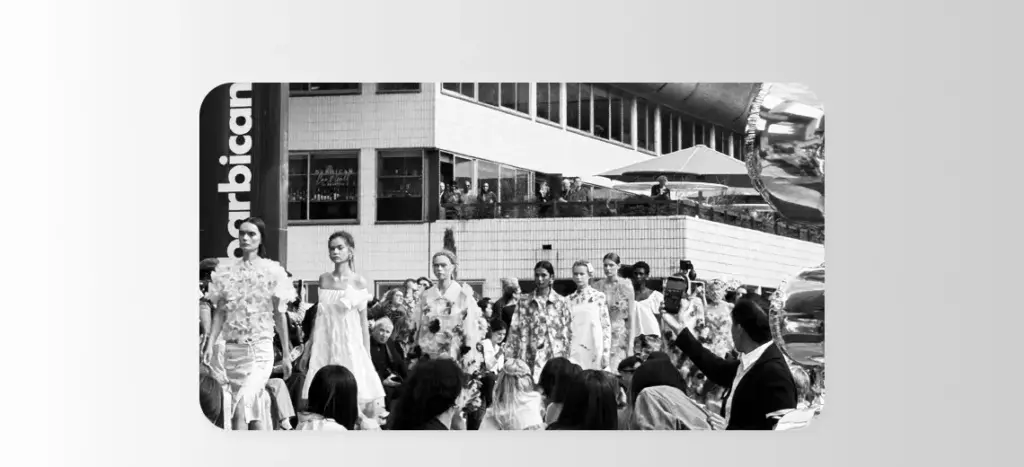
LONDON — London Fashion Week (LFW) has long held a reputation as the global incubator for unbridled creative eccentricity—a dynamic counterweight to the rigid corporate machineries of Milan and Paris. However, the recently concluded September shows (September 17–21) painted a significantly altered portrait of the British capital. Returning with a sharp, unapologetic commercial focus, LFW 2027 underscored an industry-wide scramble to align runway spectacle with bottom-line realities.
This strategic recalibration was the focal point of a recent episode of the Glossy Fashion Podcast, where senior fashion reporter Danny Parisi sat down with international reporter Zofia Zwieglinska to dissect the triumphs, tensions, and structural shifts defining the week. From high-stakes creative debuts at storied heritage houses to the survival tactics of independent visionaries, London’s latest showcase revealed an industry deeply preoccupied with reinvention, economic pragmatism, and the delicate tightrope walk between heritage and stagnation.
Executive Overview: A Pragmatic Return to Form
The overarching narrative of London Fashion Week’s latest iteration is one of strategic pivot. Amid persistent global economic headwinds and shifting consumer behaviors, the British fashion ecosystem is doubling down on commercial viability. According to data released by the British Fashion Council (BFC), accredited buyer attendance surged by 19% year-over-year, punctuated by an impressive 41% spike in international buyer participation. While the BFC stopped short of disclosing absolute headcounts or the precise volume of downstream wholesale orders generated, the palpable influx of global purchasing power signaled a renewed confidence in London’s market relevance.
Yet, this influx of commercial attention brings intense scrutiny. As Zwieglinska noted during the Glossy podcast, a stark dichotomy continues to persist between the sensory-driven atmosphere of the physical runway and the unforgiving digital lens that follows.
"There is still a gap between the people who go into the runway rooms and how those collections are received afterward online," Zwieglinska observed. "The venue, music, and crowd can elevate a show. Once the images circulate, the clothes face closer scrutiny."
This sentiment set the tone for a week where legacy brands were forced to prove whether their multi-million-dollar turnarounds could translate into compelling, forward-looking product lines, while independent designers mastered the high-wire act of sustaining avant-garde creativity without institutional financial cushions.
Detailed Chronology & Brand Deep Dives
Mulberry’s High-Stakes Test: Christopher Kane’s Ready-to-Wear Ambitions
Few houses faced as much pressure during the September showcases as Mulberry. The 55-year-old British leather goods titan has spent the last several years navigating a rocky financial and operational landscape. Under the stewardship of CEO Andrea Baldo—formerly of Ganni—the brand has shown signs of a stabilizing pulse. In the fiscal year ended March 28, Mulberry’s revenues ticked up 4% to reach $167 million (£125.5 million), while its pre-tax loss narrowed significantly from £32.2 million to £8.9 million.
To cement this recovery and expand its footprint beyond its iconic core handbags, Mulberry tapped designer Christopher Kane to spearhead its evolution into a formidable ready-to-wear player. For his Spring 2027 collection, Kane leaned heavily into the brand’s institutional memory, repeatedly adapting the squared metal fastening of Mulberry’s legendary Bayswater bag across the garments.
While certain outerwear pieces won praise for their craft, the heavy reliance on a single, highly familiar archival code drew mixed reviews from critics and editors alike.
"I don’t think the Bayswater motif in itself is enough of a signature to stamp [across the collection]," Zwieglinska critiqued.
Discussions among fashion editors following the presentation echoed a shared hope: that Kane will be granted broader creative latitude in subsequent seasons to establish a distinct ready-to-wear identity unchained from historical handbag hardware.
Alexander McQueen: Homecoming and the Archive Trap
Alexander McQueen’s return to London Fashion Week—its first local showing since relocating to Paris in 2001—was framed as a major homecoming. The move closely followed the appointment of former Prada CEO Gianfranco D’Attis, who took the helm in June. Under the ultimate ownership of luxury conglomerate Kering, the house is currently undergoing a calculated contraction of its distribution network, aiming to reposition the brand as the undisputed British authority in sharp tailoring and high-end occasionwear.
The runway presentation featured all the structural hallmarks of the McQueen lexicon: Huntsman-inspired tailoring, delicate lace, dramatic eveningwear, and signature leather harnesses. However, Zwieglinska argued that the collection fell into a dangerous comfort zone, leaning too heavily on well-worn historical references rather than forging new ground. The inclusion of armor-like footwear and theatrical eyewear felt less like a bold evolution and more like a nostalgic retrospective.
"Commercializing archive pieces is not really a business strategy," Zwieglinska asserted. "In terms of the rebelliousness and edginess that were so symbolic of McQueen, it feels like that has gone."
This critique opens up a broader philosophical debate within contemporary luxury fashion, one that Danny Parisi framed succinctly during the podcast:
"How do you build on the legacy and reference iconic pieces without becoming over-reliant on them? If you change everything, people say you are disrespecting the history. But if you do not go far enough, it feels stagnant."
Burberry: A Breath of Fresh Air and the ‘Burberry Forward’ Turnaround
In stark contrast to the structural growing pains at Mulberry and McQueen, Burberry delivered a masterclass in how to execute a creative turnaround while injecting genuine joy back into a brand. Marking a clear departure from heavy corporate minimalism, Burberry’s runway presentation centered on a vibrant collaboration with legendary textile designer Celia Birtwell.
The resulting collection introduced a lighter, airier sensibility to the runway, defined by buoyant florals, a revitalized color palette, and lightweight fabrics. Parisi described the aesthetic as "brighter, lighter, and almost a little ’70s," while Zwieglinska noted, "There was a lightness to the collection that maybe wasn’t there before."
Operationally, this creative refresh provides vital momentum for CEO Joshua Schulman’s sweeping "Burberry Forward" strategy. The turnaround plan deliberately refocuses the business on core, recognizable archetypes—specifically outerwear and scarves—that have historically driven the brand’s global equity. The strategy is already bearing fruit: in the most recent financial year, Burberry posted a 2% rise in comparable store sales, reversing a painful 12% decline from the previous year. More impressively, adjusted operating profit soared from £26 million to £160 million, proving that commercial clarity and creative charm can successfully coexist.
Supporting Context & Market Metrics
Beyond the high-profile transformations of legacy houses, the democratization and commercial immediacy of fashion week reached unprecedented levels in London this season. The boundary between the runway and the retail checkout counter dissolved further through innovative "see-now, buy-now" frameworks and strategic retail partnerships.
- Marks & Spencer’s Centenary Milestone: Celebrating 100 years in fashion, high-street staple Marks & Spencer staged its inaugural LFW runway show. True to its consumer-facing ethos, every single look was instantly shoppable, with half of the collection priced accessibly below $67 (£50).
- H&M and eBay’s Instant Commerce: H&M similarly deployed an immediate purchasing model, while resale titan eBay hosted its high-octane "Endless Runway" experience. In a testament to real-time consumer demand, Zwieglinska watched firsthand as a front-row guest attempted to purchase an Alaïa skirt digitally while the garment was literally being modeled on the catwalk.
The Independent Equation
While heritage brands grapple with multi-million-dollar restructuring, London’s independent design vanguard continues to demonstrate remarkable resilience. Zwieglinska highlighted the tenacity of local independent talents including Erdem, Di Petsa, Mithridate, Simone Rocha, Susan Fang, and Chopova Lowena.
Operating largely without the deep financial safety nets of luxury conglomerates like Kering or LVMH, these designers have pioneered sophisticated survival strategies. By diversifying revenue streams through strategic accessories lines, cross-brand collaborations, and corporate sponsorships, independent creators are effectively subsidizing their high-concept runway ambitions.
Official Statements and Industry Perspectives
The structural evolution of London Fashion Week has not occurred in a vacuum; it is the direct result of deliberate administrative policies and executive realignments.
The British Fashion Council’s official metrics—highlighting a 19% year-over-year increase in accredited buyers and a 41% surge in international attendees—demonstrate that global retail executives are looking to London not merely as a hub for avant-garde theater, but as a serious market for trade.
However, industry analysts remain cautious about conflating attendance metrics with immediate economic health. As discussed on the Glossy Podcast, the ultimate metric of success for any fashion week remains conversion: translating the fleeting digital impressions of Instagram and TikTok feeds into tangible wholesale orders and retail sell-through rates.
Reflecting on the unique ecosystem of the British capital, Zwieglinska offered an admiring concluding assessment:
"London designers have almost become experts at marrying commerciality with creativity. The heritage names are back in a bigger way, but the independents have also done incredibly well to keep building without major financial backing."
Future Outlook: The Road Ahead for British Fashion
As the dust settles on London Fashion Week, the industry faces a transitional horizon. The Spring 2027 season made one thing abundantly clear: the era of unchecked creative indulgence disconnected from fiscal reality is officially over.
For legacy powerhouses like Burberry, Mulberry, and McQueen, the coming seasons will test the longevity of their respective leadership teams and strategic pivots. Burberry must maintain the commercial momentum of its outerwear-centric resurgence without fatiguing its newly found joyful aesthetic. Mulberry and Christopher Kane face the delicate task of refining a ready-to-wear identity that stands proudly on its own merits, independent of hardware motifs. Meanwhile, Alexander McQueen must rediscover its historical edge under Kering’s tight curation, proving that commercial polish does not have to come at the expense of rebellion.
Concurrently, the independent design community will continue to serve as the beating heart of London’s cultural cachet. Their ability to innovate under extreme financial pressure proves that necessity remains the ultimate mother of invention.
Ultimately, London Fashion Week has successfully redefined its value proposition. By proving that rigorous commercial strategies can harmonize with British eccentric creativity, the capital has reinforced its indispensable position on the global fashion calendar—not just as a spectacle of imagination, but as a powerhouse of modern retail intelligence.