Executive Overview
The landscape of modern music is defined by butterfly effects—pivotal, razor-thin moments where history could have easily diverged onto an entirely different path. In the grand tapestry of hip-hop, few moments are as consequential as the young James Todd Smith, better known as LL Cool J, deciding whether or not to drop his microphone for good in the mid-1980s. At the absolute peak of his formative powers, Smith was a singular force: a teenage prodigy blessed with an uncanny ability to fuse ferocious street bravado with tender, chart-topping romantic vulnerability. Had he walked away from the culture during a wave of demoralizing rejection letters, the trajectory of popular music would look unrecognizable. Not only would hip-hop have been robbed of one of its most enduring crossover icons, but Def Jam Recordings—the legendary label that fundamentally industrialized and globalized the genre—might never have evolved into the cultural juggernaut it became.
Before he was the undisputed pioneer of rap balladeering and battle-tested heavyweight rhymes, LL Cool J was just a 16-year-old kid from Queens, New York, drowning in rejection slips. Armed with a relentless work ethic and a cassette deck, he had cold-called and mailed demo tapes to every single record label address he could scavenge from the back covers of his burgeoning vinyl collection. Silence was his only reward. Convinced that his lyrical ambitions were a fool’s errand, he prepared to pack it in.
What changed the course of musical history was a combination of maternal intuition, an investment in a $300 rhythm machine, and a fateful connection with an NYU student-turned-producer named Rick Rubin. This comprehensive retrospective examines the near-miss that nearly robbed hip-hop of its first true solo superstar, detailing the grueling climb, the pivotal interventions, and the foundational recordings that turned Def Jam from a dorm-room operation into a multi-billion-dollar empire.
Detailed Chronology: From Queens Basements to Global Stardom
The Early Spark: Emulating the Masters (1978–1983)
Long before the platinum plaques and Hollywood acting credits, hip-hop was an oral tradition passed down through park jams, cassette bootlegs, and neighborhood cyphers. Growing up in Queens, a young James Todd Smith found his calling at the tender age of 10. Inspired by pioneering golden-era rap groups like The Treacherous Three—whose intricate cadence, breath control, and storytelling mastery set a new benchmark for the genre—Smith began scribbling rhymes into notebooks.
By his early teens, the bedroom rapper had graduated from reciting other artists’ bars to writing his own distinct material. He possessed a natural cadence and an aggressive, booming delivery that belied his age. However, transitioning from a local neighborhood talent to a recorded artist required overcoming massive structural barriers. In the pre-internet era, breaking into the music industry required physical access: physical demos, physical addresses, and a staggering amount of luck.
The Wall of Rejection and the Brink of Quitting (1984)
By the time he turned 16, Smith was working tirelessly on his craft. He recorded numerous demo tapes, treating the creative process with the discipline of a seasoned veteran. Armed with album sleeves from his personal collection, he methodically copied down the mailing addresses of every record label he could find—from major traditional pop houses to nascent independent imprints.
He dropped his tapes into mailboxes across New York City, waiting anxiously for the phone to ring or for an acceptance letter to arrive in the mail. Instead, weeks turned into months of absolute silence. A few generic rejection notices eventually trickled in, but mostly, his submissions vanished into the corporate void.
The psychological toll on a teenager was immense. Doubt crept in, replacing the invincible confidence of youth. Smith began to question whether rapping was genuinely his calling or merely an adolescent fantasy. In a revealing 1986 interview with Record Mirror, the young rap icon looked back on those agonizing months of silence:
"I went to the record store and bought all the rap albums and looked at all the record company addresses. I sent tapes to all of them, and all of them turned me down. So I told my mother I was going to quit."
The Maternal Intervention and the $300 Lifeline
In moments of existential crisis, support systems are everything. For LL Cool J, that system was anchored entirely by his mother, Ondrea Gray, who recognized her son’s raw talent long before the industry validated it. Rather than brushing off his ambitions as a distraction from his education, she urged him to persevere through the institutional rejection.
"And she said don’t quit, because you never [know] when you’re going to get a break."
Understanding that inspiration requires the right tools, Gray made a financial sacrifice that would yield generational dividends for the music industry. She went out and purchased a state-of-the-art rhythm machine—an investment of roughly $300 that, in the mid-1980s, was a significant sum for a working-class family.
Armed with this new piece of musical hardware, Smith relocated his creative operations to the basement of a neighborhood friend and collaborator known as Finesse Frank. The drum machine gave his voice a driving, rhythmic backbone, allowing him to construct fully realized tracks rather than acapella verses shouted over borrowed instrumental breaks. It was in this makeshift basement studio that the foundational blueprint for "I Need A Beat" was born.
The Rick Rubin Connection and the Birth of Def Jam (1984–1985)
With his newly minted demo tape in hand, Smith fired off his creation once more. This time, the tape found its way to a young, eccentric New York University student and punk-rock aficionado named Rick Rubin. Alongside promoter Russell Simmons, Rubin was in the process of launching a fledgling independent record label out of his NYU dorm room: Def Jam Recordings.
Rubin heard the raw, unadulterated urgency in the young rapper’s voice, combined with the hard-hitting minimalist beats driven by the drum machine. Recognizing an undeniable spark, Rubin didn’t just listen to the demo—he took action.
As LL Cool J recalled in his Record Mirror interview:
"So to keep me going, she went out and bought me this $300 rhythm machine. I could play beats on it, so I went into the basement of a friend of mine, his name is Finesse Frank — and I made a demo of ‘I Need A Beat’, just buggin’ out. I sent it in to Rick Rubin, he called me back and about three days later I was in the studio making a record. [‘I Need A Beat’, which now turns up on the Radio album.] That was definitely not the Rick Rubin that you know of now."
Within 72 hours of that phone call, the 16-year-old was standing inside a professional recording booth. The resulting single, "I Need A Beat," was released in 1984. It sold over 100,000 copies independently, serving as the commercial proof-of-concept that Def Jam needed to secure a landmark distribution deal with Columbia Records through CBS.
Supporting Context & Metrics: The Rise of Radio and an Empire
Radio (1985): Setting the Gold Standard
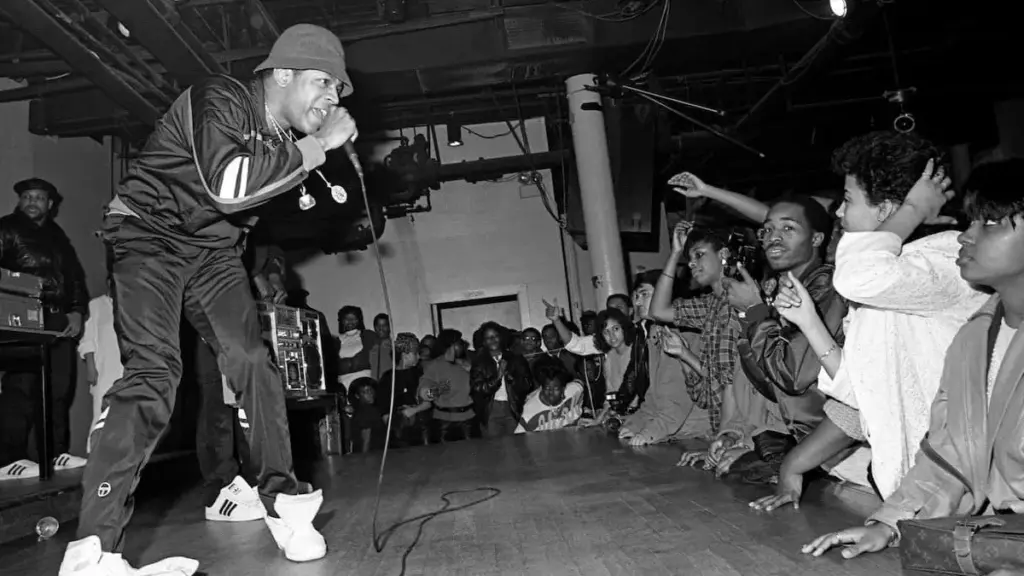
Following the underground success of "I Need A Beat," LL Cool J was officially minted as Def Jam’s flagship solo artist. In November 1985, the label released his full-length debut album, Radio.
The album was nothing short of a seismic cultural event. Produced entirely by Rick Rubin using minimal instrumentation—primarily heavy 808 drum machine patterns, sparse scratching, and aggressive rock samples—Radio established the sonic DNA of early golden-era hip-hop. Critics and fans alike were instantly captivated by Smith’s commanding, booming vocal presence, his complex internal rhymes, and his unmatched lyrical confidence.
Key tracks from the record immediately entered the cultural lexicon:
- "I Can’t Live Without My Radio": An anthemic, high-energy declaration of hip-hop’s centrality in urban youth culture, matching the physical dominance of the boombox era.
- "Rock The Bells": A masterclass in battle rap bravado that showcased Smith’s technical superiority and cemented his status as a formidable force on the mic.
- "I Need Love" (on subsequent releases): Though later perfected on his sophomore effort Bigger and Deffer, Smith’s early inclination toward romantic storytelling broke the hyper-masculine mold of early rap, proving that a tough street MC could also write sensitive, chart-topping love songs.
Metrics of Success
The commercial impact of Radio cannot be overstated:
- Chart Performance: The album peaked at No. 6 on the Billboard Top R&B/Hip-Hop Albums chart and reached No. 46 on the general Billboard 200, a massive feat for a debut rap record in 1985.
- Certification: By 1989, Radio was officially certified Platinum by the Recording Industry Association of America (RIAA), having surpassed one million units sold.
- Label Genesis: The commercial momentum generated by LL Cool J provided Def Jam with the financial security and market visibility required to sign subsequent legendary acts, including the Beastie Boys, Public Enemy, Slick Rick, and EPMD. Without LL Cool J’s early viability, the house that Rubin and Simmons built might have collapsed under the weight of underground overheads.
Official Statements and Archival Reflections
The historical weight of this near-miss has been reflected upon extensively by both LL Cool J himself and industry contemporaries who witnessed the birth of the golden era.
Reflecting on his mother’s pivotal role, Smith has frequently emphasized that his career was built on collective familial sacrifice rather than overnight industry luck:
"My mother didn’t just buy me a machine; she bought into my dream when nobody else in the world cared to listen. When every single record executive slammed the door in my face, she held the key open."
Rick Rubin, speaking in various retrospective interviews regarding the early days of Def Jam, has often highlighted the sheer rawness and authenticity that Smith brought to the NYU dorm room:
"When I heard James’s tape, there was something undeniably urgent about it. It wasn’t polished pop rap; it was fierce, adolescent, and completely authentic to the streets of New York. He sounded like a kid who had something to prove to the entire universe—and as it turned out, he did."
Cultural historians note that this dynamic—young, disenfranchised urban youth utilizing minimal technology to build self-sustaining art forms—became the economic and cultural engine of modern hip-hop. The $300 rhythm machine stands today as one of the most culturally valuable pieces of equipment in music history, a tangible artifact of a pivotal turning point.
Future Outlook: A 50-Year Legacy and Enduring Influence
As LL Cool J’s career spans across five decades, his footprint extends far beyond the foundational days of 1980s boomboxes and vinyl singles. He transitioned seamlessly from a pioneering battle MC to a multi-platinum crossover pop star, a Hollywood leading man, a Kennedy Center Honoree, and a respected Rock & Roll Hall of Fame inductee.
Yet, looking at the contemporary musical landscape, the echoes of that basement studio session in Queens remain vividly alive. The blueprint established by LL Cool J and Rick Rubin—independent hustle, minimal technological barriers to entry, and unyielding self-belief—paved the way for today’s era of bedroom producers, independent SoundCloud rappers, and self-made streaming moguls.
If Ondrea Gray had not purchased that $300 rhythm machine, or if a 16-year-old James Todd Smith had allowed rejection letters to permanently silence his pen, the global cultural economy of hip-hop would look entirely different. Def Jam might have remained an obscure college-radio footnote, and the voice of modern youth culture would have lost one of its most defining architects. Instead, an act of maternal faith transformed a discouraged teenager into a timeless icon, proving that sometimes, the difference between historical obscurity and legendary immortality comes down to a single beat, a supportive parent, and the refusal to quit.