Executive Overview
As the autumn nights draw in and television audiences across the United Kingdom eagerly return to the time-honored tradition of gripping Sunday-night prestige television, ITV is preparing to drop its latest high-stakes contribution to the genre. Following in the prestigious footsteps of contemporary British crime-drama heavyweights like Broadchurch, Line of Duty, and Happy Valley, The Blame arrives with a formidable pedigree. Adapted from Charlotte Langley’s critically acclaimed novel and penned by master screenwirter Megan Gallagher (All Her Fault), the six-part series promises to marry a masterclass in procedural mystery with a razor-sharp, unflinching examination of institutional decay, systemic sexism, and the heavy moral price of complicity.
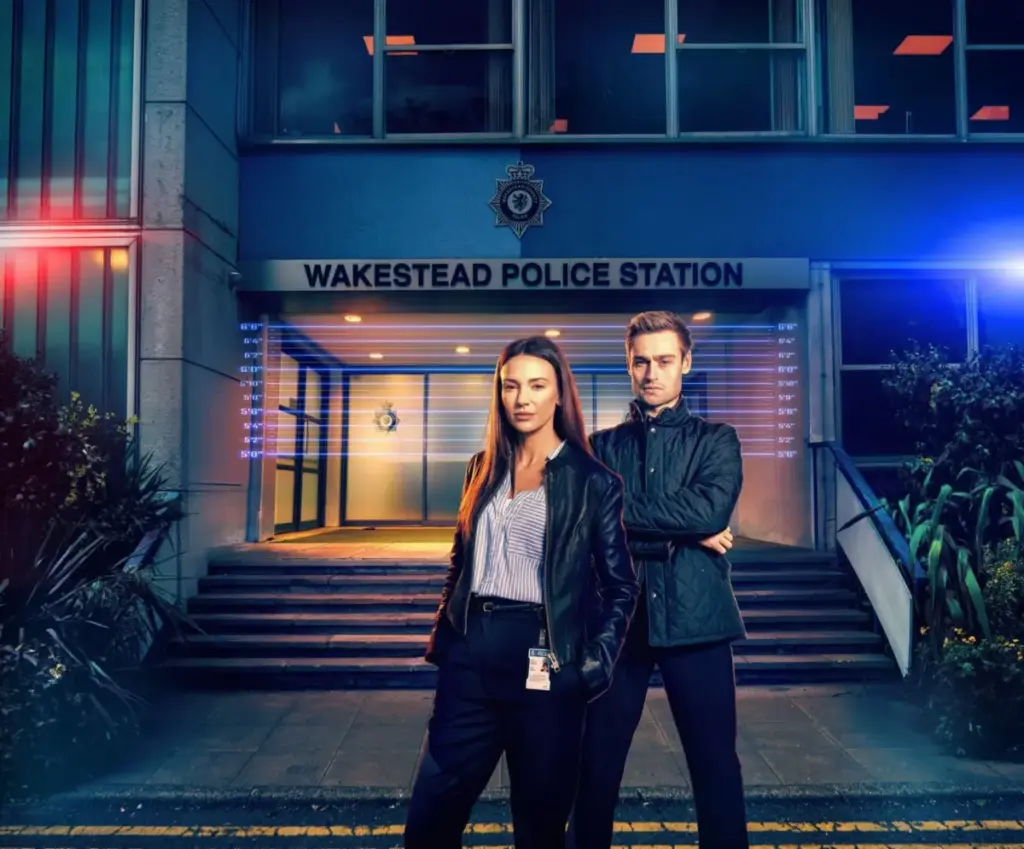
At the center of the narrative are detectives DI Emma Crane, portrayed with steely resilience by Michelle Keegan, and DT Tom Radley, brought to life with nuanced complexity by Douglas Booth. Set against the atmospheric, claustrophobic backdrop of the fictional town of Wakestead, the series kicks off with a horrific catalyst: the discovery of the body of a teenage figure skater. What begins as a localized tragedy quickly spirals outward, exposing a treacherous web of lies, systemic cover-ups, and moral compromises that reach deep into the heart of the local constabulary.
Ahead of the show’s highly anticipated premiere on Sunday, 20 September, Keegan and Booth sat down with Stylist to discuss the arduous process of bringing these characters to life, the rigorous technical research that went into ensuring procedural authenticity, and why The Blame aims to do much more than simply entertain Saturday and Sunday night audiences. By tackling the murky waters where institutional loyalty collides with personal integrity, the series sets its sights on dissecting the uncomfortable realities of modern policing—asking not just who pulls the trigger or hides the evidence, but who looks away while it happens.
Detailed Chronology: The Anatomy of Wakestead’s Darkest Secret
To fully understand the gravity of The Blame, one must trace the meticulously constructed narrative arc designed by Gallagher and brought to the screen by Quay Street Productions. The story unfolds across six tightly paced episodes, utilizing a narrative structure that continuously destabilizes the viewer’s perceptions of safety, authority, and truth.
The Inciting Incident
The series opens in the seemingly idyllic, tight-knit community of Wakestead. The fragile peace of the town is shattered irrevocably when the lifeless body of a young, promising teenage figure skater is discovered in a public park. The visual framing of the discovery immediately signals that this is no ordinary homicide; it is a crime that touches upon the hidden underbellies, local ambitions, and whispered secrets of a community that prides itself on keeping up appearances.
The Investigation and the Spiral
Enter DI Emma Crane (Keegan) and DT Tom Radley (Booth). Initially tasked with a straightforward homicide investigation, the duo quickly finds themselves stonewalled. Clues do not merely run cold; they are actively redirected. As Emma and Tom peel back the layers of the case, they unearth a trail of institutional protectionism. Crucial evidence is mishandled, witness testimonies are quietly altered, and the bureaucratic machinery of the police force begins to shift—not toward finding the killer, but toward protecting the institution’s reputation.
Turning Inward: The Betrayal of Trust
What elevates The Blame above a standard whodunnit is its pivot toward psychological and institutional horror. As the investigation progresses, DI Crane realizes that the threat does not merely lie outside the precinct doors among the civilian suspects of Wakestead. The corruption is internal. Emma is forced to turn her investigative lens onto her own team, interrogating the loyalties of colleagues she has trusted with her life. This internal fracturing creates an atmosphere of immense paranoia, where every casual conversation, late-night shift, and shared cup of coffee becomes laden with hidden tension.
Supporting Context & Metrics: Authenticity, Research, and Cultural Resonance
The production team behind The Blame understood that for a crime drama to genuinely resonate with a savvy contemporary audience, superficial tropes would no longer suffice. Viewers today demand procedural accuracy, psychological realism, and a mature engagement with real-world social issues.
Consulting the Experts
To achieve this level of grounded realism, both Keegan and Booth relied heavily on the real-world expertise of veteran detective Lisa Farrand. Farrand, whose impressive resume includes advising on Sally Wainwright’s critically acclaimed BBC masterpiece Happy Valley, served as an indispensable anchor on set.
For Keegan, Farrand’s presence was vital in navigating the high-stakes interrogation scenes that form the dramatic backbone of the series. "I felt really confident when she was on set, especially when we did interrogation scenes," Keegan shares. "If she read something that wasn’t 100% correct, she’d always ask to pull it out or add something to the script. So when she was on set, I knew we were going to be in safe hands." This dedication to accuracy ensures that the police procedures, interview tactics, and inter-departmental politics depicted on screen reflect the harsh realities of modern law enforcement.
Informing the Performance: The Charing Cross Investigation
For Douglas Booth, preparing to play DT Tom Radley required delving into darker, more systemic cultural critiques. A core thematic pillar of The Blame is the exploration of systemic sexism and the subtle, insidious ways male-dominated environments foster cultures of silence.
To prepare for the role, Booth looked closely at real-world scandals that have rocked public trust in British policing, specifically citing the BBC’s Panorama investigations into the horrific culture of misconduct exposed at Charing Cross police station. These reports detailed systemic misogyny, homophobia, and institutional failures that shocked the nation. By studying these cases, Booth was able to capture the psychological friction faced by officers who find themselves trapped within toxic institutional cultures—where speaking out carries a severe professional and social penalty, yet remaining silent erodes one’s moral core.
Official Statements & Cast Insights
In their exclusive conversations ahead of the launch, the lead actors offered profound insights into their motivations, the psychological weight of their characters, and why this particular script demanded their involvement.

Michelle Keegan on Playing Agency and Moral Compass
Michelle Keegan is no stranger to demanding television roles, but she found something uniquely compelling in the character of DI Emma Crane. In an industry where female characters in crime dramas are occasionally written as mere reactive vessels or pigeonholed into tired tropes, Emma stands out as a beacon of unyielding agency.
"I love playing strong female roles, and I feel like Emma was exactly that," Keegan explains. "She holds her own; she’s opinionated when it matters. She’s got a good moral compass and she goes above and beyond for justice."
Keegan also noted that her decision to join the project was immediate upon finishing the final page of the script. "I got to the end and I was so shocked," she reveals. "That’s [always] a really good sign if I want to do a drama – I have to want to tell the story."
Douglas Booth on Complicity and Male Accountability
Douglas Booth’s reflections on his character, Tom, delve deep into the philosophical questions the series poses to its audience—particularly its male viewers. Wakestead’s police force operates on a code of quiet conformity where individuals keep their heads down to survive. But Booth challenges viewers to examine the point at which passive observation crosses the line into active complicity.
"Firstly, we hope people will be entertained, but I hope that it uncovers some of the ugly truths," Booth states candidly. "From a male point of view, I hope that men who watch it will also question some of their own behaviour – even if they recognise micro details of behaviour that impact other people. Or if they themselves have been made to feel uncomfortable and aren’t able to speak out and challenge that authority."
He continues, touching on the pervasive atmosphere of fear that keeps corrupt systems intact: "Because that’s what’s always playing within it – people are keeping their head below the parapet, but at what point do you become complicit?"
The Climax: A Masterclass in Tension
When asked what audiences have to look forward to as the narrative unfolds over its six-week run, Booth promises an explosive and intensely rewarding conclusion. Having already screened the final cuts, he offers a word of warning to viewers: distractions will not be tolerated.
"I’ve just finished them all, and I would say [episodes] five and six," Booth says enthusiastically. "Just because you start to get some really juicy answers. My wife was trying to talk to me while I was watching it, and I was like, ‘Do not talk to me!’ It gets really intense."
Future Outlook & Cultural Impact
As The Blame prepares to make its grand debut on ITV, it enters a landscape where television viewers are increasingly fatigued by superficial procedural procedurals that tie up complex societal traumas in neat sixty-minute packages. Modern audiences are hungry for serialized storytelling that acknowledges the gray areas of human morality and the institutional hurdles that stand in the way of true justice.
By marrying the high-octane pacing and twist-laden plotting characteristic of top-tier British crime fiction with a fearless examination of systemic sexism, corruption, and the courage required to dismantle toxic cultures from within, The Blame is positioned to be more than just a seasonal ratings hit. It is poised to spark vital cultural conversations around accountability, whistleblower protection, and the true cost of institutional silence.
With stellar performances from Michelle Keegan and Douglas Booth, meticulous scripting by Megan Gallagher, and the uncompromising creative backing of Quay Street Productions, Sunday evenings are about to become appointment viewing once again.
The Blame lands on ITV and ITVX on Sunday, 20 September.