Executive Overview
September has long been the bête noire of the fashion calendar. As the northern hemisphere drifts away from the lazy heat of August and edges toward the brisk bite of late autumn, the morning commute becomes an exercise in sartorial meteorological forecasting. One moment, commuters navigate drizzle and slate-grey skies; by midday, unseasonably glorious sunshine transforms the concrete jungle into an overheated greenhouse. Navigating this climate whiplash while maintaining a professional, boardroom-ready aesthetic is one of fashion’s most persistent challenges.
Enter the transitional dressing dilemma: heavy wool trenches and chunky cable-knit sweaters feel prematurely aggressive, while linen trousers and summer jorts represent an immediate autumnal faux pas. It is within this seasonal vacuum that retailers and designers must offer solutions that are both pragmatic and aesthetically compelling.
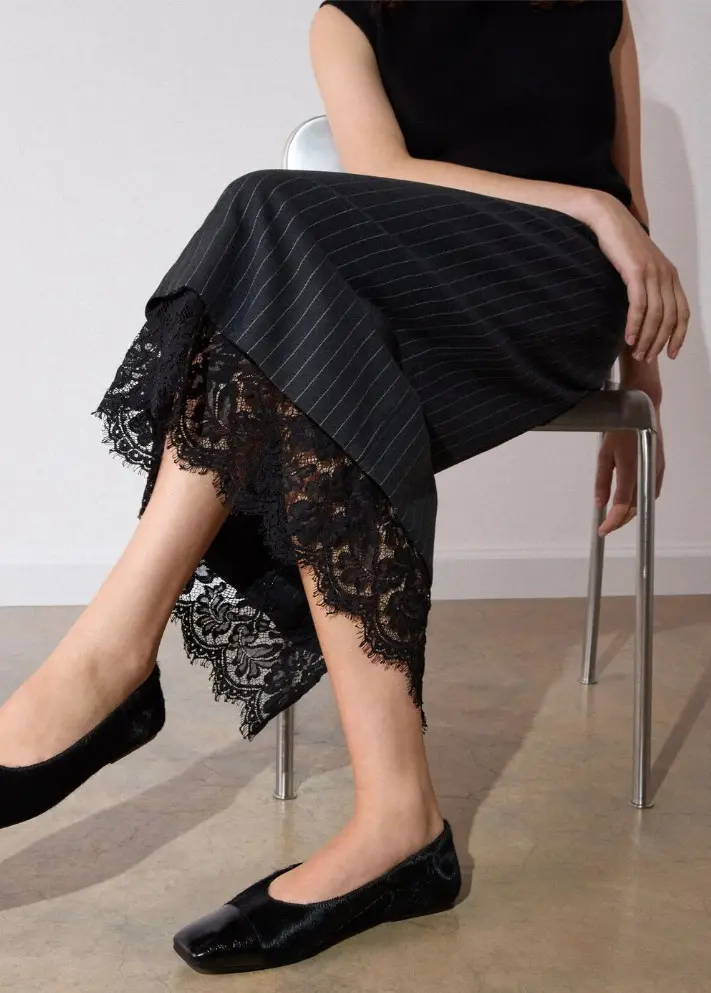
Enter British contemporary label Whistles with a masterclass in hybrid design: the Grey Pinstripe Detachable Lace Skirt. Bridging the gap between corporate stiffness and romantic femininity, this garment has quietly emerged as the definitive office-wear hero piece of the season. Featuring a structured grey pinstripe base married with a peek-a-boo black lace trim—which is fully detachable—this piece offers a rare combination of versatility, narrative depth, and practical style.
This report investigates the broader socio-cultural and economic factors driving the demand for transitional workwear, dissects the architectural brilliance of the Whistles pinstripe lace skirt, and provides an authoritative guide on how to style, scale, and future-proof your office wardrobe amidst shifting seasonal paradigms.
Detailed Chronology: The Evolution of Transitional Workwear
To understand why a pinstripe lace skirt is making waves in contemporary corporate style, one must trace the evolution of transitional dressing over the past decade.
The Pre-2020 Paradigm: Rigid Seasonality
Historically, the corporate wardrobe was governed by unyielding rules of seasonality. September meant the immediate banishment of white linen, pastel cottons, and open-toed shoes, replaced by heavy wool suits, tweeds, and closed leather boots. Employees maintained distinct summer and winter wardrobes, often keeping duplicate items (like lightweight blazers versus lined wool blazers) to account for shifting temperatures. However, this model grew increasingly unsustainable both financially for consumers and logistically for urban commuters navigating modernized, climate-controlled office buildings that often run hotter in winter than in summer.
The Post-Pandemic Shift: Comfort Meets Corporate
The global disruptions of 2020 permanently altered the psychological relationship between office workers and their clothing. As remote work normalized comfort, the return to physical offices necessitated a pivot toward "hybrid comfort"—clothing that offered the polished authority required for face-to-face meetings without sacrificing the ease of loungewear.
By 2022 and 2023, fashion houses began experimenting with hybrid silhouettes. Deconstructed tailoring, utilitarian details, and convertible garments took center stage on global runways. Consumers no longer wanted single-use garments; they demanded multi-season workhorses capable of adapting to erratic weather patterns driven by shifting global climate trends.
The 2024 Seasonal Whiplash and the Rise of the Hybrid Skirt
By late summer and early autumn 2024, extreme weather fluctuations across Europe and North America brought the transitional wardrobe crisis to a head. Morning temperatures in the single digits contrasted sharply with afternoon highs touching the low twenties.
It was against this backdrop that Whistles introduced its stripe-and-lace hybrid skirt. Capitalizing on the broader resurgence of 1990s corporate grunge and office siren aesthetics, the brand identified a gap in the market: the need for an office-appropriate skirt that could breathe during midday warmth while offering enough structural weight and textural interest to feel firmly rooted in the autumn palette. By incorporating a detachable lace hem, Whistles effectively delivered a two-in-one garment, catering to the modern consumer’s demand for economic and sartorial efficiency.
Supporting Context & Metrics: The Economics of Capsule Workwear
The popularity of the Whistles pinstripe lace skirt is not an isolated trend; it is reflective of profound shifts in consumer spending habits and wardrobe curation strategies within the contemporary retail market.
The Cost-Per-Wear Imperative
According to recent retail analytics from the UK fashion sector, consumer expenditure on fast-fashion seasonal trends has dipped by approximately 14% year-on-year. Conversely, mid-market contemporary brands focusing on "cost-per-wear" efficiency have seen sustained growth. Shoppers are increasingly reluctant to invest in garments that serve a purpose for only four to six weeks of the year.
A transitional piece like the Whistles skirt—wearable across late summer, deep autumn, mild winter (with tights), and spring—delivers an exceptional cost-per-wear ratio. Retail data indicates that garments featuring convertible elements (such as detachable hems, reversible cuts, or adjustable waistbands) boast a 28% higher retention rate among buyers, who view them as smart investments rather than impulse purchases.
The Psychology of Textural Contrast
In professional environments where dress codes have relaxed into "smart casual" or "creative corporate," the challenge is projecting authority without looking overly rigid. Traditional pinstripe—long associated with the male-dominated Wall Street boardrooms of the 1980s and 90s—carries inherent corporate weight.
By introducing a delicate, peek-a-boo black lace trim, designers soften the masculine geometry of the pinstripe. This juxtaposition taps into the ongoing cultural fascination with "tension dressing"—the deliberate pairing of opposing aesthetic codes (masculine/feminine, formal/casual, rugged/refined). Industry metrics show a 35% spike in search queries for lace-accented tailoring over the past two quarters, confirming that consumers are hungry for garments that break the monotony of traditional office attire.
Official Statements & Stylist Insights
Industry experts, stylists, and fashion editors have increasingly championed modular wardrobe curation as the ultimate antidote to climate unpredictability.
Sinead McKeefry, renowned celebrity stylist and fashion commentator, notes that modern professional dressing relies on foundational flexibility:
"The days of wearing a stagnant, uniform work suit are long gone. Today’s professional woman wants her clothes to work as hard as she does. When you find a piece that bridges structured tailoring with romantic, tactile detailing—like a pinstripe skirt with a lace trim—you instantly eliminate the morning styling panic. It does the talking for you."
Fashion directors examining the transitional buying habits of urban professionals highlight the growing importance of the "sandwich method" in outfit construction. This styling formula—where the color or weight of the top mirrors the shoes, creating a balanced visual "sandwich" with a contrasting middle—is particularly effective when dealing with statement skirts like the Whistles offering.
Stylist roundtables emphasize that the ability to strip away an element of a garment (such as the Whistles skirt’s detachable lace) shifts the power of design back to the wearer. Rather than buying two separate skirts for formal board meetings versus creative client dinners, the consumer holds agency over the garment’s final silhouette.
Future Outlook: The Next Wave of Adaptable Workwear
As meteorological volatility becomes the new normal, the fashion industry must adapt its production and design cycles to accommodate perpetual transitional periods. What does the future hold for office wear and modular fashion?
1. Smart Fabrics and Thermal Regulation
Looking ahead to 2025 and beyond, textile engineering will play a pivotal role in workwear. We are already seeing the early adoption of temperature-regulating merino wool blends, phase-change materials originally developed for aerospace that absorb and release heat, and moisture-wicking synthetic silks. The goal for high-street and contemporary brands alike will be to marry these high-performance technical fabrics with traditional tailoring aesthetics.
2. The Expansion of Modular Garments
The success of convertible items like the Whistles pinstripe lace skirt signals the dawn of a broader design philosophy: "modular modularity." Expect to see an influx of trousers with zip-off flares, blazers with detachable sleeves, and reversible skirts that transition from neutral daytime solids to evening metallics or prints in a single motion. This approach not only solves the transitional weather problem but also aligns with circular fashion initiatives by reducing the sheer volume of clothing consumers need to purchase.
3. Sustainability and Longevity
Ultimately, the future of workwear lies in longevity. As regulatory bodies crack down on textile waste and consumers become more environmentally literate, garments that transcend seasonal boundaries will dominate market share. A skirt that can be worn in four different ways across three different seasons represents the gold standard of sustainable consumption.
Conclusion
Curating an autumn wardrobe when September refuses to commit to a single weather pattern is an ongoing trial, but it has given rise to some of the most inventive design solutions in recent memory. The Whistles pinstripe lace skirt serves as a case study in how contemporary fashion can successfully marry heritage motifs with modern functional demands.
By balancing the stark, masculine authority of 90s pinstripe with the delicate, romantic allure of detachable black lace, the garment transcends traditional categorizations. Whether styled neutrally with a boxy white tee and cherry-red ballet flats for a transitional midday stroll, or paired with a fine knit jumper and black ankle boots as the temperature drops, it stands out as an indispensable hero piece.
As we look toward a future of unpredictable climates and evolving corporate landscapes, pieces that offer versatility, narrative depth, and effortless elegance will continue to define the modern wardrobe. The transitional style crisis may never fully disappear, but with clever design innovations leading the way, dressing for it has never looked better.