EXECUTIVE SUMMARY
For more than a century, Stanley operated in the shadows of the outdoor and utility goods market, known primarily as a maker of rugged thermoses favored by blue-collar workers, campers, and construction crews. Over the past several years, however, the 113-year-old drinkware brand—owned by PMI WW Brands, LLC—underwent a seismic, internet-fueled transformation. The viral explosion of the "Quencher" tumbler turned Stanley into a cultural phenomenon, redefining hydration accessories as must-have fashion statements.
Yet, hyper-growth fueled by internet trends carries an inherent risk: the fickle nature of viral consumption. Eager to avoid the fate of a one-hit wonder, Stanley’s leadership has embarked on an ambitious strategic pivot. The goal: convert short-term, limited-edition hype into a diversified, long-lasting global lifestyle business.
This maturation process was underscored by Stanley’s recent collaboration with the vibrant Brazilian fashion brand Farm Rio. Launched globally on August 18, the partnership—which spanned Quenchers, bottles, and a soft cooler in three striking tropical prints—nearly achieved its anticipated four-week sell-through target in a staggering seven days. For most brands, a week-long sell-out would be an unmitigated victory. But for Stanley 1913, the immediate sales figures represent only the opening chapter of a much larger, highly calculated six-month experiment.
By closely tracking post-purchase behavior, expanding its product mix far beyond handled tumblers, scaling international distribution, and even cautiously re-evaluating its stance on discounts, Stanley is rewriting the playbook for modern consumer goods. This comprehensive report explores the data, strategies, and executive insights driving Stanley’s evolution from a viral sensation into a diversified global powerhouse.
1. DETAILED CHRONOLOGY: THE ANATOMY OF THE FARM RIO LAUNCH
To understand Stanley’s modern marketing mechanics, one must examine the precise timeline and execution of the Farm Rio collection. Unlike previous drops that relied on hyper-exclusive, single-silhouette celebrity partnerships, the Farm Rio collaboration was designed as an expansive, multi-category lifestyle assortment.
The Buildup and Anticipation
Months before the August launch, preliminary indicators signaled robust global demand. In Latin America alone, the collection accumulated an impressive 12,500 "Notify Me" registrations—a critical metric that Stanley utilizes to gauge pre-launch appetite and fine-tune inventory distribution.
The partnership arrived at a fascinating juncture for Farm Rio as well. Just days prior to the collaboration’s global release, Farm Rio’s parent company, Azzas 2154, made headlines by announcing plans to break up the fashion empire following strategic disagreements between controlling shareholders. With Farm Rio slated to become an independently managed, privately held company jointly owned by Alexandre Birman and Roberto Jatahy—and with investment banking giant Morgan Stanley exploring potential partnerships or sales—the lifestyle brand was navigating a pivotal corporate chapter, making the successful global Stanley collaboration all the more crucial for brand momentum.
The Global Rollout and Immediate Impact
On August 18, the collection officially dropped globally. Priced between $55 and $155, the range featured three vibrant tropical prints: Tropical Woods, Red Bananas, and Green Forest, applied across Quenchers, bottles, and an innovative soft cooler.
The market response defied even the most optimistic internal projections. Stanley anticipated that the broader assortment would steadily sell through over approximately four weeks, allowing the presentation to remain live on digital and physical shelves to capture sustained interest. Instead, the collection reached nearly 50% global sell-through within its first seven days.
Geographically, the momentum was broad-based rather than isolated to a single market. Sell-through exceeded 50% across North America, Canada, Europe, the Middle East, and Africa (EMEA), as well as Brazil and Argentina. Performance was particularly blistering for the Tropical Woods print, which achieved near 100% global sell-through in less than a week. Furthermore, despite minimal paid-media support, six out of Stanley’s top 10 best-selling products globally that week originated from the Farm Rio collaboration.
Experiential Activation
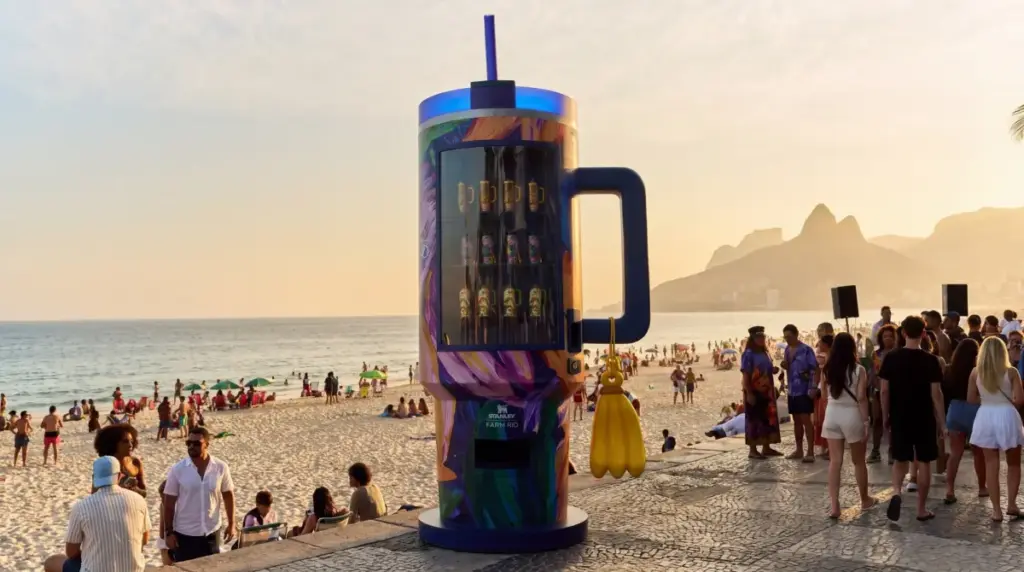
To amplify the digital buzz, Stanley executed targeted experiential marketing events. In New York City, pop-up events drew massive crowds, with dedicated inventory selling out within hours. Meanwhile, in Rio de Janeiro, Stanley set up an imaginative beach activation centered entirely around a massive, Quencher-shaped vending machine. These physical touchpoints effectively bridged the aesthetic worlds of both brands, reinforcing the core themes of color, design, and self-expression.
2. SUPPORTING CONTEXT & METRICS: DECONSTRUCTING THE LIFESTYLE PIVOT
The success of the Farm Rio drop is not an isolated anomaly; it is the direct result of a deliberate corporate restructuring designed to reduce Stanley’s reliance on a single product silhouette.
The Deceleration of the Quencher Monopoly
At the peak of the viral craze, the Quencher accounted for an astonishing 80% or more of Stanley’s global product mix. While the massive, handled tumbler remains the company’s undisputed top-selling silhouette, executive leadership recognized that long-term brand health required portfolio diversification.
Today, the Quencher accounts for roughly 40% to 50% of Stanley’s global product mix. This significant rebalancing has been achieved through aggressive expansion into adjacent categories. Stanley is now actively scaling its footprint across:
- Café Products: Mugs, pour-overs, and specialized travel vessels.
- Fitness Products: Gym-centric hydration solutions and shakers.
- Coolers & Lunch Bags: High-performance soft and hard coolers designed for outdoor and day-to-day use.
- Backpacks & Gear: Functional lifestyle carry solutions.
This product diversification is matched by an aggressive international expansion strategy. Ben James, Stanley’s general manager for EMEA, noted that the brand continues to unlock remarkable growth momentum even as it scales. By identifying new distribution points and fresh retail channels outside of its traditional North American stronghold, Stanley is ensuring that its addressable market remains vast and resilient.
The Six-Month Horizon: Redefining Customer Lifetime Value
For Stanley, the traditional metric of a successful product drop—immediate sell-out speed—is no longer considered the definitive measure of success. While selling out in 24 hours provides a dopamine hit of marketing hype, it does not guarantee long-term customer retention.
This is where Stanley’s proprietary tracking methodology comes into play. The brand shifts its analytical lens from the initial two-week frenzy to a six-month time horizon. By evaluating how consumers acquired through a specific collaboration interact with the brand over a half-year period, Stanley can map out consumer lifetime value (LTV).
For example, when Stanley partnered with musician Post Malone, the collaboration unexpectedly attracted a heavily male demographic alongside robust, unexpected demand from Europe and Asia-Pacific. By tracking this cohort over the subsequent six months, Stanley discovered a high propensity for these customers to cross-shop into the brand’s café product line. Collaborations, therefore, are deployed not merely as quick revenue drivers, but as sophisticated customer acquisition funnels.
3. OFFICIAL STATEMENTS & EXECUTIVE INSIGHTS
To gain a deeper understanding of the mechanics behind Stanley’s modern strategy, industry observers look directly to the architects of the brand’s global expansion.
Kate Ridley, Chief Brand Officer of PMI WW Brands, LLC (Stanley 1913), provided crucial clarity on the company’s analytical approach in a recent interview.
"We look at how those consumers who are acquired through that collaboration come into the brand and what they do after they’ve purchased," Ridley explained. "We generally don’t measure that in the first couple of weeks. We look at it over a six-month time horizon."
Reflecting on the unexpected velocity of the Farm Rio drop—which outpaced traditional celebrity-led capsules—Ridley admitted that the brand had to recalibrate its inventory expectations.
"It was very pleasantly surprising to us that we had such an immediate response," said Ridley. "We need to have enough inventory that the presentation can stay live for at least a couple of weeks."
Ridley contrasted the Farm Rio partnership with single-celebrity capsules, such as those featuring Olivia Rodrigo or Lionel Messi. While celebrity drops typically focus on a single silhouette and are engineered to sell out within 24 to 72 hours to maximize acute scarcity, the Farm Rio partnership served a different psychological and strategic purpose. It was not intended to blast the brand into an entirely unknown demographic, but rather to deepen emotional resonance with overlapping communities that already share a passion for bold color, artistic design, and personal self-expression.
On the international front, Ben James emphasized the strength of the brand’s global infrastructure.
"We’re still seeing amazing growth momentum, even as we scale," James noted. "We’re finding new distribution points and new channels of distribution."
4. FUTURE OUTLOOK: DISCOUNTS, HOLIDAY CAMPAIGNS, AND RETAIL REALITIES
As Stanley looks toward the future, the brand faces the complex challenge of sustaining double-digit growth while managing shifting consumer habits and retail calendars.
The Re-Evaluation of Promotional Strategy
Historically, Stanley has operated strictly as a premium, non-promotional brand, rarely relying on markdowns or discounts to clear inventory. However, as the brand attempts to cast a wider net and capture budget-conscious consumers who may balk at paying $50 or more for a water bottle, leadership is reconsidering its stance.
"I don’t think there’s an inverse relationship between being a premium brand and discounting," Ridley asserted. "There are times throughout the year that consumers just expect it."
Stanley views strategic promotions—often coordinated with wholesale and marketplace partners like Amazon, sometimes paired with exclusive product bundles—as a vital entry point for hesitant shoppers. Just like collaboration buyers, these promotional cohorts are carefully tracked to see if they eventually convert into full-price, loyal brand advocates. Nevertheless, Ridley acknowledges that Stanley remains in a "discovery phase" regarding markdowns, noting, "We are not a very promotional brand. We don’t do it very often, and we recognize that, in the future, we could probably do more of it."
Navigating the Retail Calendar Compression
Another emerging challenge for Stanley is the accelerating timeline of global retail. Shopping periods are creeping earlier each year; U.S. retailers have increasingly requested back-to-school product assortments as early as June, while holiday and Black Friday promotional windows stretch longer and longer.
This creates a strategic tension for a brand built on scarcity and urgency. Stanley’s internal testing has revealed that consumer demand frequently loses momentum after the initial opening days of a promotional window. Balancing the commercial opportunity of an extended sales period against the urgent need to drive immediate conversion remains a delicate tightrope walk for the brand’s merchandising teams.
Looking Ahead: The Holiday Push
To maintain its upward trajectory, Stanley is preparing to roll out a major, multi-channel holiday marketing campaign in late October. This campaign will prominently feature the brand’s newly diversified product ecosystem—highlighting fitness gear, café items, and coolers alongside its iconic Quenchers.
By pairing high-heat, design-forward collaborations like Farm Rio with disciplined long-term data analysis, international retail expansion, and calculated promotional testing, Stanley 1913 is proving that its viral moment was not a fluke. Instead, it was the explosive genesis of a modern, highly adaptive lifestyle empire.