Executive Overview
When the cinematic world first encounters a Frankenstein-inspired narrative, expectations instantly tether themselves to a specific visual vocabulary: flickering black-and-white laboratories, heavy stitching, dreary, rain-soaked cobblestones, and heavy, utilitarian garments that prioritize function over form. Yet, in Yorgos Lanthimos’s dazzling, darkly comedic, and fiercely feminist sci-fi dark comedy Poor Things—adapted from Alasdair Gray’s landmark 1992 postmodern novel—the traditional gloom of the gothic horror genre is systematically dismantled. In its place rises a hyper-vibrant, audaciously modern, and visually intoxicating exploration of identity, autonomy, and liberation.
At the pulsating heart of this visual revolution are the costumes crafted by visionary costume designer Holly Waddington. Rather than adopting a strict historical reenactment of late-19th-century Victorian and Edwardian fashion, Waddington collaborated closely with Lanthimos to concoct an anachronistic sartorial playground. The resulting wardrobe does not merely dress the characters; it functions as an externalized nervous system for Bella Baxter—the childlike, reanimated protagonist brilliantly brought to life by Emma Stone.
From structured, architectural experiments to chaotic street-style ensembles that look as though they were plucked straight from a contemporary London fashion blog, the costumes of Poor Things narrate a profound psychological journey. They trace Bella’s explosive evolution from an isolated subject of scientific experimentation to a self-possessed, intellectually liberated woman shaking off the suffocating shackles of patriarchal society. This comprehensive investigative feature explores the creative mechanics behind Waddington’s designs, the ideological clashes embedded within the textiles, and the ways in which a 19th-century silhouette was radically reimagined for the modern cinematic canon.
Detailed Chronology: The Sartorial Evolution of Bella Baxter
The narrative arc of Poor Things is mapped directly onto Bella Baxter’s physical body through a sequence of distinct sartorial phases. Each transition in her wardrobe mirrors an internal psychological milestone, charting her departure from naive confinement into radical self-actualization.
Phase 1: The Genesis of the Inchoate Mind
When audiences are first introduced to Bella, she exists in a state of arrested development following a dramatic suicide attempt and a radical brain-transplantation experiment orchestrated by the eccentric, god-like surgeon Dr. Godwin Baxter (Willem Dafoe). Confined within the sterile, surreal walls of Godwin’s estate, Bella’s early wardrobe consists of loose, voluminous tops and exaggerated bloomers.
These garments are purposefully unstructured, giving Emma Stone’s character a sense of physical unruliness. Because Bella has spent years cut off from the real world, her movements lack the practiced grace of a refined Victorian lady. Waddington designed these initial pieces to feel impulsive, organic, and wildly unrestrained. They visually articulate a mind untouched by societal conditioning, operating purely on instinct, curiosity, and primal impulse.
Phase 2: The Explosion of Street-Style Modernity
As Bella’s insatiable curiosity inevitably drives her beyond the sanctuary of her only known home, her wardrobe undergoes a dramatic metamorphosis. Stepping out into the wider world alongside the hedonistic lawyer Duncan Wedderburn (Mark Ruffalo), Bella’s clothes transform into a riot of saturated, punchy colors and radical silhouettes.
Waddington deliberately tossed aside historical accuracy to channel contemporary street-style aesthetics. In one standout sequence, Bella pairs a crisp white ruffled top with canary yellow shorts, anchoring the look with tiny black sunglasses, a cropped blue jacket, and modern-leaning ankle boots. In another, she dons a voluminous white ruffled top layered over a fluid, translucent bubble-gum pink skirt.
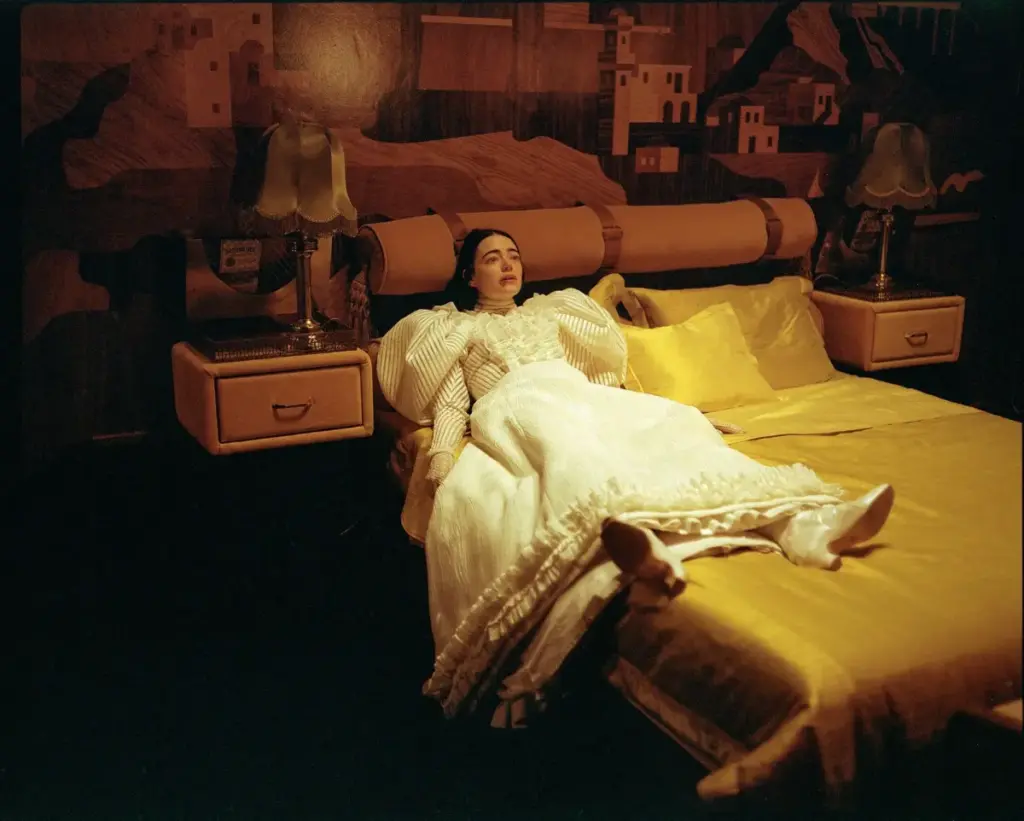
This phase of her journey represents absolute sensory overload. As Bella encounters new cities, exotic landscapes, and the harsh realities of human suffering for the first time, her clothes become increasingly complex. When she is suddenly confronted with global poverty during her travels, the abrupt realization of her elite socioeconomic status is starkly framed against a traditional Victorian dress featuring oversized, architectural white puff sleeves. The clothing here acts as a collision between whimsical fantasy and harsh worldly awakening.
Phase 3: The Iron Cage of Patriarchal Conventions
Before her complete liberation, Bella’s past life—and her encounters with the oppressive societal norms of the era—demanded a vastly different visual language. To symbolize the crushing weight of institutionalized confinement and patriarchal ownership, Waddington looked closely at 19th-century high-society fashion photography.
During these sequences, Emma Stone is encased in striking, heavily armored garments. These include a magnificent, structured blue dress paired with a traditional heavy coat, as well as a striking copper-toned gown boasting rigid, armor-like gold detailing. These pieces are intentionally austere, deeply serious, and profoundly weighty. They serve as a visual antithesis to the fluid, chaotic freedom of her post-experiment looks, representing the physical and mental cages that wealthy women of the era were expected to inhabit gracefully.
Even when attempting to conform to matrimonial expectations, Bella refuses to be entirely silenced. Her wedding dress is a magnificent, voluminous white creation topped with a traditional veil. However, in a stroke of subversive genius, the veil is wrapped tightly across the lower half of her face. This simple yet provocative styling choice—arrived at after days of deliberation by Waddington—subverts a deeply traditional garment into a striking symbol of restrained voice, ultimately becoming one of Emma Stone’s favorite looks from the production.
Phase 4: The Final Self-Actualization
The cinematic journey culminates in a moment of profound peace and self-possession. Free from the expectations of Victorian morality, the scientific gaze of Godwin, and the manipulative impulses of her suitors, Bella arrives at her authentic identity.
In the film’s closing movements, the high drama of exaggerated puff sleeves and hyper-saturated colors recedes. Bella is seen wearing a simple, understated cremeflavored knit pullover paired with a textured copper maxi skirt. As Waddington aptly notes, at this juncture, the clothes are simply clothes. The frantic experimentation of her wardrobe settles into an effortless harmony, signaling to the audience that Bella finally knows precisely who she is.
Supporting Context & Metrics: Crafting an Anachronistic Universe
To fully appreciate the scale and ambition of the costume department on Poor Things, one must examine the intersection of historical research, material science, and cinematic world-building.
Breaking Down the Wardrobe Metrics
- Era Targeted: Loosely anchored in the 1890s, the film uses late-Victorian and Edwardian silhouettes as a baseline while aggressively mutating them.
- Key Silhouettes Explored: Giant mutton-leg sleeves, exaggerated bustle structures, high-collared bodices, and voluminous bloomers.
- Color Palette Transition: Beginning with muted, organic tones in the laboratory, exploding into neon pinks, electric blues, and sunburst yellows during her global travels, and ultimately resolving into earthy, grounding cream and copper tones.
- Design Philosophy: Anti-historicism. Director Yorgos Lanthimos explicitly instructed Holly Waddington to ignore strict period-accuracy in favor of textures that felt wild, chaotic, and tactile.
The Contrast of Masculine Uniformity
While Bella’s wardrobe undergoes a radical evolution of color, shape, and freedom, the male characters in Poor Things remain anchored in the stiff, rigid orthodoxy of the late 19th century. Dr. Godwin Baxter—whom Bella affectionately and accurately refers to as "God"—wears somber, muted hues and structurally severe tailoring.
This stark visual dichotomy reinforces the thematic core of the film. Godwin represents the literal and metaphorical architect of the patriarchal past: scientific, controlled, institutionalized, and monochromatic. Bella, by contrast, represents the fluid, unpredictable, and endlessly mutable future. Her chaotic, impulsive fashion choices constantly threaten to rupture the sterile environment that Godwin and society attempt to maintain around her.
Official Statements and Design Insights
The creative synergy between director Yorgos Lanthimos and costume designer Holly Waddington was central to achieving the film’s singular aesthetic. In behind-the-scenes accounts and design reflections, the philosophy guiding the production became clear: visual freedom had to match narrative liberation.
"[Lanthimos] did not want me to stay historically faithful with the costumes," Waddington explained during discussions surrounding her design methodology. “I started my research by looking at the fashion of the 1890s—when giant sleeves were all the rage—before adapting those looks to the imaginative plot of the film. I used Victorian silhouettes, but looked for ways to reinterpret the textures of the time. For me, they had to feel wild, chaotic, and organic.”
This tactile, organic approach dictated how fabrics were chosen and manipulated. Rather than utilizing pristine silks and laces that suggested delicate, aristocratic parlor life, Waddington favored fabrics that held structure, captured light strangely, and moved with a kinetic energy that mirrored Bella’s erratic intellectual growth.
Reflecting on Bella’s mental state during her transition from confinement to global exploration, Waddington noted the deliberate psychological underpinning of the character’s early travel wardrobe:
“She hasn’t participated in the real world for years and has essentially undergone a form of brainwashing. That gives her a certain impulsivity—and I loved the idea of putting her in looks that appeared effortless, yet carried immense visual weight.”
Even during moments of high stress, such as the surreal and emotionally fraught wedding sequence, the design team prioritized psychological subversion over traditional beauty tropes. The decision to drape the wedding veil across Emma Stone’s lower face transformed a symbol of bridal purity into an emblem of muzzled identity—a barrier that Bella ultimately transcends.
On the final, calming wardrobe choices that signal Bella’s complete autonomy, Waddington emphasized minimalism as the ultimate storytelling tool:
“By that point, those are simply clothes. I wanted her outfit to look as though she had finally found herself—as though she knew exactly who she is.”
Future Outlook: The Legacy of Poor Things on Cinematic Fashion
As Poor Things continues to captivate audiences worldwide following its theatrical release, its cultural footprint extends far beyond traditional film criticism. The movie has ignited rigorous conversations within the fashion and academic communities regarding the power of anachronism in period pieces.
For decades, historical dramas have been chained to the dogma of strict sartorial accuracy—often to the detriment of emotional and thematic resonance. Directors like Yorgos Lanthimos and artisans like Holly Waddington have proven that historical settings can serve as malleable sandboxes rather than restrictive museums. By injecting contemporary street-style sensibilities, surrealist color theory, and aggressively modern structural elements into a Victorian framework, Poor Things has established a bold new benchmark for conceptual costume design.
In the future, we can anticipate a ripple effect across both independent cinema and high-fashion runways. The willingness to blend eras, subvert traditional garments like bridal wear and corsetry, and use clothing as a direct visualization of psychological liberation will undoubtedly inspire a new generation of filmmakers and designers.
Ultimately, Poor Things reminds us that fashion on film is never merely decorative. In the hands of master storytellers, a pair of yellow shorts, a rebellious puff sleeve, or a simple knit pullover can tell the entire story of a human soul breaking free from its chains and claiming the universe on its own terms.