Executive Overview
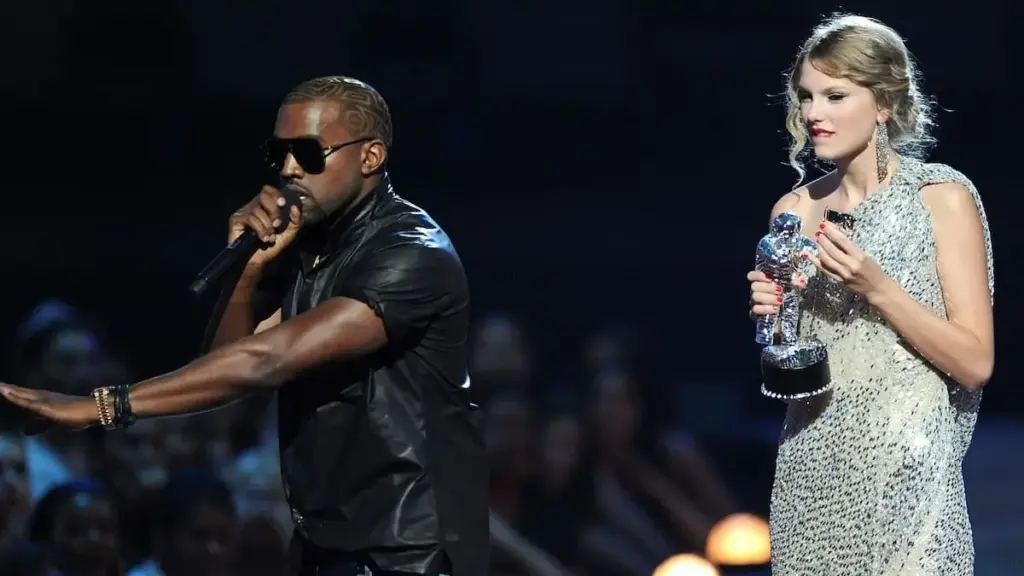
Seventeen years ago, a single unscripted intrusion on live television permanently altered the trajectory of modern pop culture, music history, and celebrity branding. When Kanye West bounded onto the stage at the 2009 MTV Video Music Awards (VMAs) to wrest the microphone from a bewildered 19-year-old Taylor Swift, he sparked an interstellar collision between two of the defining musical titans of the twenty-first century.
What began as a startling, alcohol-fueled outburst over a trophy for "Best Female Video" metastasized into a multi-decade saga defined by public humiliation, retaliatory art, presidential condemnation, leaked phone calls, and the shared psychological burden of global fame. Far from remaining a mere footnote in award-show history, the "Imma let you finish" incident served as the genesis for two radically divergent career evolutions.
For Taylor Swift, it catalyzed an underdog-to-superstar ascent, eventually culminating in unprecedented global dominance and a masterclass in reclaiming narrative control. For Kanye West, it marked the tragic, brilliant descent into an isolated villain persona—one that birthed some of the most critically acclaimed hip-hop albums of all time while laying the foundation for a volatile public existence. This is the definitive retrospective of the night that stopped the entertainment world in its tracks, tracing how a ten-second interruption shaped the musical landscape we navigate today.
Detailed Chronology: The Night the Music World Stood Still
September 13, 2009: The 2006 VMA Stage Incursion
The setting was Radio City Music Hall in New York City. The category was Best Female Video. Nominee Taylor Swift—then a rising country-pop darling known for her earnest guitar-strumming and relatable lyricism—sat among heavyweights like Lady Gaga, Kelly Clarkson, Pink, Katy Perry, and Beyoncé. When presenter Alicia Keys announced Swift as the winner for her ubiquitous crossover hit "You Belong With Me," the teenager beamed with genuine, breathless disbelief.
As Swift delivered her acceptance speech, expressing sheer gratitude for simply being in the room, Kanye West materialized from the VIP section. Dressed in a sleek suit with his signature sunglasses, West strode up the steps, gently took the microphone from the young singer’s hand, and delivered the immortal lines:
"Yo, Taylor, I’m really happy for you, and I’mma let you finish, but Beyoncé had one of the best videos of all time!"
The broadcast cut to a stunned Beyoncé in the audience, mouthing a silent expression of horror and disbelief. West shrugged his shoulders, handed the mic back, and flashed a defiant, toothy grin to the booing crowd. The internet erupted instantly, birthing a viral meme template that would endure for nearly two decades. Yet, beneath the punchlines, the cultural shockwaves were immediate and severe.
September 14–15, 2009: The Immediate Backlash and Apology Tour
The morning after the ceremony, the backlash was universal and unforgiving. Entertainment publications, morning talk shows, and social media platforms united in condemnation. Recognizing the severity of the PR disaster, West appeared on The Jay Leno Show just days later to offer a tearful, unprompted mea culpa.
"It’s been a difficult day," West admitted to Leno. "I’m just dealing with the fact that I hurt someone or took anything away from a talented artist or from anyone… I immediately knew in this situation that it was wrong. It’s someone’s emotions that I stepped on. It was rude, period."
Despite the contrition, the public appetite for outrage was unquenchable. The incident escalated from a pop-culture gaffe to a national talking point when President Barack Obama, caught on a hot mic during an off-the-record interview segment, famously labeled West a "jackass."
Swift, meanwhile, navigated the storm with strategic grace. She appeared on Saturday Night Live, delivering a witty monologue and a musical opening number ("Monologue Song (La La La)") that gently lampooned the incident without leaning into bitterness. However, the emotional toll found its way into her music, notably on her 2010 track "Innocent," where she seemingly extended an olive branch to the embattled producer:
“It’s all right / Just wait and see / Your string of lights is still bright to me / Who you are is not where you’ve been / You’re still an innocent… It’s OK / Life is a tough crowd / 32 and still growing up now.”
Supporting Context & Metrics: The Dual Ascents of Swift and West
The Artistic Fallout: My Beautiful Dark Twisted Fantasy
For Kanye West, the 2009 VMAs created an unbridgeable chasm between his artistic genius and his public standing. Banished to creative exile in Hawaii, West channeled his isolation, shame, and societal rejection into what many critics regard as the greatest rap album of the 21st century: My Beautiful Dark Twisted Fantasy (2010).
In a revealing 2013 retrospective interview with The New York Times, West laid bare the psychological mechanics behind the album, describing it not merely as a collection of songs, but as a calculated social strategy:
"My Beautiful Dark Twisted Fantasy was my long, backhanded apology," West explained. "You know how people give a backhanded compliment? It was a backhanded apology… It was like, all these raps, all these sonic acrobatics. I was like, ‘Let me show you guys what I can do, and please accept me back. You want to have me on your shelves.’"
The Pop Monarchy: Taylor Swift’s Transition
While West wrestled with his self-inflicted villain status, Taylor Swift capitalized on her widespread sympathy to engineer a historic crossover. Shedding her country-music ringlets for high-fashion pop aesthetics, she released Red (2012) and 1989 (2014), the latter of which won the Grammy Award for Album of the Year and cemented her status as an untouchable global pop monarch.
For a brief, shining moment, the hatchet appeared buried. At the 2015 MTV VMAs, an olive branch was seemingly extended when Taylor Swift presented Kanye West with the prestigious Michael Jackson Video Vanguard Award. The two embraced on stage, sharing smiles that convinced the public the long chapter of animosity had finally closed.
Official Statements and Escalating Tensions: The 2016 "Famous" War
The truce dissolved permanently in February 2016 with the release of West’s track "Famous." The song featured the incendiary, highly provocative lyric:
*"I feel like me and Taylor might still have sex / Why? I made that b**h famous."
The PR Blitz and the Leaked Phone Call
When the track dropped, Swift’s public relations team immediately pushed back, asserting that West had never consulted her regarding the explicit lyric and that she had warned him about releasing a song with such a misogynistic undertone.
Enter Kim Kardashian. The reality television star and then-wife of Kanye West detonated a cultural hand grenade in July 2016 by publishing secretly recorded video footage on Snapchat. The clips captured a phone conversation between West and Swift, in which West read her the line about sex, and Swift appeared to give her blessing, calling it a "compliment" and joking that she would laugh about it on the Grammy red carpet.
The fallout was swift and devastating for Swift’s reputation. The internet turned on her overnight, deploying the snake emoji across her social media channels in millions. The backlash forced Swift into a self-imposed hiatus from public life, during which she retreated to draft the blueprints for her 2017 revenge-pop masterwork, Reputation.
On tracks like "This Is Why We Can’t Have Nice Things," Swift directly addressed the betrayal:
“There I was giving you a second chance / If only you weren’t so shady / But you stabbed me in the back while shaking my hand / And therein lies the issue / Friends don’t try to trick you / Get you on phone and mind-twist you.”
Years later, unedited footage of the phone call leaked in full, vindicating Swift by proving that West had omitted the critical line—"I made that b***h famous"—from the snippet he played for her over the phone. However, by the time the truth emerged, both artists had already weaponized their respective public perceptions to fuel their art.
Future Outlook: Diverging Paths in the Modern Era
Today, Kanye West and Taylor Swift inhabit entirely different stratospheric realms of the entertainment industry, their paths diverging into starkly contrasting realities.
Taylor Swift stands at the absolute zenith of modern music history. Fresh off the historic, billion-dollar economic juggernaut of The Eras Tour—which reshaped global tourism, set new benchmarks for live-entertainment revenue, and solidified her status as a cultural institution—Swift has fully embraced her complex relationship with fame. Through tracks like "Anti-Hero," she has learned to lean into her vulnerabilities, acknowledging her own flaws while retaining absolute dominion over her art, her masters, and her narrative.
Kanye West, conversely, has navigated a turbulent series of controversies, erratic public behavior, and business excommunications that have deeply alienated mainstream partners. Yet, true to his cyclical career trajectory, the producer-rapper has spent recent years attempting to rebuild his foundation through international performance residencies, informal apology tours, and a return to the foundational sonic architecture that made him a legend.
Seventeen years after a startled teenager clutched a Moon Person trophy on a New York stage, the shockwaves of the 2009 VMAs continue to reverberate. It stands as a cautionary tale about the perils of live television, the weaponization of celebrity culture, and the extraordinary power of two distinct creative forces who used the same incendiary spark to forge entirely opposite destinies.