Executive Overview
In the season-three premiere of HBO’s Euphoria, an exhausted Rue—played by Zendaya—finds herself on a remote southwestern ranch, staring into a bucket of raw cow’s milk. After scooping out a mug and taking a deep gulp, she proclaims, “That’s the best f*cking milk I’ve ever had.” The experience is so profoundly restorative that Rue instantly begins romanticizing the rancher lifestyle, fixating on its quiet, internet-free simplicity compared to her own chaotic reality. She conveniently overlooks the inhabitants’ disdain for immigrants and the women’s regressive "tradwife" attire. The show suggests that a fresh, cold glass of milk possesses a unique magic: it can anchor you, offer solace, evoke forgotten memories, and manufacture nostalgia for a simpler world that may never have actually existed.
Now, the beauty and wellness industries are asking a pivotal question: Can a milky perfume do the same?
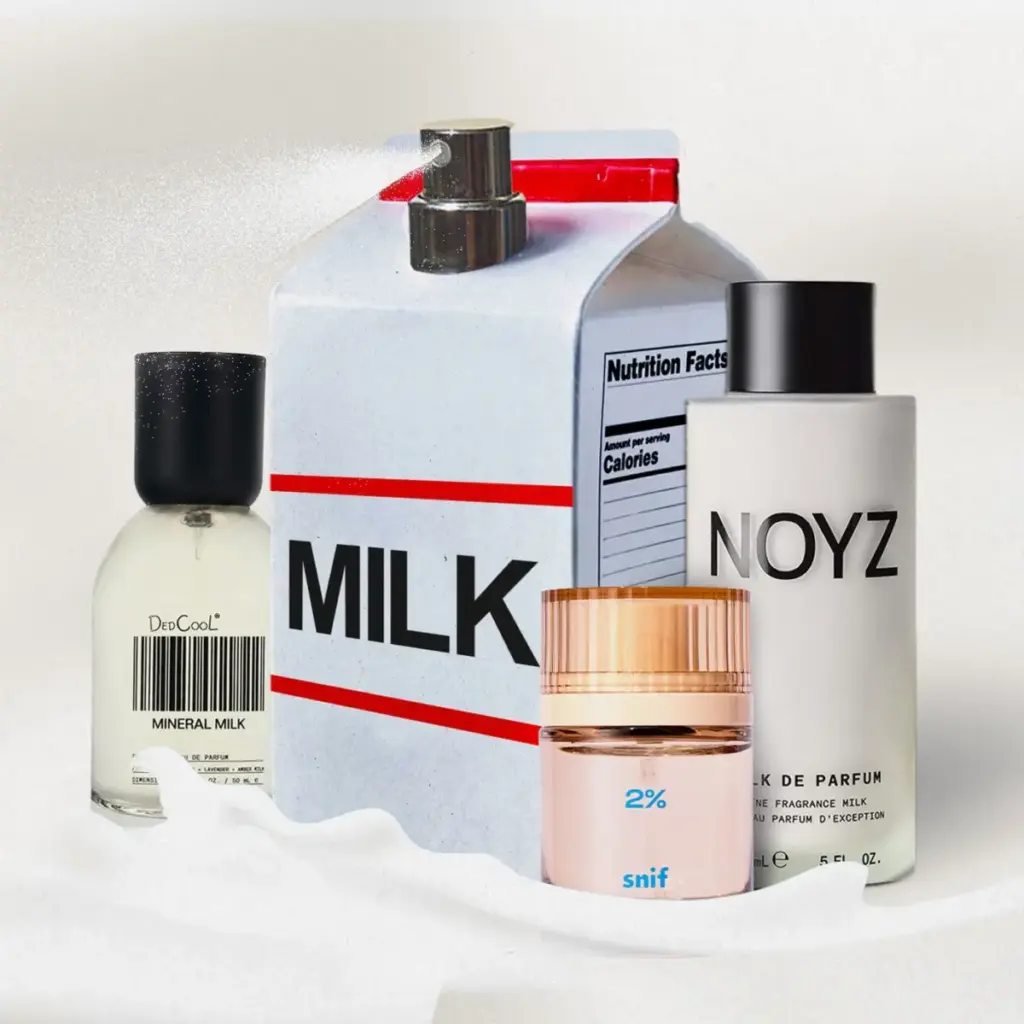
In recent years, the concept of "milk" has broken free from the dairy aisle and saturated the global beauty market. From Glossier’s pioneering Milky Jelly Cleanser and Milk Makeup to Rhode’s viral Glazing Milk and Herbivore’s glass-bottle-mimicking Coco Rose Milky Body Mist, dairy-inspired and texture-driven formulations dominate shelves at Ulta, Sephora, and Olive Young. Parallel to this skincare boom, the fragrance market has undergone a dairy-forward revolution. Brands like DedCool, Commodity, Snif, The Nue Co., and Noyz have built empires on "lactonic" notes, transforming the concept of milk into one of the most lucrative and culturally telling scent profiles of the decade.
This obsession with milk—both literal and olfactory—arrives at a fascinating intersection of modern socio-political and dietary trends. As "proteinmaxxing" dominates digital fitness culture and GLP-1 weight-loss drugs reshape the nutritional landscape, consumption habits are shifting. Simultaneously, the glamorization of homesteading on social media has propelled raw milk and agrarian aesthetics into the political mainstream, championed by figures like Robert F. Kennedy Jr.
Yet, the explosion of milky perfumes is not merely a byproduct of agricultural shifts. Instead, it represents a deep-seated cultural psychological retreat. In an era marked by stubborn inflation, geopolitical volatility, and hyper-connected burnout, consumers are reaching for tactile, olfactory creature comforts. Milk-inspired fragrances serve as a sensory security blanket—an accessible, genderless micro-luxury offering youth, innocence, and safety in a chaotic world.
Detailed Chronology: The Rise of the Lactonic Aesthetic
While milky notes have historical roots in classical perfumery, their contemporary ascent can be mapped across a distinct timeline of shifting beauty standards and pandemic-era escapism.
.jpg)
2016–2019: The Conceptual Seeds
The modern baseline for milk-infused beauty was planted in 2016 with the simultaneous launches of Milk Makeup and Glossier’s Milky Jelly Cleanser. While these products were skincare-focused, they mainstreamed the aesthetic and textural connotations of milk: gentle, hydrating, minimalist, and wholesome. Concurrently, indie perfumeries began experimenting with lactones—organic compounds that produce creamy, milky olfactory profiles. In 2020, just as the COVID-19 pandemic paralyzed traditional retail, DedCool launched its signature "Milk" perfume. Conceptualized years prior by founder Carina Chaz as a light, intimate skin scent, the fragrance struck a chord precisely as global lockdowns forced consumers inward.
2020–2023: The Fragrance Boom and Skin-Scent Era
During the early pandemic, makeup sales plummeted, but the fragrance and skincare categories experienced unprecedented growth. As Business Insider reported, perfumes functioned as critical self-care tools and affordable emotional escapes. DedCool’s Milk sold out instantly upon its official launch. The fragrance laid the groundwork for a broader cultural shift toward "skin scents"—fragrances engineered to sit close to the body, blending with individual chemistry rather than projecting loudly across a room. This era also cemented a massive market obsession with vanilla, paving the way for more complex gourmand profiles.
2024–Present: The Floodgates Open
By 2024, the milk trend reached critical mass. Commodity expanded its popular Milk line with Milk Orchid; The Nue Co. launched First Milk; Snif introduced 2%, a sweet cereal-milk fragrance accompanied by body mists evoking iconic breakfast cereals; and LA-based indie brand Noyz debuted its Mylk de Parfum collection. Today, the market is saturated with dairy-adjacent and explicitly lactonic creations, from Dossier’s Milky White to regional releases like Arcadia by Amna’s Milk Musk. Milk is no longer just an ingredient; it is the dominant conceptual vocabulary of modern perfumery.
Supporting Context & Metrics: Diet Culture, GLP-1s, and Big Milk
The parallel surges in real dairy consumption and milk-inspired cosmetics highlight a broader macroeconomic and cultural realignment.
The Proteinmaxxing and GLP-1 Wave
Diet culture in the mid-2020s is defined by "proteinmaxxing"—the relentless pursuit of high protein intake paired with minimal calories. Concurrently, the widespread adoption of GLP-1 receptor agonists (such as Ozempic and Wegovy) has fundamentally altered consumer appetites. By 2025, approximately 12% of U.S. adults reported taking a GLP-1 medication for weight loss, diabetes, or related conditions. Nutritionists frequently recommend high-protein, nutrient-dense diets to mitigate muscle loss during GLP-1 treatment, driving renewed interest in dairy products as accessible, highly bioavailable protein sources.
However, this protein obsession has created a fascinating dichotomy. While agricultural researchers note that proteinmaxxing has spurred farmer interest in alternative crops like peas, lentils, and chickpeas—as reported by Reuters—consumers are not lining up for "eau de chickpea" at Sephora. Instead, milk has captured the collective imagination because of its deeply ingrained psychological symbolism.

The Revival of Traditional Dairy
After decades of declining per-capita consumption driven by the explosive growth of plant-based milks (oat, almond, soy), the U.S. dairy industry is experiencing a surprising renaissance. According to data highlighted by the New York Times, 2024 marked the first significant increase in whole-milk consumption in years, and only the second-ever increase recorded since the 1970s.
This resurgence is intrinsically tied to the anti-ultra-processed food movement. Consumers are increasingly skeptical of chemical-heavy ingredient lists, driving a cultural pivot toward "farm-to-table" staples. This dietary preference has bled directly into political and social spheres. The romanticization of agrarian life—manifested online through the viral "tradwife" movement and offline through figures like Robert F. Kennedy Jr., who famously championed raw milk—has elevated dairy from a breakfast staple to a cultural symbol of purity, health, and a rejection of modern industrialization.
Official Statements and Industry Insights
Perfumers, dairy executives, and brand founders agree that the milk-perfume phenomenon transcends traditional marketing; it is a direct response to the psychological climate of the mid-2020s.
Rachel Kyllo, Chief Marketing Officer for Dairy Brands at Dairy Farmers of America (DFA)—who has spent nearly four decades in the industry—views the return to dairy through the lens of comfort and authenticity.
"I think as people are looking for a beverage that harkens back to a simpler time, and also a product that isn’t ultra-processed, it just takes them to milk," Kyllo explains. "It’s just a simple, real, farm-to-table nostalgic kind of beverage, and then you couple that with the nutrition that folks are looking for today."
Perfumer Lorna McKay, co-founder of the Perfume Society, emphasizes that "milky" fragrances do not actually rely on literal dairy extracts. Instead, they harness evocative chemical architectures.

"Milky is not a material or an ingredient; it’s a concept and a feeling," McKay notes. "You’ll get things like tonka, vanilla, sandalwood, and all these softening elements that will make the milky fragrance in the end. But a perfumer will make a milky fragrance—they’ll call it lactonic or all sorts of things—but there’s not a milky ingredient. It’s the feeling that the people get when they wear these ingredients."
This sentiment is echoed by Kara Kowalski, Director of Fragrance and Formula Development at Snif, who developed the cereal-milk-inspired fragrance 2%.
"When the world is uncertain and we don’t know what to do, we want to go back to our creature comforts," Kowalski says. "I know in perfumery, we say that’s why gourmands are trending, because they’re comfortable. I think, in some way, milk does that too."
Carina Chaz, founder and CEO of DedCool, points out that the minimalist, non-invasive nature of milk scents made them ideal for a generation seeking personalized beauty.
"It was a noninvasive, everyone-likes-this scent profile. It changes on everyone’s skin," Chaz reflects on her original formulation. "We’re seeing a lot of milk, and it’s not only in fragrance; it’s in so many different categories in beauty. I think it makes sense. It’s something you can interpret in any way."
Malena Higuera, CEO of Noyz, highlights how cultural perspectives on self-care influence the adoption of rich, tactile fragrance formats like Mylk de Parfum.

"It’s so much for us, too, about how if we feel good on the outside, we actually feel good on the inside," Higuera says. "Flipping that script about self-care in a way that it is about the micro luxuries that are within reach."
Future Outlook: Where is the Milk Trend Headed?
As the beauty industry looks toward the horizon, the milk-perfume trend shows no signs of curdling. Far from being a fleeting TikTok-driven micro-trend, lactonic fragrances have established themselves as a permanent pillar of modern perfumery, sitting alongside florals, citruses, and woods.
The longevity of the trend lies in its radical versatility. Unlike hyper-specific seasonal scents, milk is a blank canvas. It can be twisted into a myriad of sub-genres:
- The Nostalgic Gourmand: Blended with cereal accords, marshmallow, and praline (e.g., Snif’s 2%) to evoke Saturday morning cartoons and childhood kitchen tables.
- The Intimate Skin Scent: Enhanced with pink pepper, cashmeran, and ambroxan (e.g., DedCool’s Milk and Noyz’s Only Human) to mimic the natural scent of warm skin.
- The Botanical Hybrid: Infused with lavender, amber, or rich florals (e.g., DedCool’s Mineral Milk and Commodity’s Milk Orchid) to offer a sophisticated, spa-like olfactory experience.
Furthermore, the societal drivers underpinning the trend—economic anxiety, digital burnout, and an ongoing cultural yearning for authenticity and safety—are unlikely to dissipate soon. As long as the external world remains unpredictable, consumers will continue to seek out olfactory armor.
Ultimately, milk fragrances offer a rare duality: they are deeply comforting yet entirely genderless, subtle yet deeply indulgent. They allow wearers to curate an aura of softness in a harsh landscape. Whether sprayed on as an act of radical self-care after a grueling workday or worn as a subtle nod to agrarian innocence, milky perfumes have successfully secured their place as the definitive comfort scent of the modern era.