Executive Overview
If you stepped onto a New York City subway platform this past summer, you likely encountered the season’s definitive style accessory: the portable personal cooling device. Whether it was a sleek, electric hand-held fan humming quietly in a commuter’s grip, a futuristic ergonomic neck fan channeling chilled air, or a chic paper fan snapping open with dramatic flair, cooling gadgets have graduated from the realm of practical emergency tools to items as ubiquitous and curated as a pair of designer headphones or signature sunglasses.
This transformation is more than a quirky seasonal trend; it is the commercial convergence of a warming planet and modern lifestyle marketing. As extreme weather events rewrite historical climate benchmarks—typified by New York’s Central Park hitting a scorching 100 degrees Fahrenheit, marking its highest temperatures in over a decade—global warming is shifting from an intermittent crisis to an everyday reality.
In response, brands across the beauty, wellness, and consumer technology sectors have seized an unprecedented market opportunity. By borrowing heavily from the playbooks of fashion and beauty marketing—leveraging limited-edition colorways, high-profile athlete endorsements, influencer-driven unboxings, and strategic lifestyle collaborations—companies have successfully transformed functional climate-mitigation tools into highly covetable lifestyle accessories. The "cooling aisle" may not yet exist as a distinct brick-and-mortar retail category, but savvy executives are rapidly carving out the space, educating consumers, and permanently rewriting how the modern urbanite dresses for an overheating world.
Detailed Chronology: The Evolution of the Personal Cooling Market
The metamorphosis of the portable fan from a utilitarian contraption into a luxury fashion statement did not happen overnight. It is the culmination of shifting consumer behaviors, worsening environmental conditions, and aggressive retail positioning that accelerated rapidly between 2024 and 2026.
The Spark: International Inspiration and the Birth of "Coldies"
The narrative began taking commercial shape when industry innovators experienced firsthand the grueling realities of international heatwaves. Katie Sturino, founder of the prominent body-care brand Megababe, found herself on a sweltering trip to Japan—a country long accustomed to advanced personal cooling culture. Searching in vain for sophisticated domestic products that offered instant, discreet relief from high humidity and heat, Sturino conceptualized a new category of wearable temperature control.
In August 2025, Megababe officially launched "Coldies," a line of reusable cooling patches engineered to be worn discreetly under bra cups or wrapped snugly around the neck. The product addressed a critical gap in Western wellness markets: the need for invisible, on-demand physical cooling. The response was immediate and overwhelming. The initial inventory sold out within a week of its late-summer debut, instantly generating a staggering 6,000-person waitlist for subsequent drops. Capitalizing on viral momentum, Megababe took the product directly to Gen Z consumers later that month by partnering with floss brand Cocolab to sell Coldies at the University of Georgia during the hyper-competitive campus Rush Week.
Design Leads the Way: The Blueair and Tech-Brand Pivot
While patches like Coldies targeted covert relief, visible gadgets required a different strategic angle. Traditional air-care companies quickly realized that consumers would no longer buy portable fans based purely on mechanical specifications, decibel levels, or battery life.
Swedish air-care brand Blueair recognized this cultural shift early. Rather than leading marketing campaigns with technical data sheets detailing airflow velocity and battery run-time, Blueair positioned its hardware as an extension of the consumer’s wardrobe.
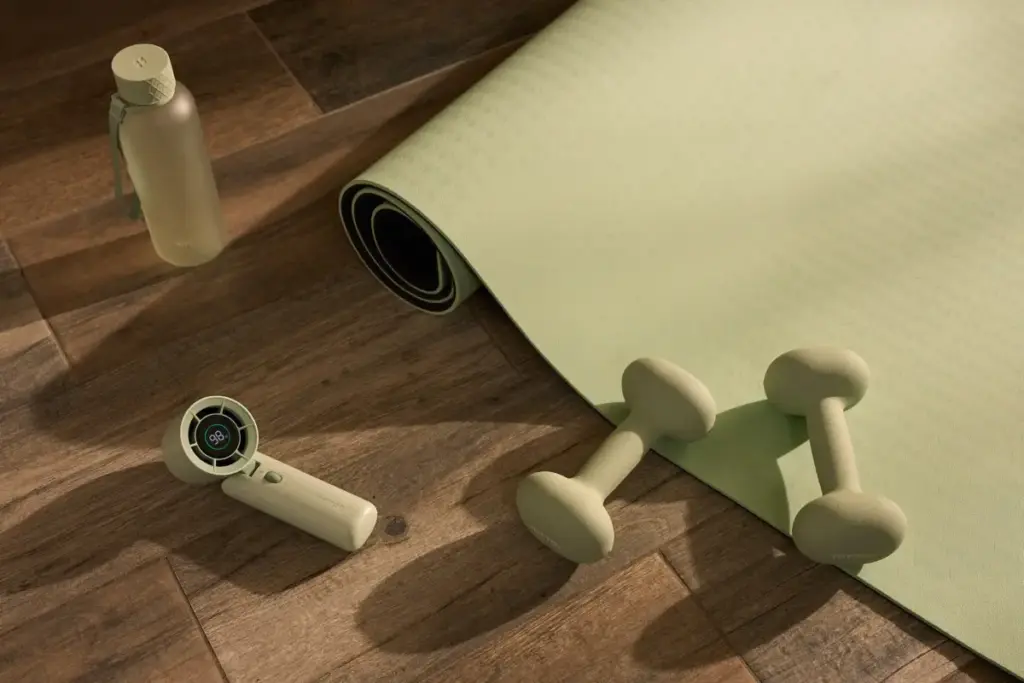
The brand’s $59.99 AlwaysCool Portable Handheld Fan was engineered to double as a fashion accessory. While available in minimalist neutral tones like matte black and stark white, it was an earthy sage green colorway that unexpectedly rocketed to the top of the sales charts. Sensing a cultural goldmine, Blueair doubled down on bold palettes. Ahead of the 2026 U.S. Open, the brand collaborated with tennis star and official ambassador Jessica Pegula to drop a vibrant tennis ball-green colorway. By aligning itself with high-profile athletes—including the September 2026 announcement of American tennis star Tommy Paul as a brand ambassador—Blueair successfully embedded itself within the booming "wellness enthusiast" demographic.
The Tech Giants Enter the Arena
By mid-2026, the competitive landscape had attracted heavy hitters from consumer electronics and home appliances.
- Dyson debuted its $99.99 Hushjet Mini Cool Fan, promoting it through strategic influencer partnerships. Content creator Mina Ceran famously showcased the blush-pink mini fan during a "What’s in my bag?" segment at the Cannes Film Festival, demonstrating how seamlessly the device slid into a luxury evening clutch alongside high-end lip liner and gloss.
- JisuLife captured the budget-conscious trendsetter market with its $69.99 Handheld Fan Pro1 Mini, heavily saturated in on-trend lilac and obsidian black.
- SharkNinja entered the fray with the $149.99 ChillPill Personal Fan and Cooling System, offering a striking palette ranging from aggressive hot pink to sophisticated matcha green.
The Analog Resurgence at Fashion Week
Curiously, the technological explosion of motorized, battery-operated gadgets ran parallel to a massive resurgence in traditional analog tools. At New York Fashion Week in September 2026, high-end fashion houses such as Retrofête and PatBo distributed custom-branded portable paper and cloth hand fans to front-row attendees and influencers alike. These traditional fans served a dual purpose: providing immediate physical relief from cramped, overheated runway tents while acting as highly effective, portable brand billboards captured endlessly by street-style photographers.
Supporting Context & Metrics: A Planet Heating Up
The rapid commercial expansion of the portable cooling industry is fundamentally anchored in harsh meteorological and digital data. Extreme heat is no longer an occasional meteorological anomaly; it is a statistical baseline.
+---------------------------------------------------------------------------------+
|                         KEY CLIMATE & MARKET METRICS                            |
+---------------------------------------------------------------------------------+
| • Global Temperatures: 2025 ranked as the 3rd-hottest year on Earth since 1850  |
|   (Berkeley Earth Global Temperature Report).                                   |
| • Frequency: U.S. heatwaves have doubled in frequency since the 1980s           |
|   (Fifth National Climate Assessment).                                          |
| • Urban Extremes: NYC recorded 100°F temperatures in summer 2026—the highest    |
|   in over a decade.                                                             |
| • Digital Interest: r/PortableFans subreddit views surged 2,075.8% YoY.         |
| • Search Intent: Pinterest searches for "hand fan aesthetic" spiked by 98%.     |
+---------------------------------------------------------------------------------+
Climate Data Realities
According to Berkeley Earth’s 2025 Global Temperature Report, the year 2025 cemented its place in history as the third-hottest year recorded on Earth since modern record-keeping began in 1850. This warming trend directly correlates with findings from the Fifth National Climate Assessment, which reveals that the annual frequency of heatwaves across the United States has officially doubled since the 1980s. When urban heat island effects are factored into densely populated concrete jungles like New York City, Tokyo, and London, daily summer commuting transforms into an endurance test.
Digital Demand and Search Intent
Consumers are mobilizing online to research, curate, and display their cooling equipment. Data compiled from Reddit indicates that between September 2025 and August 2026, the niche community r/PortableFans generated 16,900 global views, representing a staggering 2,075.8% year-over-year increase.
Simultaneously, visual-search engines point to explosive aesthetic curation:
- Pinterest searches for mini handheld fans grew by 64% between August 2025 and August 2026.
- Searches for portable neck fans increased by 55%.
- Search interest for the specific term "hand fan aesthetic" surged by 98%.
- Counter-intuitively, even low-tech options saw massive digital demand, with year-over-year searches for the "traditional hand fan" jumping 145% in August 2026.
This consumer behavior mirrors the exact playbook previously written by the reusable water bottle industry. Brands like Stanley transformed heavy, industrial, temperature-retaining metal tumblers into coveted, collectible fashion statements through limited-edition colorways and high-profile collaborations with design houses like LoveShackFancy and Farm Rio. Competitor Owala similarly generated sneaker-drop-level chaos with pop-up lines for its brightly colored, ergonomic bottles, while Hydrojug captured the youth market crown during the 2026 holiday shopping season. Portable fans have officially inherited this exact cultural architecture: a utilitarian object re-engineered as an expression of personal identity.
Official Statements and Industry Insights
To understand how corporate leadership views this hyper-growth phase, industry executives point toward profound psychological shifts in how consumers manage daily comfort and personal wellness.
"We are witnessing the start of a huge category explosion because being dangerously hot isn’t a summer gimmick — it’s a daily comfort issue. There’s no ‘cooling aisle’ on retail shelves yet, which means we get to build that space, educate shoppers and lead the conversation."
— Katie Sturino, Founder of Megababe
Sturino’s perspective highlights the greenfield nature of the market. Because historic retail environments categorized personal care strictly by skin type, hair texture, or oral hygiene, thermal comfort was historically ignored as an organized retail sector. Brands are now aggressively staking their claims on shelf space—both digital and physical.
From the consumer electronics and lifestyle design perspective, the messaging centers on identity integration. Lindsay Lane, Head of Brand at Blueair, emphasizes that modern buyers view their cooling gear not as medical or emergency apparatuses, but as curated additions to their daily wardrobes.
"I think what people are doing is they’re really utilizing these items as an extension of their wardrobe and how they want to feel that day. Rather than leading with specs and dimensions and how many feet the airflow will reach, I wanted to lead first and foremost with a lifestyle and with a design story."
— Lindsay Lane, Head of Brand at Blueair
Lane notes that the modern buyer is deeply invested in "habit-stacking"—the psychological phenomenon where consumers relentlessly optimize their daily routines by combining wellness rituals, wearable health trackers, and lifestyle optimizations.
"These are the people that are habit-stacking. They’re constantly improving their routines and wearing all the wearables, and thinking about, ‘How can I do my sleepy-girl mocktail at night?’ We become a part of all of these different things by way of these consumers optimizing their lives in all ways."
— Lindsay Lane, Head of Brand at Blueair
Future Outlook: The Permanent Integration of Cooling Culture
As global temperatures continue to challenge historical records and urban centers grapple with the compounding effects of climate change, the portable cooling market is poised for permanent, structural integration into the consumer goods economy.
1. The Institutionalization of the "Cooling Aisle"
Just as the skincare industry successfully evangelized the daily application of SPF 50 sunscreen year-round regardless of cloud cover, the personal cooling industry is laying the groundwork for thermal regulation to become a 365-day wellness practice. Retailers are expected to formalize "cooling" as a permanent department within major department stores and beauty retailers, bridging the gap between personal care, outdoor apparel, and consumer electronics.
2. Smart Integration and Advanced Materials
Future iterations of portable cooling devices will likely move beyond simple battery-powered brushless motors. Industry analysts predict the rapid integration of phase-change materials (PCMs), thermoelectric cooling plates (Peltier coolers) integrated into wearable jewelry, and smart-device connectivity that syncs personal fans with local weather APIs and wearable biometric sensors to automatically adjust airflow based on core body temperature.
3. High-Fashion Co-Branding Normalization
The crossover success seen at New York Fashion Week and the Cannes Film Festival signals that luxury fashion houses view personal cooling accessories as viable runway and retail merchandise. Expect future seasons to feature luxury leather fan holsters, designer neck-fan straps, and co-branded drops that merge haute couture with high-output aerodynamics.
Ultimately, the humble portable fan has transcended its origins as a cheap plastic trinket bought in desperation at a souvenir stand. It has matured into a sophisticated lifestyle marker—a functional armor worn proudly by urbanites navigating a warming world with style, utility, and undeniable cool.