In the upper echelons of global fashion, few names carry the subversive legacy of Franco Moschino. During the height of 1980s conspicuous consumption, Moschino weaponized humor, transforming high fashion into a satirical commentary on its own vanities. From a Chanel-esque jacket embroidered with the bold declaration "This is a Waist of Money" to skirts fashioned from neckties and handbags labeled "This Is Not an It Bag," his creations were never mere gimmicks. They were profound acts of design deconstruction grounded in an immaculate understanding of couture technique.
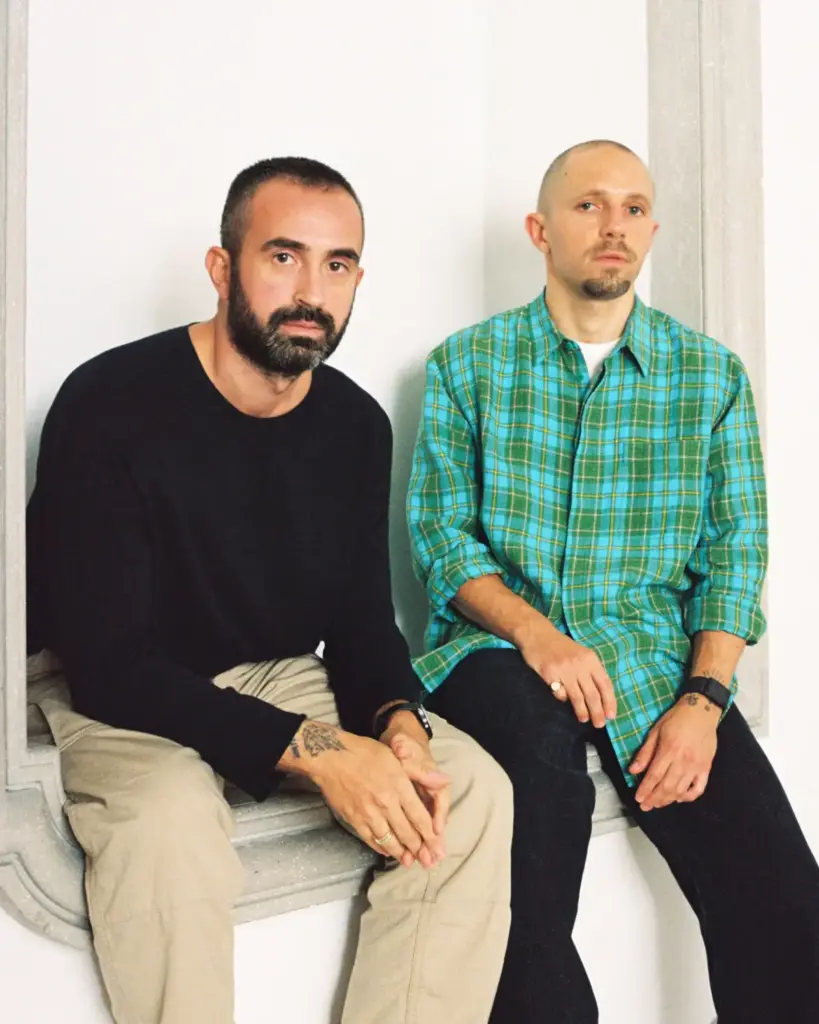
Enter Simone Rizzo and Messina Loris, the former creative minds behind indie cult label Sunnei, who assumed creative direction at Moschino last June. Stepping into a lineage previously helmed by Rossella Jardini, Jeremy Scott, and Adrian Appiolaza, the duo spent their initial two months listening rather than shouting. Rather than treating the brand’s iconic archives as a dressing-up box of nostalgic props—avoiding the reflexive reliance on smiley faces, slogans, and wind-mill buttons—Rizzo and Messina are intent on metabolizing the house’s foundational spirit.
As they approach their forty-year milestones, these self-described rompipalle (pains in the neck) are transitioning from driving a metaphorical "Fiat 500" at Sunnei to steering a racing-grade "Maserati" at Moschino’s parent company, Aeffe. Their inaugural chapter represents a paradigm shift: moving away from surface-level novelty and digital hyper-broadcasting toward an intellectual, highly crafted conceptualism. By rejecting the modern "digital bulimia" of the current fashion landscape—even choosing to omit a livestream for their debut runway presentation—Rizzo and Messina are redefining what it means to be a provocative house in the 21st century.
DETAILED CHRONOLOGY: From Sunnei’s Underground to Moschino’s Executive Suite
The journey of Simone Rizzo and Loris Messina to the helm of Moschino spans over a decade of calculated rebellion against traditional industry standards.
Phase 1: The Independent Years at Sunnei (2012–2024)
For twelve years, Rizzo and Messina operated outside the established machinery of the traditional fashion system. Building Sunnei from the ground up, they earned a reputation for upending runway conventions. Their presentations were experiments in audience psychology and collective behavior:
- The Cognitive Runway: Staged voice-overs narrated the inner monologues of models mid-walk.
- Interactive Spectacle: Audiences voted in real-time on the looks paraded before them.
- Radical Staging: Crowdsurfing was integrated into performance art installations, positioning fashion as a behavioral canvas rather than a static commercial display.
Operating as anti-system outsiders, they honed a distinct aesthetic vocabulary grounded in agility, independent thought, and punk sensibilities.
Phase 2: The Sabbatical and the Call from Aeffe (Early 2024)
Following more than a decade at Sunnei, the duo intentionally stepped away from the industry for a year-long sabbatical. Disconnecting entirely from the fashion cycle, they traveled, exercised, and reconnected with the physical world. This period of deliberate distance provided them with critical perspective, immunizing them against the burnout characteristic of modern creative directorships.
By mid-2024, the call came from Aeffe, the Italian luxury group and parent company of Moschino. Tasked with succeeding Adrian Appiolaza, Rizzo and Messina accepted the challenge of scaling their artistic vision to a historic global house.
Phase 3: The First Two Months at Moschino Headquarters (June–August 2024)
Upon taking over the Milan-based headquarters, Rizzo and Messina enacted a strict rule of observation. They began by meticulously mapping out the physical archives dispersed between Milan and Cattolica. Moving past the superficial caricatures of Franco Moschino’s pop-culture era, they examined the pristine tailoring, advanced draping, and structural rigor underscoring the brand’s historic garments. By late summer, they finalized the framework for their debut collection—a body of work designed without the intermediary layer of an external stylist, relying entirely on internal alchemy and precise craftsmanship.
SUPPORTING CONTEXT & METRICS: The Business of Subversion
To understand the weight of Rizzo and Messina’s appointment, one must contextualize the operational scale and commercial gravity of Moschino within the contemporary luxury market.
| Metric / Indicator | Historical Context | The Rizzo-Messina Strategy |
|---|---|---|
| Manufacturing Infrastructure | Creative bursts anchored by diverse external suppliers and varied historical execution. | Leveraging Aeffe’s elite industrial execution to match intellectual concepts with exacting luxury standards. |
| Digital Footprint | Hyper-broadcasted, instant-gratification social media streams and livestreaming saturation. | Intentional reduction in digital volume; a shift away from livestreams toward physical, real-world "happenings." |
| Stylistic Approach | Literal reproduction of archival jokes (smiley faces, slogan tees, plastic food accessories). | Conceptual irony rooted in tailoring; viewing the archive as a laboratory rather than a museum. |
| Brand Equivalence | Fashion house as a novelty machine. | Brand positioned as a "cultural amplifier" comparable in cultural ubiquity to global entities like Coca-Cola. |
The "Aristocrat on Mars" Paradigm
Rizzo and Messina’s vision for the modern Moschino consumer is encapsulated by their striking persona: the "aristocrat on Mars." This fictional demographic defines the tension between heritage luxury and eccentric futurism. It demands a wearer who possesses the autonomy to dress independently, appreciates elite tailoring, and rejects pedestrian trends in favor of intellectual sophistication.
Furthermore, the designers frequently reference the industrial upgrade from Sunnei to Moschino as a shift from a "Fiat 500 to a Maserati." While Sunnei thrived on scrappy, bootstrap innovation, Aeffe’s manufacturing ecosystem grants the creative directors access to elite Italian ateliers. This allows them to produce garments where high conceptual irony is inextricably bound to impeccable material execution.
OFFICIAL STATEMENTS: In the Designers’ Words
The creative direction of Rizzo and Messina is defined by a distinct manifesto of intentionality, captured through their shared press statements and preview disclosures:
-
On the Nature of Irony:
"For us it is fundamental that irony is in the concept. If irony is in the product, it becomes ornament."
-
On Moving Beyond Literal Replication:
"We are meticulously studying why Moschino made sense. But we don’t want to replicate it. We want to understand it in order to create the Moschino of the future… The only thing we are carrying forward is his spirit and his way of thinking."
-
On Their Anti-System Roots:
"We have always been spaccapalle, not really simpatico. We were born outside the system and became anti-system, even though now we are inside it up to our necks."
-
On Rejecting Digital Overload:
"There is a digital bulimia that, frankly, is excessive. There has to be a way of breaking free from this addiction to being there at all costs… We don’t want to waste energy creating something that will last for zero seconds of attention."
-
On the Radical Power of Beauty:
"Today there is nothing more irreverent than the serenity of beauty. Knowing how to stand, a certain posture. We don’t want to have to climb over ourselves to find formulas to be cool. We will go straight ahead, concentrating on creating something beautiful."
FUTURE OUTLOOK: What Lies Ahead for Moschino
As Rizzo and Messina prepare to unveil their debut collection, the industry watches with bated breath. Their refusal to utilize an external stylist signals an inward-looking, highly personal creative control designed to protect the purity of their artistic vision.
Key Pillars of the New Era:
- The Death of the Livestream: By opting out of broadcasting their debut runway show across digital platforms, the designers are challenging the fashion week status quo. They aim to restore exclusivity, physical presence, and genuine human exchange over metrics-driven visibility.
- Intellectualizing the Archive: Moving forward, the physical collections will eschew recycled gags (such as plastic fast-food packaging or literal traffic cones) in favor of semantic wit. The focus will rest on tailoring that communicates complex sociological and cultural ideas.
- Reviving the "Cultural Amplifier": Just as Franco Moschino treated his garments as a mirror reflecting the absurdities of consumerism, Rizzo and Messina intend to position Moschino as an incubator for cross-disciplinary cultural critique, bridging fashion, fine art, and performance.
Ultimately, Rizzo and Messina are not positioning themselves as ghostly impersonators of Franco Moschino. Instead, they are acting as custodians of his uncompromising freedom. By marrying disciplined, obsessive craft with a deliberate step away from the industry’s cacophony, they are proving that true subversion in the modern age requires neither a megaphone nor a recycled gimmick—it requires the quiet, unshakable confidence to create beauty with purpose.