Tucked away in the Smithsonian Institution’s National Museum of African American History and Culture is a stunning piece of fashion history: a pharaonic black velvet scoop-neck evening gown from 1961, detailed with a straight skirt of gold sequins, geometric embroidery, and a coordinating black chiffon scarf with matching paillettes. This vintage couture masterpiece was worn by Ophelia DeVore, a visionary widely celebrated as America’s first Black model.
Yet, the true historical weight of DeVore’s legacy rests quietly at the bottom of this dress’s display placard, bearing a provocative and paradigm-shifting subheading: The Roots of New York Fashion Week.
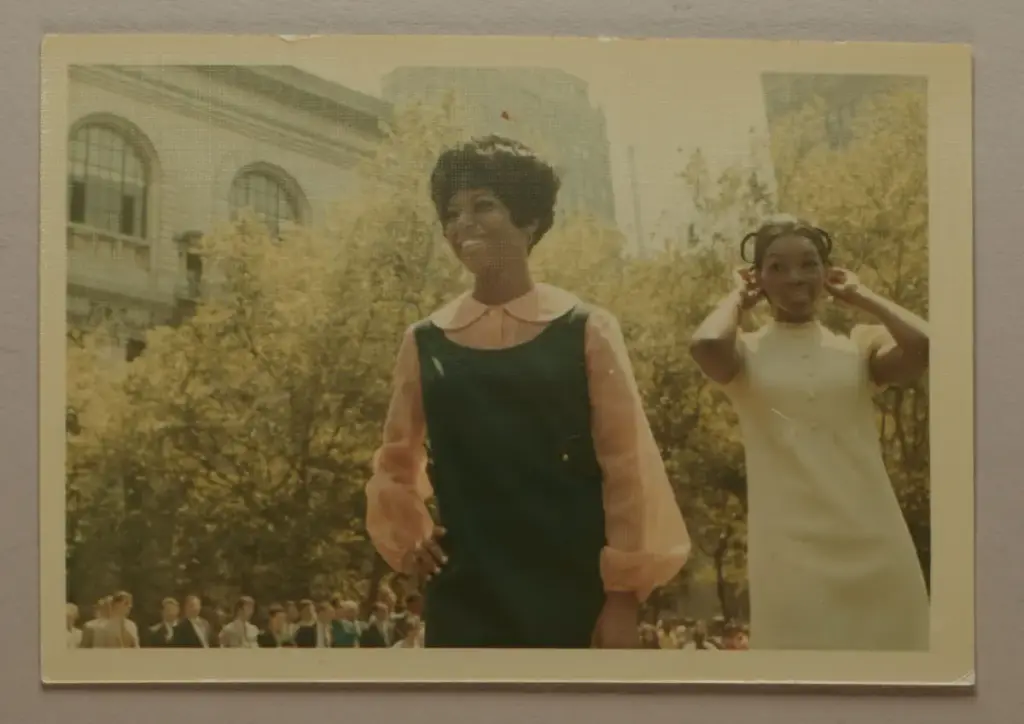
According to the museum’s documentation, DeVore utilized her groundbreaking Grace Del Marco modeling agency to orchestrate innovative fashion shows in New York City’s Bryant Park. During summer lunch hours, her multicultural models walked the runway, presenting avant-garde styles in an open-air format. The presentations were so overwhelmingly impressive that mainstream marketers eventually co-opted the concept, erecting tents and inviting global designers to establish what would officially become New York Fashion Week.
This startling revelation cuts to the core of institutional amnesia, systemic tokenism, and the historical erasure of Black creators within the fashion industry. While mainstream publications like Vogue and institutions like the Council of Fashion Designers of America (CFDA) have largely omitted DeVore from the genesis story of New York Fashion Week, an investigative look into her extraordinary life reveals a staggering web of resilience, innovation, and cultural disruption. DeVore did not simply participate in fashion history—she wrote its blueprints.

Detailed Chronology: The Life, Trials, and Triumphs of Ophelia DeVore
To understand how Ophelia DeVore laid the groundwork for modern fashion, one must traverse a timeline marked by near-fatal tragedy, corporate diplomacy, and audacious public spectacles.
Early Barriers and Breakthroughs (1940s–1950s)
Long before diversity became a corporate buzzword, DeVore was shattering ceilings piece by piece. As early as 1949, she elevated showroom exhibits by modeling a gray Persian lamb fur coat designed by John T. Vidal, America’s premier Black furrier at the time, during a landmark "fashion cruise and dance."
By 1955, DeVore expanded her media footprint by hosting ABC’s Spotlight on Harlem, recognized as New York’s first television show produced by and for Black Americans. Identifying a glaring void in the cosmetic market, the multiracial pioneer launched a custom line of beauty products tailored specifically for non-white skin tones. Her modeling agency achieved international acclaim in 1959 when one of her proteges, Cecelia Cooper, became the first American and first Black woman to win the Miss Festival beauty contest at the Cannes Film Festival—a feat repeated by another Del Marco model the following year. These historic victories positioned DeVore’s agency as the primary pipeline for international fashion houses, prompting Christian Dior to source Helen Williams directly from her roster for global expansion.
The Detroit Crash and Hospital-Room Innovation (1952)
DeVore’s momentum faced a catastrophic hurdle in 1952 when she was involved in a horrific car accident during a blinding Detroit snowstorm. Friends pulled her broken body from the flaming wreckage of a Buick Special just moments before it exploded. She awoke from a two-week coma encased in a body cast from the neck down, suffering from crushed legs, broken shoulders, a dislocated arm, and shattered teeth.

"The only thing holding me together was the brand-new girdle I had worn," she later recounted to her family.
Confined to a hospital bed for nine months—including five months in traction—DeVore refused to let physical trauma halt her ambition. Alina Mitchell, author of the biography The Color of Beauty, notes: "She had one good hand and she used it to sign contracts from her hospital room… Imagine being stuck in a hospital for months and using that time to think up ways to improve the fashion industry."
The Bryant Park "Fashion Extravaganzas" (1969–1970)
Decades before white marketers formalized fashion week inside massive white tents, DeVore was already transforming Bryant Park into an open-air runway. Archival flyers, handwritten logistics, and family photographs reveal that weeklong shows in 1969 and 1970—hailed as "fashion extravaganzas" by The Amsterdam News, New York’s Black newspaper of record—featured garments from Butterick, Gay Gibson, Pandora Frocks, menswear by Oleg Cassini (Jacqueline Kennedy’s favorite designer) and Federico Pio, and wigs by Jacqueline Lee.
An article from September 1970 details the scope of these productions:

"Featured in the fashions in the park were noted Black, Oriental and Spanish-speaking male and female models, both adults and children. They paraded garments contributed by major manufacturers, fashion houses, accessories firms and designers. Ophelia DeVore commentated."
Set to the eclectic soundtrack of a Chicano garage band from California, The Premiers, and radio hits like The Jones Girls’ "My Own Special Way," these meticulously planned events required City Hall permits, rain dates, and strictly enforced capacities capped at 500 attendees.
Global Diplomacy and Later Years
DeVore’s influence extended far beyond the runway. She served as an elite image consultant for the governments of Haiti and Nigeria, styling political figures with the poise of an international diplomat. In 1985, she partnered with Zenami Mandela—daughter of Nelson Mandela—to open the Fashion & Beauty Centre in Swaziland while the anti-apartheid leader remained imprisoned in South Africa.
Balancing her global endeavors, DeVore spent the latter half of her life managing The Columbus Times, a Georgia-based Black newspaper she inherited after her second husband’s death. She passed away in 2014 at the age of 92, leaving behind an agency that had trained over 40,000 hopefuls across seven decades.

Supporting Context & Metrics: Unpacking the Erasure of Black Excellence
The minimization of DeVore’s pioneering role in establishing New York Fashion Week is part of a broader historical pattern. Similar systemic amnesia clouded Central Park’s 1969 "Black Woodstock" concert for decades until Questlove’s Oscar-winning documentary Summer of Soul brought it to light.
The Mechanics of Institutional Erasure
Scholars and archivists point to various factors contributing to this collective memory loss. Gabrielle Dudley, an archivist at Emory University—the caretaker of DeVore’s personal archives—notes the exhausting nature of being a historical pioneer:
"Ophelia DeVore lived a long life… and these shows were maybe a blip to her. In the Black fashion community, it was something that was very much looked forward to. It was very significant… [but] so many Black people were doing it that of course someone was doing it in the fashion industry."
Furthermore, structural gatekeeping within academic and cultural institutions has hindered the dissemination of DeVore’s history. Emory University, for instance, operates under a policy requiring up to 15 business days to digitize a single image from its vast DeVore collection. Over 13 years of stewardship, only a single image of DeVore had been digitized prior to media inquiries—highlighting how bureaucratic hurdles inadvertently suppress the visibility of Black women’s historical achievements.

Cultivating "Black Diamonds"
DeVore’s charm school and modeling agency did more than produce mannequins; they cultivated self-worth. MaryLouise Patterson, who attended DeVore’s charm school in the 1950s as a teenager before becoming one of America’s leading pediatricians, reflects on the profound impact:
"It was like I was going from being a little girl to being a young lady… the distinction being that you had these manners and this refinement that was special. Not everybody had that. I always wanted to present myself in the best light and Ophelia DeVore gave me that… It has helped me through."
DeVore’s philosophy rejected the superficial exclusivity of high fashion. As she famously summarized: "They did not have to be the most beautiful, the best dancer, or the most talented. All they had to be was the best representation of themselves. My philosophy was there was no such thing as an ugly person, only a lazy one."
Official Statements and Institutional Responses
When confronted with the historical attribution on the Smithsonian placard regarding the roots of New York Fashion Week, the museum’s public affairs office declined interview requests, and media specialists were unable to provide specific details regarding the exact years, marketers, or designers involved.

Mainstream fashion institutions have demonstrated a similar blind spot. The CFDA’s official website makes no mention of DeVore, and Vogue has historically relegated her influence to brief, passing references regarding her charm school while ignoring her foundational runway productions.
Industry icons, however, are acutely aware of the systemic omission. Legendary model Bethann Hardison reflects on the era of systemic integration:
"You could do things back then. You could just do things—could be the first of things. You don’t think of it at that time. You’re so busy integrating. The struggle was a wonderful fight because we knew what we had on our side. We were gangsters, revolutionaries, Buffalo soldiers. But it wasn’t one note. Del Marco knew how to change over decades, over generations."
Future Outlook: Reclaiming the Narrative
As contemporary fashion grapples with issues of diversity, equity, and inclusion (DEI), the rediscovery of Ophelia DeVore’s legacy serves as both a corrective and an inspiration.

Emory University’s stewardship of the DeVore archives has already sparked university courses centered on "Black Beauty," "The Power of Black Self-Love," and "Resisting Racism." Student research and scholarly dissertations are slowly transforming private archives into public consciousness, ensuring that future generations recognize the foundational architecture built by Black women in fashion.
When artists create masterworks, their signatures are traditionally emblazoned in paint, stone, or stitchwork for the world to see. DeVore’s magnum opus, by contrast, was baked directly into the modern concept of runway presentation, multicultural representation, and industry infrastructure. Understanding the magnitude of her contributions, DeVore spent her life fighting against obscurity. Explaining why she proudly attached her own name to her agency and charm school, she offered a sentiment that history is finally beginning to honor:
"I had a gut feeling I was on the brink of something huge and I wanted the world to know I was behind it."