Executive Overview
For decades, the undisputed gold standard of topical skincare has been anchored by a single powerhouse family of molecules: retinoids. Celebrated universally by dermatologists, clinical researchers, and beauty editors alike, ingredients derived from vitamin A deliver near-miraculous transformations. From accelerating cellular turnover and clearing congested pores to stimulating collagen synthesis for firmer, brighter, and more resilient skin, the biological benefits of retinoids are backed by an unassailable mountain of clinical fact.
Yet, for the average consumer stepping into the skincare aisle—or scrolling through endless digital shelves—the journey toward radiant skin is immediately complicated by a fundamental question: What constitutes the best retinoid?
The confusion is entirely understandable. "Retinoid" is not a singular active ingredient; rather, it is an overarching umbrella term for a diverse family of vitamin A derivatives. While they all share a common mechanism of action—communicating directly with skin cells to encourage healthier, more youthful behavior—their structural differences are profound. The primary differentiator among them is deceptively simple yet physiologically complex: how directly and rapidly they can be converted into the active form that human skin can actually utilize.
Navigating this biochemical landscape requires more than just picking up the strongest bottle on the shelf. As leading board-certified dermatologists emphasize, factors such as molecular formulation, concentration, skin sensitivity, and personal tolerance play an equally critical role in determining clinical success. This comprehensive report explores the nuances of the retinoid family, breaking down the science of conversion, evaluating the leading product categories—from gentle over-the-counter retinols to potent prescription tretinoins—and offering a strategic framework to help you select the ideal formula for your unique skin concerns.
Detailed Chronology and Biochemical Evolution
To truly understand how topical vitamin A transforms the skin, one must look at the biochemical pathway these molecules travel once applied. The journey is governed by a series of molecular "speed bumps" that dictate both the efficacy and the tolerability of a given product.
At the pinnacle of this pathway sits retinoic acid (also known as tretinoin). As board-certified dermatologist Dr. Brendan Camp explains, retinoic acid is biologically active in its native state. When applied topically, it requires zero cellular conversions; it goes to work immediately upon binding to the skin’s receptors.
However, moving backward down this biochemical chain introduces varying degrees of separation from that active state:
- Tretinoin and Tazarotene (Direct Retinoic Acid): These require no conversion. They are potent, fast-acting, and typically available via prescription. Adapalene, a synthetic retinoid engineered specifically to target acne receptors, functions similarly without requiring metabolic conversion.
- Retinal (Retinaldehyde): Occupying the middle ground of over-the-counter options, retinal requires just one metabolic conversion step to transform into retinoic acid. Because of this shorter path, it is exceptionally bioavailable and powerful.
- Retinol: The most famous and widely adopted OTC retinoid, retinol requires two distinct conversion steps—first converting into retinal, and then finally into retinoic acid.
These conversion steps act as natural buffers. By slowing down the rate at which the active molecule interacts with cellular receptors, they inherently mitigate the risk of severe irritation, making the ingredient far more manageable for broader populations. As board-certified dermatologist Dr. Azadeh Shirazi notes, "Generally, the fewer steps, the more direct and potentially more powerful the ingredient can be."
The historical trajectory of retinoids reflects this biochemical reality. Tretinoin was first synthesized and approved in the latter half of the 20th century primarily as an acne therapeutic, before researchers serendipitously discovered its profound anti-aging side effects—namely, reversing photoaging and smoothing fine lines. Retinol followed as a cosmetic alternative, designed to deliver similar benefits without the severe peeling and erythema associated with early medical formulations. Today, advanced bio-engineering has popularized retinaldehyde, bridging the performance gap between gentle cosmetics and heavy-duty prescriptions.
Supporting Context & Metrics: Formulations, Tolerability, and Diagnostics
A common pitfall in modern skincare culture is the assumption that potency always equals progress. Driven by maximalist beauty trends, consumers often rush to acquire the highest available percentage of a harsh active ingredient, only to abandon their routines within a week due to compromised barrier function, chronic flaking, and stinging inflammation.
Dermatologists stress that this "more is better" philosophy is counterproductive. Skin barrier health is non-negotiable; once compromised, the skin becomes susceptible to moisture loss, bacterial intrusion, and heightened sensitivity. Consequently, clinical efficacy is intrinsically tied to compliance.
"A retinoid that you can comfortably use consistently will usually serve you better than one that leaves your skin irritated and forces you to stop," explains Dr. Shirazi.
To determine the ideal entry point within the retinoid spectrum, skincare professionals rely on a diagnostic framework built around three foundational questions:
- What primary concern are we treating? (e.g., active inflammatory acne, cystic breakouts, hyperpigmentation, fine lines, loss of elasticity, or general dullness).
- What is your baseline skin sensitivity? (e.g., resilient, easily flushed, prone to rosacea, or compromised barrier).
- What is your prior experience with retinoids? (e.g., absolute beginner, intermediate user accustomed to OTC formulas, or veteran looking to upgrade).
By mapping these variables against the appropriate molecule class, patients can maximize therapeutic rewards while minimizing adverse side effects.
Official Categorization & Expert-Vetted Product Breakdown
1. Retinol: The Accessible Pioneer
Retinol remains a household name not because it is the most advanced retinoid, but because it was the first to achieve mass-market commercialization. Requiring two conversion steps, it is inherently milder and represents the gold standard for beginners or those managing sensitive complexions.
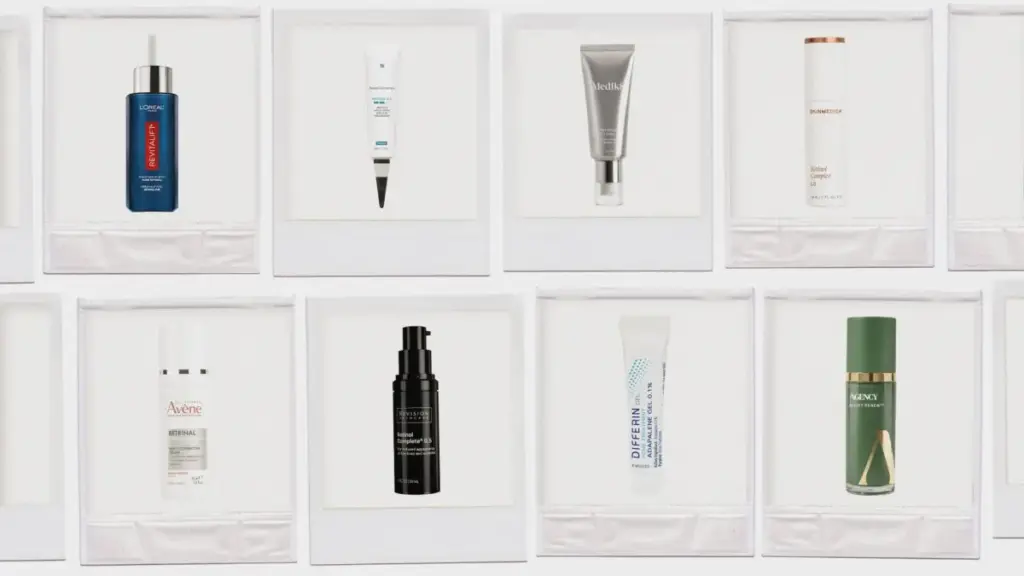
- SkinCeuticals Retinol 0.5: Praised by Dr. Camp for its tiered concentration system (available in 0.3, 0.5, and 1.0), this formula accommodates novices and experts alike, allowing users to titrate their dosage upward as their skin adapts.
- Revision Skincare Retinol Complete 0.5 Serum: Utilizing a time-released delivery system, this serum maximizes cellular efficacy while dampening the inflammatory response, successfully brightening dull skin and smoothing uneven texture.
- SkinMedica Retinol Complex 1.0: Highly recommended by Dr. Shirazi for sensitive skin types or newcomers due to its intelligent formulation, which pairs high-strength retinol with soothing peptides, ceramides, and vitamin E to support the skin barrier.
- L’Oréal Paris Revitalift 0.3% Pure Retinol Night Serum: Proof that high potency can be found at the drugstore level, this formula delivers an accessible yet impactful dose ideal for those seeking to break through a skincare plateau.
2. Retinal (Retinaldehyde): The High-Performance OTC Contender
Retinal sits at the bleeding edge of non-prescription skincare. Requiring only a single conversion step to become retinoic acid, it offers near-prescription-level performance with exceptional bioavailability.
- Medik8 Crystal Retinal 6: Operating more as a progressive system than a single SKU, this line spans six distinct concentrations (from 0.01% to 0.24%). It allows users to steadily graduate in strength as their cellular receptors build tolerance.
- Avène Retrinal Intensive Multi-Corrective Cream: A French pharmacy favorite that pairs a comfortable 0.1% concentration of retinal with comforting emollients like squalane and shea butter, making it uniquely suited for redness-prone or reactive complexions.
3. Adapalene: The Acne Specialist
Adapalene stands apart as a synthetic retinoid engineered explicitly to target follicular hyperkeratinization and inflammation. It binds selectively to specific nuclear receptors without requiring metabolic conversion, making it uniquely effective for acne.
- La Roche-Posay Effaclar Adapalene Gel 0.1%: A dermatologist favorite for clearing blackheads, whiteheads, and active blemishes while maintaining a tolerable side-effect profile on oily skin.
- Differin Acne Retinoid Treatment Gel: Pioneering the transition of adapalene from prescription counters to over-the-counter accessibility, this gel delivers a dual benefit: clearing active breakouts while concurrently fading post-inflammatory hyperpigmentation (dark spots).
4. Tretinoin: The Prescription Heavyweight
Tretinoin is pure retinoic acid. It requires no biological conversions, interacting instantly with skin cells. Extensively studied for decades, it remains unrivaled in its ability to reverse sun damage, smooth deep wrinkles, and restructure collagen matrices. However, its intensity requires careful medical supervision and diligent moisturization to combat dryness.
- Musely The Anti-Aging Cream: A custom-compounded prescription formula pairing tretinoin with supportive barrier ingredients like niacinamide and hyaluronic acid, tailored precisely to individual user profiles via virtual medical consultation.
- Agency Night Renew: An advanced overnight treatment that blends tretinoin with targeted co-factors such as estriol (for hormonal hydration) and tranexamic acid (for targeted brightening), customized through a licensed dermatology provider.
Future Outlook
As cosmetic chemistry and dermatological science continue to converge, the future of retinoids looks increasingly sophisticated. The primary frontier of innovation no longer lies simply in making ingredients stronger, but in making them smarter.
We are currently witnessing the rapid rise of next-generation delivery systems—such as lipid nanoparticle encapsulation, time-release polymers, and intelligent vectorization—which transport delicate vitamin A molecules deeper into the epidermis while virtually eliminating surface-level irritation, redness, and peeling. Furthermore, the industry is moving decisively toward synergistic formulations. Rather than forcing the skin to endure isolated retinoids, modern laboratories are routinely combining retinol, retinal, and tretinoin with barrier-repair lipids, calming botanical extracts, and microbiome-supporting postbiotics.
Ultimately, the evolutionary trajectory of skincare points away from aggressive, punitive routines and toward sustainable, long-term cellular health. As Dr. Shirazi aptly summarizes, the ultimate goal is not to punish your skin into submission with the harshest available molecule, but to find the precise formulation that delivers maximum biological transformation with absolute comfort. Whether through a gentle drugstore retinol or a customized prescription tretinoin, the path to radiant, youthful skin is a marathon—not a sprint.