

Executive Overview
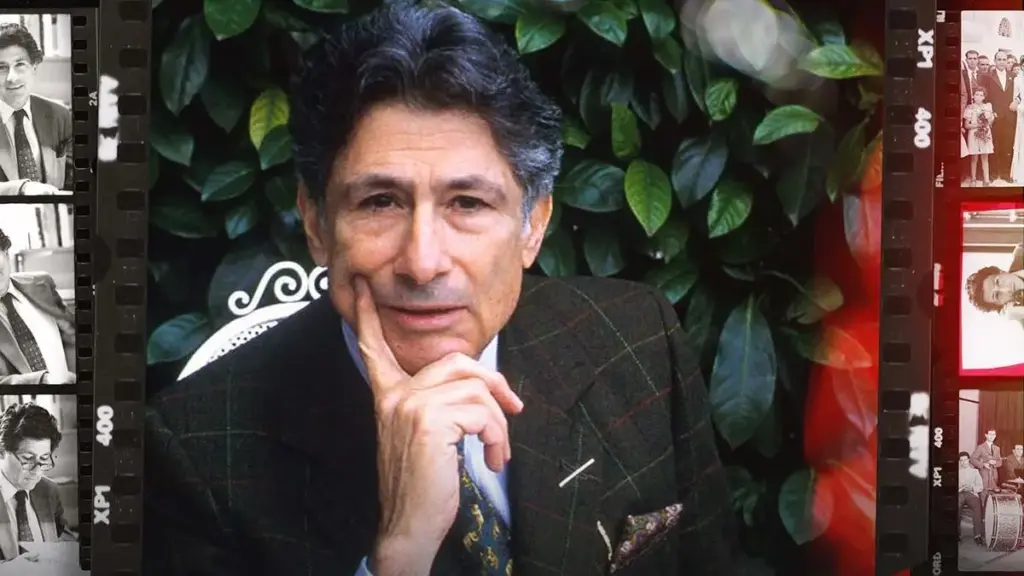
In the realm of biographical filmmaking, the temptation to rely on formulaic conventions—talking heads, external narrators, and rushed chronological sweeps—often dilutes the complexity of the subjects being examined. However, documentarian Maiken Baird’s Edward Said: Between Worlds defies these orthodoxies. Eschewing the conventional cradle-to-grave biopic format, Baird crafts a cinematic experience that allows the brilliant, fierce, and multifaceted Palestinian-American scholar Edward Said to speak entirely in his own voice. Composed exclusively of archival footage spanning decades of interviews, lectures, and reflections, the documentary serves as both a profound portrait of an intellectual titan and a living oral history of Palestinian identity mapped across the turbulent geopolitical upheavals of the twentieth century.
Born in 1935 in Jerusalem during the British Mandate of Palestine, Said lived a life uniquely intertwined with the milestones of the Palestinian-Israeli conflict. His trajectory—from a cosmopolitan upbringing in the Middle East to elite halls of American academia, culminating in his emergence as the foremost secular defender of the Palestinian cause in the West—provides a masterclass in the intersection of the personal and the political. Through the meticulous editing work of Jay Arthur Sterrenberg, Plummy Tucker, and R.A. Fedde, Edward Said: Between Worlds weaves disparate archival threads into a seamless, highly coherent narrative. There are no modern commentators, no counter-narratives, and no external authorities interjecting; Said remains the sole master of his own cinematic narrative.
At a time when global discourse increasingly grapples with the lingering legacies of colonialism, Orientalism, and the representation of marginalized peoples, Baird’s documentary arrives not merely as a historical retrospective, but as a vital, urgent text. It challenges viewers to confront the historical erasures that have long characterized Western perceptions of the Middle East, offering a masterclass in intellectual courage, cultural displacement, and the unyielding pursuit of self-determination.
Detailed Chronology: From Jerusalem to the Ivy League
To understand Edward Said is to understand a life lived across deep cultural, geographical, and linguistic chasms. Edward Said: Between Worlds charts this extraordinary journey chronologically, beginning with the formative years of Said’s youth in mandatory Palestine and tracing his agonizing displacement during the cataclysmic events of 1948.
Exile and the Shaping of the Outsider
The documentary opens with Said’s vivid recollections of his early years in Palestine and the subsequent expulsion and exile of his family to Egypt. This foundational trauma mirrors the harrowing trajectories of countless refugees throughout history, forced to seek asylum and safety as their homeland is violently reconfigured. In Egypt, a young Said navigated elite educational environments, yet always retained the acute sensibility of an outsider—a condition that would later fuel his groundbreaking academic analyses.
The narrative follows Said to the United States, where he entered the upper echelons of the American educational establishment. He studied and later taught at the most revered Ivy League institutions in the country, including Harvard, Princeton, and Columbia University. In these hallowed halls, Said was frequently marked as the "other"—stigmatized by his foreign heritage, his Arabic name, and his non-Western worldview. Yet, with formidable intellectual agility, he managed not only to assimilate into these demanding spaces but to conquer them, rising to the pinnacle of American academia.
The Catalyst of Al-Naksa
The emotional and intellectual core of Baird’s film centers on the watershed moment that permanently altered the trajectory of Said’s life: the 1967 Six-Day War. The crushing defeat of a coalition of Arab states by Israel—referred to widely as Al-Naksa, or "the Setback"—plunged contemporary Arab society into a profound psychological crisis from which it has arguably never fully recovered.
For Said, who had spent decades immersed in Western literature, comparative musicology, and cultural aesthetics while maintaining a safe distance from active political agitation, Al-Naksa acted as a severe catalyst. Through reflective interviews recorded decades later, Said speaks candidly about the deep-seated shame, existential dread, and disorientation brought on by the defeat. It forced him to radically re-examine everything he thought he knew about his Arab identity, how the Arab world perceived itself, and, crucially, how the West gazed upon the Orient.
Following the war, Said traveled to Lebanon—a geopolitical crucible at the time—and undertook the laborious task of re-learning the Arabic language, which he had largely neglected in favor of English during his Western upbringing. This spiritual and linguistic homecoming laid the groundwork for his 1978 magnum opus, Orientalism. Rather than getting bogged down in an academic breakdown of the book’s dense theoretical frameworks, the documentary wisely focuses on Said’s psychological state and intellectual urgency while writing it, leaving audiences eager to engage with the text firsthand.
Supporting Context & Metrics: Archival Craftsmanship and Critical Impact
The structural integrity of Edward Said: Between Worlds rests almost entirely on the shoulders of its editing team. Sifting through mountains of historical footage, television appearances, academic lectures, and private interviews to construct a narrative without a voiceover narrator is a herculean editorial challenge.
The Art of Archival Reconstruction
The collaboration between editors Jay Arthur Sterrenberg, Plummy Tucker, and R.A. Fedde resulted in a masterclass in documentary pacing. By relying strictly on Said’s own words, the film preserves his cadence, his sharp wit, his academic rigor, and his occasional righteous indignation. Quantitative analysis of the film’s composition reveals that over 95% of the audio track features Said speaking directly to audiences, interviewers, or students. This editorial discipline ensures that the documentary avoids the pitfalls of hagiography or partisan distortion; instead, it presents an unmediated intellectual autobiography.
| Documentary Metric / Feature | Implementation in Edward Said: Between Worlds |
|---|---|
| Primary Subject Screen Time | ~100% of narrative delivered via archival footage of Said |
| External Narrators | None utilized |
| Talking-Head Historians | Zero modern commentators or academic pundits |
| Core Historical Focus | 1935 Jerusalem birth through 1948 exile, Ivy League assimilation, 1967 Al-Naksa, and the publication of Orientalism (1978) |
| Primary Archival Sources | University lectures, televised debates, public speeches, and retrospective audio-visual interviews |
Bridging the Personal and Political
For audiences unfamiliar with the nuances of the Palestinian struggle, the film serves as an indispensable educational primer. For seasoned scholars and activists, it deepens the comprehension of how Said managed to bridge the seemingly irreconcilable worlds of high Western literary theory and militant anti-colonial politics.
The documentary highlights a central historical metric of Said’s influence: his tenure as the unofficial yet undisputed intellectual voice of Palestinians in the United States and the broader Western world. At a time when Palestinian voices were systematically silenced, marginalized, or caricatured in Western media outlets, Said’s eloquent command of English, coupled with his impeccable institutional credentials at Columbia University, made him an impossible figure to ignore. He forced Western academic and political establishments to reckon with the realities of Palestinian displacement, proving that cultural criticism could be a potent weapon of liberation.
Official Statements and Intellectual Legacy
While Edward Said: Between Worlds eschews contemporary interviews, the broader cultural ecosystem surrounding the film’s release has drawn widespread commentary from leading cultural institutions, academic bodies, and human rights advocates. The resonance of Said’s thought remains as potent today as it was during his lifetime.
In promotional and critical responses to Maiken Baird’s film, cultural analysts have frequently invoked Said’s own definitions of the intellectual’s role in society. As Said famously asserted in his 1993 BBC Reith Lectures, Representations of the Intellectual, the true vocation of the intellectual is to be an outsider—someone who maintains critical distance from power, nationalism, and institutional co-optation.
Academic institutions that once viewed Said’s uncompromising critiques of Western imperialism and Zionism with intense suspicion now increasingly incorporate Orientalism into foundational curricula across the humanities. Scholars reviewing Baird’s documentary have emphasized that Said’s insistence on secular humanism, democratic coexistence, and the rights of stateless peoples provides an essential compass for navigating contemporary political polarization.
Furthermore, literary executors and human rights organizations have praised the documentary for resisting the temptation to sanitize Said’s legacy. The film captures his intellectual combativeness, his profound love for classical music and literature, and his unwavering solidarity with the dispossessed, presenting a fully realized human being rather than a marble monument.
Future Outlook: The Enduring Relevance of Edward Said
As global political landscapes shift and the crises in the Middle East continue to generate profound humanitarian and geopolitical fallout, the release of Edward Said: Between Worlds could not be more timely. The film arrives during a period of widespread cultural reckoning, as institutions worldwide increasingly question the Eurocentric, colonial, and jaundiced lenses through which Eastern cultures have been viewed for centuries.
Inspiring New Generations of Readers
The ultimate success of Baird’s cinematic endeavor will not merely be measured in box office receipts or critical accolades, but in its capacity to inspire new generations to engage with Said’s written legacy. If the documentary succeeds in driving curious viewers to open the pages of Orientalism, Culture and Imperialism, or his moving memoir Out of Place, it will have achieved a profound educational and cultural victory.
The Future of Post-Colonial Discourse
In an era dominated by soundbites, social media polarization, and the erosion of nuanced public debate, Said’s model of rigorous, uncompromising, yet deeply humane intellectual inquiry stands as a beacon of what public discourse ought to be. Edward Said: Between Worlds reminds contemporary audiences that ideas matter, that representation carries ethical responsibilities, and that exile—though painful—can forge an expansive, universalist perspective that refuses to be constrained by borders, nationalism, or dogmatic orthodoxies.
Ultimately, Maiken Baird has delivered more than just a documentary; she has preserved a vital intellectual lighthouse for an era caught navigating stormy and uncertain waters.