In the upper echelons of global style, influence is rarely measured by what is bought retail; instead, it is charted by what is exhumed, reinterpreted, and whispered about behind closed doors. Enter For The Soup, an elite, fiercely guarded London-based fashion archive that has quietly hijacked the visual language of modern pop culture. Run by 30-year-old stylist and sourcer Jessica Temple from a bustling showroom in Hackney, the operation has, in a mere two years, evolved from a bedroom-bound side hustle into an indispensable resource for the industry’s most influential image-makers.
Though its catalog is regularly pillaged by world-class stylists and pop royalty—with pieces flown out for Lady Gaga, acquired by image architect Law Roach, and worn by artists such as Robyn, Bad Gyal, Eartheater, JT, Blackpink, and Ashnikko—For The Soup operates with a deliberate mystique. It is a world where legendary pieces by Maison Margiela, Comme des Garçons, Alaïa, and Vivienne Westwood share rails with unbranded, nameless garments discovered in obscure European flea markets.
Temple’s journey is far more than a Cinderella story of vintage curation; it is a masterclass in modern resourcefulness, working-class resilience, and the relentless pursuit of emotional resonance through garments. Rejecting the sterile uniformity of high-street consumerism and the rigid snobbery of brand-name fetishism, Temple has built a community-driven enterprise that treats clothing not as static status symbols, but as living, breathing repositories of human history. This is the definitive account of how For The Soup redefined contemporary archiving, one salvaged thread at a time.
Detailed Chronology: From Devon Outcast to Hackney Heavyweight
The Roots of Rebellion: Devon, Charity Shops, and ADHD Hyper-Focus
Long before her rails were being raided for world tours and red carpets, Jessica Temple was an outsider navigating the homogenised style landscape of rural Devon. Growing up working-class, the mainstream fashion pathways available to her peers—the ubiquitous Joni jeans at Topshop or pricey hauls from Hollister and Abercrombie & Fitch—were entirely out of reach, both financially and physically.
"I wasn’t the girl who could go to Topshop and fit into a pair of Joni jeans," Temple recalls. "And I didn’t have the money to go to Abercrombie & Fitch or Hollister. There was a uniform, and if you weren’t wearing the same Jack Wills hoodie as everybody else, you were an outsider."
This exclusion proved to be her crucible. Alongside her best friend, Temple discovered the liberating potential of local charity shops—spaces where clothes cost as little as one pound and came stripped of prescriptive sizing or trend-driven marketing. For Temple, whose relationship with clothes was deeply intertwined with an unmanaged neurodivergence, thrifting became a sanctuary. It was an ADHD-driven safe-place fixation: a hyper-focused hunt for the unloved, the unlabelled, and the discarded. Rather than lamenting her inability to conform to high-street standards, she began deconstructing, altering, and experimenting with garments, finding creative liberation where others saw only cast-offs.
The Move to London and the Dalston Resurgence
Relocating to London to study journalism introduced Temple to a creative community that finally understood her eccentricities. However, the path to fashion archiving was neither linear nor planned. With no formal design background or generational wealth to cushion her ambitions, Temple found herself working as the general manager of a Dalston cinema.
When that chapter abruptly closed with a job loss, necessity forced her hand. To make ends meet, she began selling pieces from her personal wardrobe and miscellaneous finds at local car boot sales, pop-ups, and flea markets.
The aesthetic impact was immediate. Operating out of pocket and wheeling a dangerously wobbly, metal-clinking clothing rack down Dalston High Street to local pubs, Temple offered items of staggering quality for a fraction of their worth. She recalls selling authentic Yves Saint Laurent Mombasa bags for less than £200, simply eager to see her discoveries circulate within her community.
It was during one of these early jumble sales at The Haggerston that Temple met her partner, photographer Nora Nord. Bonding over mutual frustrations regarding the near-impossibility of finding stylish footwear in their sizes—Nord had just purchased a pair of sculptural Fidan Novruzova boots—the pair forged a partnership that would underpin the entire For The Soup operation. Nord’s lens immortalized the early bedroom experiments, capturing the raw, cinematic energy of the nascent brand and transforming raw inventory into high-art visual narratives.
The Birth of For The Soup and the Hackney Showroom
The business grew organically, entirely devoid of venture capital, business loans, or institutional safety nets.
"There were no savings. There was no bank account," Temple reflects. "The decisions I had to make were so intentional. With every single piece, I was like, ‘Is this worth my money?’. No matter how much I’ve grown, that hasn’t left me."
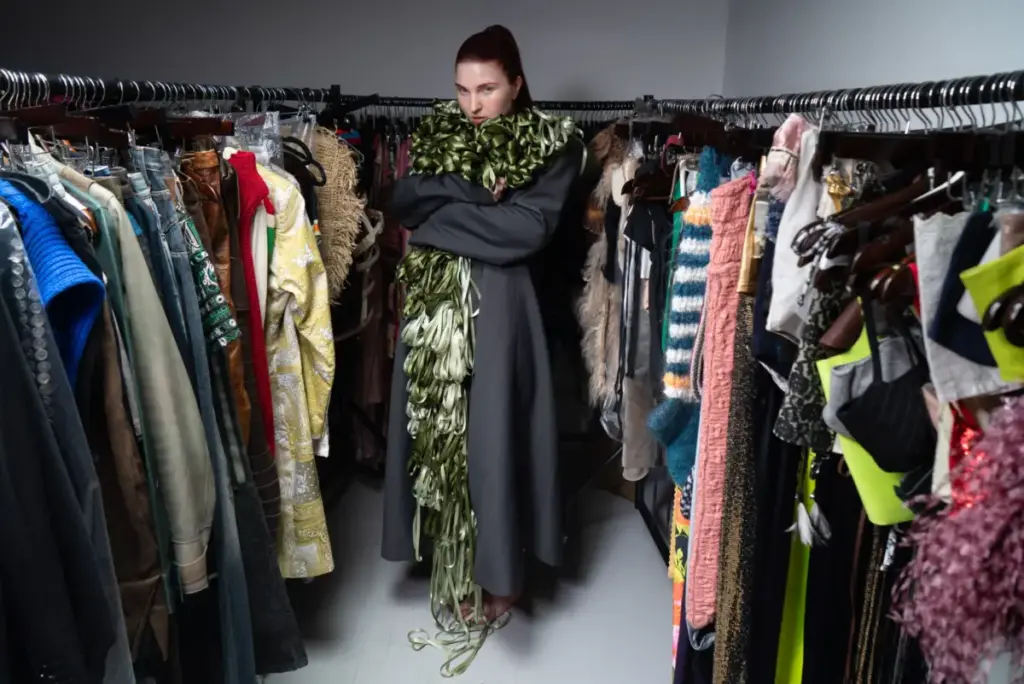
Within two years, the enterprise outgrew Temple’s bedroom. Today, For The Soup occupies a vibrant, chaotic, and meticulously curated showroom in Hackney. Rails upon rails of archival fashion history sit alongside raw bolts of tinsel, foam anime wigs, and handcrafted accessories, serving as an open-source laboratory for stylists and visionaries seeking to disrupt the visual monotony of modern entertainment.
Supporting Context & Metrics: The Philosophy of the Archive
Deconstructing the Label: Why the Designer Doesn’t Matter
In an era dominated by logomania and archival hype-beast culture—where garments are frequently appraised solely by the designer’s name and the runway season they debuted in—For The Soup champions an entirely antithetical ethos.
Temple’s curation does not discriminate based on pedigree. While her showroom boasts heavy-hitting historical pieces—such as a rare metal-sequin tank top from autumn/winter 2003 previously worn by Kelis and Kate Moss, or Karl Lagerfeld-era Fendi masterpieces like a rabbit-fur neon-tipped vest from spring/summer 2005 and a reversible tufted leather coat from autumn/winter 2002—some of her most cherished finds carry no famous label at all.
She recounts discovering a structural dress in Paris detailed with actual, carved wooden matchstick shapes across the bodice, tracing its origins to a forgotten university graduate collection. Similarly, she acquired a pair of leather drainpipe trousers featuring intricate eyelet corseting and massive silk trains, designed by an unknown student who subsequently abandoned fashion entirely to work in a completely different sector.
"Those pieces really, really excite me," Temple says, her passion palpable. "Because archives are about keeping things alive, right? That person’s true love for it, the reason they made it, all that hard work, all of that stuff within them, immortalised in someone else’s world."
The Politics of Dressing and Mental Health
Beyond renting pieces for blockbuster music videos and international red carpets, a foundational pillar of For The Soup is its private client styling service. For Temple, styling is not a superficial exercise in vanity; it is an act of empowerment, deeply rooted in her identity as a queer woman from a working-class background.
"Being a woman, being queer — there are so many politics to that," she notes. "I love to dress women. I love dressing my community. And that’s not just women — it’s everybody."
The transformative impact of this service is profound. Temple speaks movingly of clients who walk into her Hackney showroom feeling defeated by mainstream fashion’s exclusionary sizing and aesthetic norms, only to leave with a renewed sense of self-worth. It is common for clients to report profound shifts in their confidence and mental health following a session at For The Soup—with several even attributing career milestones, such as workplace promotions, to the armor-like self-assurance provided by Temple’s curated looks.
Official Statements & Insights
The ethos of For The Soup is encapsulated in the striking duality of its name. Far from a random moniker, the title carries both poetic and visceral socio-economic significance.
The Metaphor of the Bone
In a poem written prior to the brand’s formal inception, Temple explored the concept of perseverance through the phrase "bones for the soup."
"All of these things in life are eating you away at the flesh, and everybody thinks the flesh is the good bit. You’re being worn down to nothing," she explains. "But then you realise the bone is where all the flavour is."
The Literal Roots: Food Banks and Class Solidarity
There is also a deeply pragmatic, working-class reality anchoring the name. Growing up in financially precarious circumstances, food banks and meal tickets were a lifeline for Temple.
"So ‘For The Soup’ stands for ‘for the soup kitchen’, too," she reveals with a smile. "The dream is still to use the money made through these clothes to give back, so that, from all these moments of luxury, something that shouldn’t need to be considered a luxury can come out of it."
This foundational mission grounds the brand’s high-fashion aspirations in a genuine ethos of mutual aid and community accountability, ensuring that the ephemeral glamour of the entertainment industry ultimately serves a tangible, real-world purpose.
Future Outlook: The Evolution of a Cultural Institution
As For The Soup enters its third year of operation, the trajectory points toward continued expansion without sacrificing the fiercely guarded intimacy that made it a cult phenomenon. The collaborative capsule collections—such as the viral chainmail keychains co-created with designer Grete Henriette, which quickly found their way into the hands of K-pop icons Blackpink and pop provocateur Ashnikko—demonstrate that Temple’s eye extends far beyond curation into original product development.
In an industry increasingly saturated by corporate conglomerates, homogenized vintage trends, and algorithm-driven micro-trends, For The Soup stands as a defiant bastion of authenticity. By marrying rigorous historical curation with a profound empathy for the wearer, Jessica Temple has proven that the true value of an archive lies not in its market price, but in its capacity to preserve human emotion, challenge systemic exclusion, and make the wearer feel entirely, unapologetically alive.