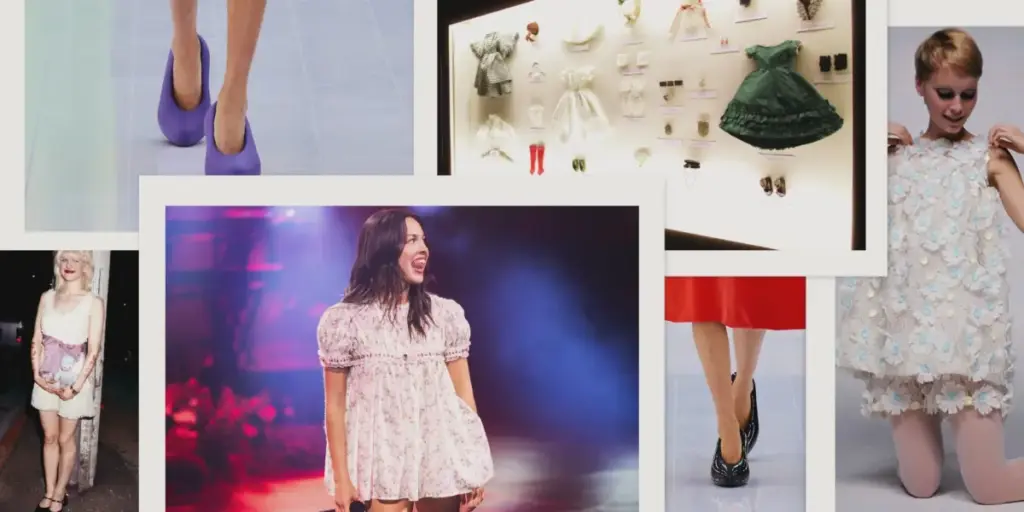
In the contemporary cultural landscape, dolls are no longer confined to the toy chests of childhood; they occupy a commanding, multifaceted role at the absolute intersection of high fashion, internet meme culture, and high-end curation. From the viral discourse surrounding Olivia Rodrigo’s revival of the babydoll dress and the persistent cultural footprint of Barbie, to adult collectors rediscovering the meticulous art of miniature dollhouses and designers like Sandy Liang sending ribbon-trimmed, doll-like silhouettes down the runway, the fashion industry is undergoing a systemic regression into playful nostalgia.
Yet, this phenomenon is far from a fleeting digital-age fad. The relationship between garments and miniatures spans centuries, evolving from 14th-century diplomatic tools of royal court exchange to the avant-garde runway spectacles of Martin Margiela, Moschino, and John Galliano. This deep-seated historical and cultural connection is the subject of the upcoming Museum at FIT (MFIT) exhibition, Doll Dressing, curated by Dr. Colleen Hill. Opening September 16, the exhibition explores how dolls have functioned not merely as playthings, but as sophisticated canvases for tailoring, identity expression, subversive gothic horror, and social commentary.
This deep-dive investigation explores the historical lineage of doll dressing, the subversive reclamation of infantilized aesthetics through movements like "kinderwhore," the complex psychological interplay between the "living doll" trope and female autonomy, and how modern designers use miniature play to offer a much-needed reprieve from the crushing weights of adulthood.
Detailed Chronology: From Courtly Couriers to Runway Satire
The history of fashion and dolls is inextricably linked, predating mass-market manufacturing by centuries. To understand why modern runways are obsessed with doll-scale proportions, one must trace the trajectory of how miniature garments have communicated style across time.
The Original "OOTD": 14th-Century Courtly Couriers
Long before lookbooks, digital campaigns, or Instagram feeds, European royalty communicated sartorial trends through intricately dressed miniatures. As early as the late 14th century, members of European courts would exchange custom-made dolls outfitted in the exact, scaled-down textiles, embroideries, and accessories of contemporary high fashion.
Dr. Colleen Hill, senior curator of costume at MFIT, notes the profound misconception surrounding these early artifacts: "They may look like toys, but they weren’t. They were meant for grown women to exchange fashion ideas." These dolls served as the 14th-century equivalent of an Outfit of the Day (OOTD) or a VIP trunk show, traveling across borders to display the latest tailoring innovations of Parisian and Italian courts to monarchs throughout the continent.
The 20th-Century Avant-Garde Awakening
As fashion entered the modern era, designers began to consciously deconstruct and elevate childhood tropes, turning dolls from communication tools into objects of theatrical subversion.
1994 (Martin Margiela): The Belgian deconstructivist icon famously upended traditional tailoring scales for his Fall/Winter 1994 collection. Margiela collected vintage clothing patterns for Ken, Barbie, and G.I. Joe dolls, meticulously blowing them up to 5.2 times their original size to fit human models. The resulting oversized seams, exaggerated proportions, and cartoonish accessories forced viewers to confront the bizarre geometry of mass-produced childhood plastic ideals.
2004 (Jean-Paul Gaultier): The enfant terrible of French fashion regularly integrated infant and doll motifs into his ready-to-wear presentations, utilizing the hyper-innocent imagery to contrast against his signature avant-garde tailoring and body-con silhouettes.
2011 (Prada): Miuccia Prada introduced her celebrated trompe l’œil doll boots for Fall 2011, embedding the optical illusion of childhood footwear directly into high-fashion leather goods.
2016–2017 (Moschino under Jeremy Scott): Jeremy Scott cemented his reputation as fashion’s premier toy-box eccentric by transforming models into life-size paper dolls for his Spring/Summer 2017 collection, complete with printed paper-fold tabs and hyper-flat construction that blurred the line between illustration and reality.
The Quarantine "Show in a Box"
When the COVID-19 pandemic ground global fashion weeks to a halt in 2020, designers were forced to rethink presentation formats. Jonathan Anderson leaned heavily into childhood nostalgia for Loewe’s Spring 2021 collection, mailing fashion editors a physical "show in a box." Inside was a curated kit featuring paper-doll-style cutouts of every look, inviting critics to physically style and assemble the collection themselves from their living rooms. It was a masterclass in interactive escapism that foreshadowed the current industry-wide obsession with tactile, doll-inspired design.
Supporting Context & Metrics: The Anatomy of a Cultural Obsession
The resurgence of doll-inspired aesthetics in the mid-2020s is underscored by staggering metrics and shifting consumer habits across lifestyle, entertainment, and luxury retail:
The Barbie Economic Engine: Since her debut at the American International Toy Fair in New York in 1959, Barbie has worn an estimated one billion distinct outfits. The cultural tsunami of Greta Gerwig’s 2023 Barbie film—which grossed over $1.4 billion globally—permanently fused high-end luxury houses (such as Prada, Chanel, and Moschino) with mass-market plastic iconography.
The Adult Hobbyist Renaissance: According to market data tracking hobbyist trends heading toward 2026, the adult demographic driving sales in miniature dollhouses, custom Blythe doll modifications, and collectible scale-model furniture has grown exponentially. Adults are seeking tactile, analog hobbies to counteract digital burnout.
The Blythe Phenomenon: Characterized by oversized heads and color-changing eyes activated by a pull-string, the big-eyed Blythe doll has long been a darling of avant-garde creators. Icons like Alexander McQueen famously "cast" Blythe dolls as models in his 2009 Target collaboration campaign, cementing the toy’s status as a muse for dark romanticism.
Official Statements & Curatorial Insights
Dr. Colleen Hill’s upcoming MFIT exhibition, Doll Dressing (opening September 16), divides the multifaceted relationship between dolls and fashion into distinct psychological and historical categories. Beyond the playful whimsy of childhood dress-up, the exhibition tackles darker, more complex thematic territory.
The "Broken Dolls" and Gothic Subversion
One of the exhibition’s most provocative sections, titled "Broken Dolls," examines the sinister, uncanny valley territory explored by German surrealist artist Hans Bellmer. Bellmer’s distorted, ball-jointed doll sculptures—which critiqued the rigid corporeal standards imposed by political regimes in pre-war Europe—left an indelible mark on fashion.
The runway’s "Goth Prince," Olivier Theyskens, famously printed Bellmer’s haunting doll imagery directly onto garments in his Spring/Summer 2019 collection. Dr. Hill acknowledges the sensitive nature of this gallery space:
"I’m kind of tucking it away because obviously it can be a little sensitive for certain audiences, but I felt it was nonetheless really important to include. I have a friend who won’t come see the show because she’s actively scared of dolls. She’s like, ‘I think it’s a great idea. I just can’t go.’"
The Kinderwhore Movement and Modern Defiance
The exhibition also honors the 1990s "kinderwhore" aesthetic pioneered by musicians such as Courtney Love (Babes in Toyland), Kat Bjelland, and KatieJane Garside (Daisy Chainsaw). Rooted in the grunge and riot grrrl movements, kinderwhore juxtaposed hyper-feminine, infantilized staples—babydoll dresses, Peter Pan collars, and hair barrettes—with ruined makeup, ripped fishnets, and punk aggression.
This aesthetic roared back into public discourse recently as pop star Olivia Rodrigo embraced babydoll silhouettes during her album promotional tours, sparking fierce internet debates. Dr. Hill defends the enduring power of the look:
"These women [in the ’90s] really deftly combined conventional beauty and irreverence. And the idea that you can essentially dress in this infantilizing way because you’re saying, ‘No, that’s your problem if you’re reading it that way, not mine,’ is something that has come up again in popular culture."
Observing the digital firestorm surrounding Rodrigo, Hill adds:
"I was following those comments very closely. And for every person who was saying, ‘Well, she shouldn’t be dressing like that,’ there were 20 other women coming to her defense saying, ‘She should dress however she wants.’"
Afrocentric Pride and Miniature Sculptures
Among the crowning achievements featured in Doll Dressing is a loan from the Museum of the City of New York: an adult-sized ensemble accompanied by a miniature matching doll, crafted by Ruby Bailey, a legendary dressmaker who operated a boutique in Harlem.
Detailing Bailey’s pioneering work in the 1960s, Dr. Hill explains:
"She started creating these dolls, first by altering Barbie dolls. She would change their skin color to a darker skin tone, and would often add natural hair because she felt that expressed her Afrocentric pride. She would eventually come to create these dolls that were entirely her own, these interesting soft sculpture dolls. They kind of hardened over time. But they’re beautifully posed and they’re wearing miniature versions of her clothes. At this point they’re kind of fragile, but I think they’re really beautiful examples of someone who was creating these one-of-a-kind dolls."
Future Outlook: The Psychological Necessity of Play
As the fashion industry navigates an increasingly hyper-digitized, algorithmic, and high-stress economic reality, the turn toward doll dressing offers more than just aesthetic novelty—it provides a crucial psychological sanctuary.
Critics and cultural analysts frequently interrogate the paradox of adult women engaging with doll aesthetics: Does it reinforce regressive, infantilizing tropes of the "living doll," reducing women to passive, decorative objects? Dr. Hill admits that any look can be interpreted through a reductive lens if viewed cynically. However, her extensive curatorial research points to a far more empowering conclusion:
"Overarchingly, I’ve found that the idea of doll dressing is really positive. I think it fosters playfulness and self-acceptance and imagination. And it also offers a bit of a reprieve from all of the pressures of adulthood."
Whether through Sandy Liang’s ribbon-laden balletcore runways, the subversive styling of modern pop icons, or museum archives preserving the radical miniature creations of Harlem’s mid-century couturiers, doll dressing remains a timeless vehicle for storytelling. It proves that within the tiny, plastic, or fabric heart of a doll lies an immense capacity for human expression—offering a much-needed escape hatch into imagination, rebellion, and joy, regardless of one’s age.