Executive Overview
Amid the glittering deluge of high-carat diamonds, couture gowns, and dramatic water-taxi arrivals that traditionally dictate the visual lexicon of the Venice Film Festival, supermodel and art collector Kendall Jenner engineered a masterclass in understated cultural luxury during her debut on the storied Lido. To the untrained eye, her ensemble—composed of a smoke-gray, bell-sleeved, silky-sheer Vivienne Westwood dress, a woven Maison Ola basket bag, vintage Manolo Blahnik pumps from The Vintage Marché, and a pair of abstract silver earrings—read as a seamless continuation of her preferred pared-back, quiet-luxury aesthetic.
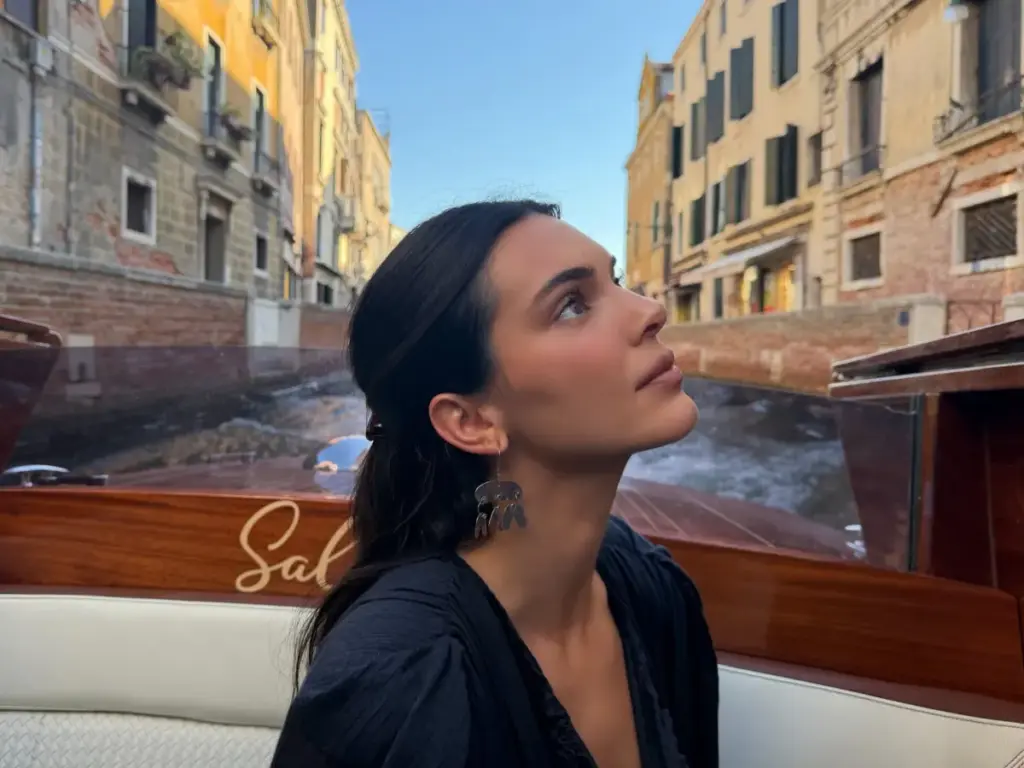
Yet, for those fluent in the esoteric intersecting languages of twentieth-century modernism and museum-grade collecting, Jenner’s choice of earwear was a seismic event. The abstract silver hardware dangling from her lobes were not commercial fine jewelry pieces, nor were they pull-requests from a contemporary design house. They were rare, museum-quality artifacts: a pair of hammered silver and steel wire earrings crafted by American master sculptor Alexander Calder in 1955.
Sourced through London-based gallerist Louisa Guinness—a preeminent authority on artist-made jewelry—the acquisition underscores a growing appetite among young, blue-chip cultural figures for wearable art. This comprehensive report details the anatomy of Jenner’s Venice style triumph, tracing the intricate logistics of how a 1955 Calder sculpture moved from a private New York collection to the canals of Italy. It explores the radical history of artist-crafted jewelry, examines Jenner’s established pedigree as a serious contemporary art collector, and contextualizes the look within a broader historical continuum defined by legendary art patron Peggy Guggenheim.
Detailed Chronology: From New York Archives to the Venetian Lagoon
The journey of Jenner’s historic earrings began weeks before the flashbulbs of the Venice Film Festival blinded the red carpet. According to Louisa Guinness, the transaction unfurled through a sophisticated web of art-world intermediaries. The trail originated with the Calder Foundation, weaving through a prominent New York collector, passing through the hands of Jenner’s stylist, Danielle Goldberg, and ultimately landing in the inbox of Guinness’s Mayfair gallery.
"Her stylist said, ‘We’re looking for some Calder earrings.’ And so I sent her a small selection," Guinness revealed in an interview with Vogue.
Unlike many celebrities and stylists who routinely request high-end items strictly for red-carpet rentals, Jenner’s camp signaled a deeper, more committed intent. "So many people just ask to borrow them, but she actually was interested," Guinness noted, praising the model’s genuine curiosity regarding the historical provenance of the pieces. "She’s interested in the art side of it, so I find that really interesting."

Securing the earrings, however, was no small feat. Within Calder’s corpus of wearable art, earrings remain exceptionally scarce. While the artist’s mobiles and larger-scale static sculptures occupy major museum wings worldwide, his jewelry output was largely intimate, spontaneous, and produced in limited quantities.
"I don’t have so many earrings left. Earrings are quite rare, and rings are rare," Guinness explained, admitting that letting go of the 1955 hammered silver and steel wire pair was a poignant moment for a gallerist who has spent decades curating her inventory. "I love those earrings; they were hard to let go of!"
Once the acquisition was finalized, Jenner packed the pieces for her inaugural journey to the Venice Film Festival. Her arrival on the Lido was carefully orchestrated to pay homage to the city’s twentieth-century avant-garde history. Beyond the Calder earrings, Jenner was spotted wearing dramatically flared, pointed sunglasses that served as a direct stylistic reincarnation of the iconic frames worn by legendary art collector and Venice resident Peggy Guggenheim.
While the statement sunglasses captured the immediate attention of street-style photographers and mainstream fashion blogs, the earrings functioned as the ultimate insider nod. As Guinness aptly summarized: "The glasses got way more attention than the earrings, but for people who know, the earrings are very, very special. Calder jewelry is like a little club."
Supporting Context & Metrics: The Radical Legacy of Calder’s Wearable Art
To fully appreciate the cultural weight of Jenner’s accessory choice, one must examine Alexander Calder’s unconventional relationship with jewelry. While the American artist is universally celebrated for inventing the mobile—transforming modern sculpture through kinetic balance—and for his whimsical, wire-and-found-object Circus, his foray into jewelry was far from a casual sideline.
Calder’s journey as a jeweler began early and humbly. His very first creations were miniature accessories crafted for his sister’s dolls. By 1929, his wearable sculptures were already commanding gallery space. Over the subsequent decades, Calder returned repeatedly to the medium, working almost exclusively in unpretentious, industrial materials like brass, copper, steel wire, and silver.

In an era dominated by the rigid opulence of the mid-twentieth century—where high society demanded platinum, traditional diamonds, precious gemstones, and mink coats—Calder’s jewelry was shockingly radical. His bold spirals, biomorphic loops, hammered surfaces, and calligraphic lines flew in the face of conventional fine jewelry canons. Rather than looking forward to modern industrial luxury, many of his pieces evoked ancient, tribal artifacts.
This rejection of traditional preciousness naturally appealed to the bohemian intellectual elite of the twentieth-century art world. Visionaries such as artist Georgia O’Keeffe and patron extraordinaire Peggy Guggenheim became fierce champions and prominent wearers of Calder’s pieces.
Crucially, what sets Calder’s jewelry apart from almost all other artist-collaborations is the method of production. "They were made by him, by his fair hand. Nobody else’s," Guinness emphasized. While subsequent artist-designed jewelry lines by houses like Picasso, Dali, or modern luxury brands frequently rely on master goldsmiths to translate a sketch into a wearable object, Calder’s pieces were physically shaped, hammered, and bent by the artist himself. Every dent of the hammer and twist of the wire bears the direct touch of his studio practice.
Kendall Jenner’s Blue-Chip Art Pedigree
Jenner’s acquisition of a 1955 Calder artifact is not an isolated stylistic outlier; rather, it aligns seamlessly with her well-documented evolution as a serious contemporary art collector. Eschewing the purely decorative art purchases often associated with celebrity lifestyle curation, Jenner has steadily built a museum-caliber collection that reflects a rigorous engagement with contemporary discourse.
Her private holdings include:
- A hypnotic light installation by conceptual neon artist Tracey Emin.
- A major site-specific light and space installation by James Turrell.
- Text-based, politically charged works by Barbara Kruger.
- Figurative and narrative paintings by Richard Prince.
- Provocative drawings and mixed-media works by Raymond Pettibon.
- Photographic documentation by Lauren Greenfield.
- Visceral, tactile sculptural works by Sterling Ruby.
By introducing historic modernism—specifically mid-century wearable sculpture—into her public fashion profile, Jenner bridges the gap between historical fine art collecting and contemporary high fashion.

Official Statements & Industry Perspectives
The convergence of high fashion, historical preservation, and celebrity endorsement has ignited vital conversations among blue-chip dealers and curators. Louisa Guinness, whose London gallery has championed artist-made jewelry for decades—working with luminaries ranging from Man Ray and Niki de Saint Phalle to Anish Kapoor—sees Jenner’s purchase as a bellwether for a broader generational shift.
"There are lots of other artists that have made jewelry that people don’t know about," Guinness noted, expressing optimism that younger, highly visible style icons might begin looking beyond the standard blue-chip jewelry houses.
Guinness has already begun conceptualizing potential next steps for Jenner’s expanding collection of wearable art. Among her suggestions are the minimalist yet structurally imposing pieces Guinness previously co-created with British-Indian sculptor Anish Kapoor. Alternatively, Guinness notes that Jenner could lean further into the avant-garde lineage of Peggy Guggenheim by acquiring wearable sculptures created by the pioneering Argentine-Italian spatialist Lucio Fontana.
The timing of Jenner’s embrace of Calder’s wearable art also intersects with broader runway trends. Nearly seventy years after their creation, Calder’s wire creations feel uncannily contemporary. Furthermore, the broader category of artist pins and brooches has experienced a massive resurgence on international runways under the creative direction of houses like Giorgio Armani, Tory Burch, and Simone Rocha.
Reflecting on the future trajectory of these pieces, Guinness offered a forward-looking fashion challenge: "I’d like to see more men wearing his pins. Maybe we’ll see Jacob Elordi in a pin…"
Future Outlook: The Evolution of Wearable Art on the Red Carpet
Kendall Jenner’s calculated deployment of 1955 Alexander Calder earrings at the Venice Film Festival signals a maturation of red-carpet styling. As the cultural appetite for traditional, highly commercialized celebrity endorsements wanes, public figures are increasingly turning to historical provenance, archival curation, and intellectual rigor to distinguish their personal brands.

This paradigm shift carries several important implications for the luxury and art markets:
- The Rise of Wearable Fine Art as an Asset Class: As historical pieces by artists like Calder, Picasso, Alexander Calder, and Salvador Dalí become increasingly scarce, their dual classification as museum-grade sculpture and wearable assets will likely drive aggressive competition between private art collectors and high-fashion stylists.
- Bridging the Gap Between Fashion and Fine Art: Stylists are no longer looking solely to historical couture archives (such as Mugler, Galliano-era Dior, or Westwood). They are now mining foundational fine art archives, treating jewelry as a medium for cross-disciplinary storytelling.
- Educational Impact on Younger Audiences: Through public appearances by cultural influencers with massive global reach, historically significant art forms that were previously confined to academic texts or niche gallery spaces are being introduced to millions of younger consumers, democratizing an appreciation for modernist sculpture.
Ultimately, Jenner’s decision to wear a delicate piece of mid-century kinetic history on the Venetian Lido proved that true luxury requires no flashing neon lights or exorbitant carat weights. It requires a narrative, a pedigree, and—above all—a profound respect for the artist’s hand.