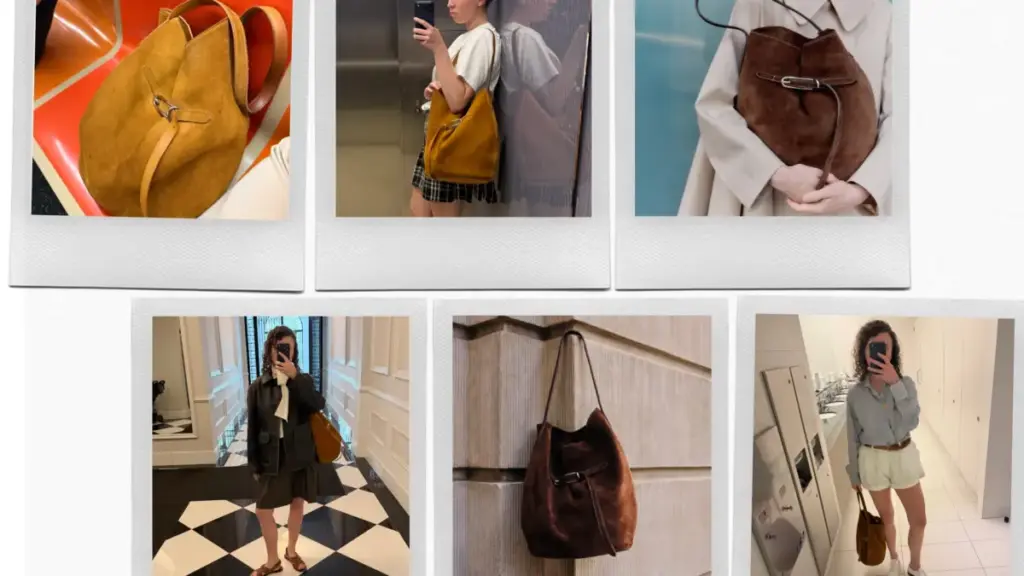
For decades, the search for the quintessential work bag has felt like an exercise in compromise. Professionals—particularly those navigating hybrid work schedules, commuting via public transit, and balancing a demanding array of personal and professional gear—have long been forced to choose between rigid, sterile leather totes that look like architectural filing cabinets and flimsy, unstructured bags that capitulate under the weight of a standard laptop.
Enter the modern accessory paradox: finding a piece that bridges the gap between high-end editorial styling and industrial-grade durability. Recently, a single accessory has captured the attention of fashion editors, street-style photographers, and pragmatists alike: the belted suede bucket bag from Stockholm-based label Liffner.
Priced at $795, this chestnut-toned, subtly buckled carryall has quietly revolutionized the concept of the daily work bag. Rather than treating durability as the enemy of elegance, it leans into the tactile richness of worn-in suede, proving that an everyday bag can survive the grueling gauntlet of modern commuting—from airplane cabins and subway floors to park lawns and boardroom chairs—without losing its sophisticated edge. This in-depth analysis explores how a contemporary Scandinavian label managed to solve one of fashion’s oldest functional equations, examining the intersection of material science, ergonomic design, and the evolving psychology of the modern work wardrobe.
Detailed Chronology: A Year-and-a-Half Stress Test in the Wild
To truly understand the value proposition of a contemporary luxury handbag, one must move past the pristine lighting of a retail showroom and observe its performance in the real world. A detailed tracking of Liffner’s large belted suede bucket bag over an eighteen-month continuous stress test reveals a fascinating narrative about modern material resilience.
Phase One: The Honeymoon and Initial Load-Bearing (Months 1–3)
Unboxed approximately a year and a half ago, the bag immediately entered heavy rotation as a primary daily commuter vessel. Unlike stiff, structured leather totes that require a breaking-in period—often resulting in strained shoulder straps or cracked glazing—the Liffner design offered an immediate, harmonious blend of structure and slouch.
The initial test involved its capacity to house a heavy, 14-inch professional laptop. Historically, standard luxury totes subject their internal seams and bottom panels to immense stress when carrying modern computing hardware, frequently resulting in structural failure or punctures within six to nine months. The Liffner bucket bag absorbed the weight effortlessly, aided by its curved, classic silhouette and a reinforced base that distributes gravitational pull evenly across the body. Alongside the laptop, the daily inventory routinely included a packed lunch, a hardcover book, an analog notebook, a voluminous wallet, noise-canceling headphones, and a rotating collection of cosmetic essentials. Despite this heavy, irregular load, the bag maintained its architectural integrity.
Phase Two: Global Transit and Seasonal Transition (Months 4–12)
As the months progressed, the bag transitioned from a local commuter accessory to an international travel companion. In August, it made its way to Copenhagen Fashion Week, navigating the bustling, unpredictable scheduling of international shows. Styled alongside casual daytime configurations of T-shirts and pleated skirts, the bag demonstrated a rare stylistic versatility.
Convention historically dictated that rich suedes be relegated to autumn and winter rotations—precious materials to be protected from rain, humidity, and sun-bleaching. However, contemporary styling philosophy has dismantled this archaic rulebook. The rich chestnut suede proved remarkably adept at transitioning across climates and seasons. By winter, when draped over the shoulder of heavy, structured wool coats, the bag felt equally anchored. It was during this period that the first signs of genuine patination began to emerge: minor scuffs on the suede nap. Far from diminishing its value, these marks told a story of active, uninhibited use, transforming the bag from a delicate luxury object into a lived-in companion.
Phase Three: The Peer Review and Cultural Phenomenon (Months 13–18)
By the second year of continuous deployment, the bag had achieved an unexpected status: a conversation piece. Frequently stopped by industry peers, fellow editors, transit strangers, and even competing accessories designers inquiring about its provenance, the wearer realized that the bag’s appeal lay in its quiet confidence. It did not scream for attention with oversized monogramming or ostentatious hardware; instead, it whispered quality through proportion, texture, and thoughtful detailing, such as the elongated dainty buckle that cinches its curved frame.
Supporting Context & Metrics: The Ergonomics and Economics of Modern Carryalls
To contextualize the success of Liffner’s design, one must examine the broader landscape of the accessories market and the economic shifts driving consumer purchasing behavior.
The Price-to-Utility Ratio in Contemporary Accessories
In the current luxury market, handbags generally fall into two extremes: transient, trend-driven pieces priced under $300 that require replacement every year due to failing hardware, or ultra-luxury status symbols priced upwards of $3,000 that owners are often too terrified to take on a crowded subway.
Bag Category
Average Price Point
Durability Expectation
Commuter Viability
Fast-Fashion Totes
$50 – $150
3 to 6 Months
High risk of strap failure; poor weight distribution
Mid-Tier Contemporary
$300 – $600
1 to 2 Years
Moderate; often lacks secure closures for transit
Liffner Belted Bucket Bag
$795
Multi-Year Stress-Tested
Exceptional; balances structure, weight, and security
Ultra-Luxury Houses
$3,000 – $6,000+
Decades (if preserved)
Low; psychological barrier to daily abuse
At $795, Liffner occupies the "sweet spot" of accessible contemporary luxury. Founded by Paulina Liffner von Sydow, the Swedish label has consistently carved out a niche by prioritizing a delicate equilibrium:
Design: Intriguing without being aggressively avant-garde.
Practicality: Functional without skewing bland or corporate.
Cost-per-wear: Economically viable for working professionals who view accessories as tools rather than museum pieces.
Material Science: Why Suede is Winning the Workwear War
The resurgence of suede in professional environments marks a significant psychological shift in fashion. Traditionally viewed as high-maintenance, modern tanning and treatment processes have rendered quality suede far more robust than legacy consumers assume. Suede’s natural nap allows it to absorb minor abrasions and blend them into the overall texture of the hide, unlike box calf leather, where a single deep scratch ruins the flawless finish.
Furthermore, the physical structure of a bucket bag inherently distributes stress better than a flat-bottomed rectangular tote. When cinched with an elongated belt, the contents are naturally compressed toward the center of gravity, reducing the pendulum effect that typically strains shoulder muscles during long walking commutes.
Official Statements and Industry Perspective
Fashion authorities and industry observers have increasingly noted a pivot toward "utilitarian luxury" as consumers reassess their post-pandemic wardrobes. The emphasis has shifted decisively away from disposable micro-trends toward durable, versatile investments that can survive the unpredictable rhythms of modern life.
"We are witnessing the death of the overly precious wardrobe," notes a prominent New York-based fashion accessories buyer. "Consumers are rejecting items that require kid-glove treatment. If a $700-plus bag cannot survive a rainy Tuesday morning commute on the subway and a quick dinner downtown, it simply does not fit into the lifestyle of today’s working professional. Brands that understand this tension between luxury aesthetics and brutal practicality are the ones capturing consumer loyalty."
Paulina Liffner von Sydow’s design philosophy has long centered on creating pieces for women who demand intellectual rigor from their wardrobes. By refusing to compromise on tactile pleasure—opting for sumptuous, tactile suedes instead of stiff, coated canvases—Liffner has tapped into a demographic of career-oriented consumers who view personal style as an extension of their active, multifaceted lives rather than a static uniform.
Future Outlook: The Evolution of the Everyday Work Bag
As we look toward the future of accessories design, the trajectory set by brands like Liffner points toward a permanent redefinition of what constitutes a "work bag."
The Erasure of Departmental Boundaries: The rigid line separating "work bags" and "weekend bags" is officially dissolving. Modern professionals refuse to transfer their belongings between multiple bags depending on the day of the week. Versatility—the ability to transition seamlessly from a corporate boardroom to a casual weekend stroll—is now the primary metric of luxury.
Embrace of Patina as a Design Feature: As sustainability and mindful consumption become paramount, the fashion industry is moving away from the pristine, factory-fresh ideal. Bags that look better with age, developing a rich patina through scuffs, weather exposure, and daily wear, will dominate the market.
Ergonomic Innovation: Aesthetic appeal will increasingly be matched by ergonomic intelligence. Brands that engineer their straps, bases, and weight distribution systems to accommodate modern technology (laptops, tablets, chargers) without sacrificing silhouette will lead the next decade of accessories design.
Ultimately, the humble suede bucket bag has proven that functionality and high fashion are not mutually exclusive. For those willing to embrace a little wear and tear along the way, the right bag doesn’t just survive the journey—it records it.