Executive Overview
In the modern cinematic landscape, the blockbuster is a monolith dominated by astronomical budgets, sprawling intellectual properties, and exhaustive franchise world-building. Yet, crouching beneath the towering shadow of event-scale releases like Christopher Nolan’s The Odyssey and the perpetual machinery of Marvel properties, a different kind of cinematic beast is clawing its way onto the big screen. Enter Fall 2: Deadpoint, the latest high-altitude survival thriller from Lionsgate that represents a fascinating, paradoxical intersection of low-budget grit and high-end theatrical presentation.
Opening over Labor Day weekend—traditionally a dumping ground for secondary titles, yet increasingly a proving ground for counter-programming—Fall 2: Deadpoint aims to recreate the unlikely box-office lightning of its 2022 predecessor. The original Fall, a modest indie about two women trapped atop an abandoned radio tower, became a word-of-mouth phenomenon that defied its frugal origins. It found its true second wind on streaming platforms like Netflix, transforming from a discarded acquisition into a bona fide cultural touchstone for thriller enthusiasts.
Now, its sequel arrives carrying IMAX aspirations, green-screened vertigo, and an unexpected lore-expansion that links back to the original film’s tragic events. Directed by genre veterans the Spierig Brothers and starring Harriet Slater and Arsema Thomas, Fall 2 leans into the deliciously shlocky traditions of B-movie cinema while demanding to be experienced on the largest canvases available. This is an analytical deep dive into how a concept as simple as "people stuck in high places" morphed into a calculated theatrical gamble, examining its production pedigree, narrative mechanics, and its strategic place in Lionsgate’s broader portfolio.
Detailed Chronology: From Radio Towers to Treacherous Thai Cliffs
The Genesis of a Surprise Hit
To understand the trajectory of Fall 2: Deadpoint, one must retrace the improbable ascent of the 2022 original. Directed by Scott Mann, Fall followed two adrenaline junkies—best friends Becky and Shiloh—alongside Becky’s estranged friend Hunter, as they climbed a decaying 2,000-foot television tower in the middle of the desert. When the rusted ladder collapses behind them, they find themselves stranded with no water, minimal shelter, and a sheer drop in every direction.
Initially acquired by Lionsgate following encouraging test screenings, Fall was marketed with a lean, frugal promotional push. Lacking marquee movie stars, the film relied instead on an elementary yet universally terrifying premise: acute, stomach-churning vertigo. While it failed to secure the premium large-format (PLF) and IMAX screens its creators initially envisioned, it performed admirably on a micro-budget, crossing the coveted $10 million worldwide threshold—a massive win for its investors.
The film’s true renaissance, however, occurred in the digital ecosystem. Upon hitting Netflix, Fall experienced an explosive second wave of viewership, dominating the service’s global charts and cultivating a passionate fanbase. Realizing they had inadvertently struck gold, Lionsgate executives fast-tracked a sequel before the digital paint had even dried.
Expanding the Lore: Enter Deadpoint
Rather than opting for a completely standalone anthology approach—which would have been the safer, more traditional route for a low-budget survival franchise—Fall 2: Deadpoint digs deep into character continuity. The sequel follows Jax (played by Harriet Slater), the surviving sister of Shiloh (originally portrayed by Virginia Gardner), who perished in the harrowing events of the first film.
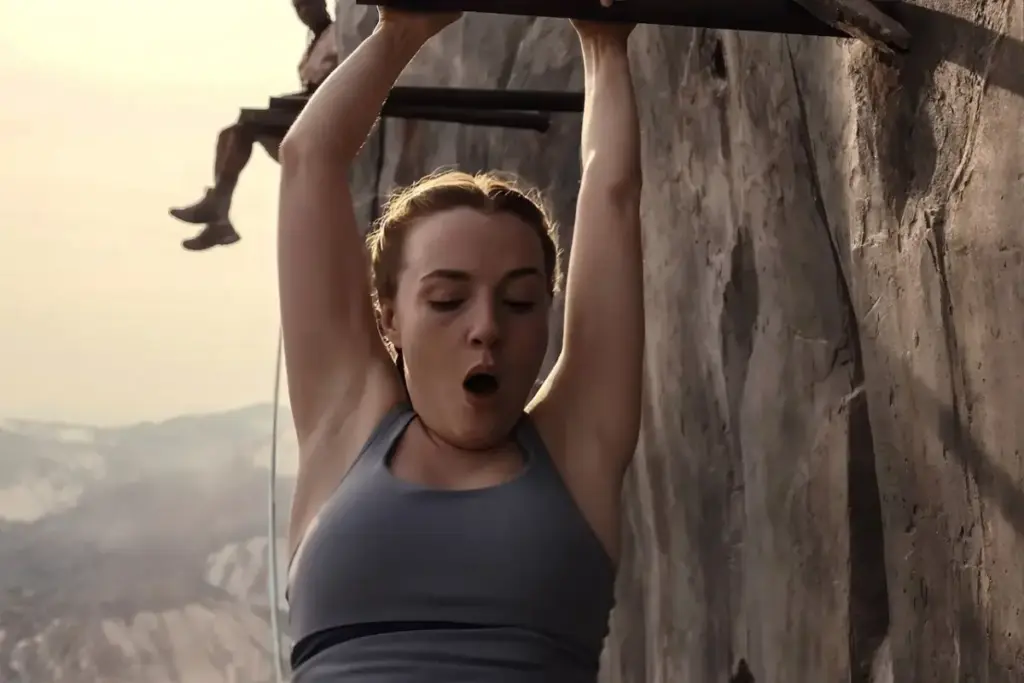
We find Jax paralyzed by grief and survivor’s guilt until Luce (Arsema Thomas), an old friend of Shiloh’s, re-enters her life with a radical proposal. To properly honor Shiloh’s memory and help Jax find closure, Luce convinces her to complete one of the extreme expeditions her late sister had meticulously planned but never executed. This journey transports the pair from the American desert to the lush, unforgiving terrain of Thailand. Their destination: an illegal, barely-there mountainside trail that requires artificial wooden pathways, specialized anchors, and a local guide to navigate.
Predictably, the mountain proves less than welcoming. Rocks give way, infrastructure collapses, and Jax and Luce find themselves stranded on a jagged cliffside. The narrative stakes are immediately escalated, placing the protagonists in a scenario that matches—and arguably surpasses—the claustrophobic terror of the original radio tower.
Supporting Context & Metrics: The Mechanics of Vertigo and Shlock
Crafting the Illusion
Translating the visceral dread of the first film to a tropical mountain range presented unique technical hurdles. While the original Fall utilized physical location shooting high above the ground (though crucially not at the literal heights depicted on screen), Fall 2 relies more heavily on controlled environments, digital backdrops, and sophisticated green-screen compositing.
This shift introduces a slightly "faker" aesthetic compared to its predecessor’s sun-baked authenticity. However, the directing duo known as the Spierig Brothers—whose horror credits include Jigsaw (2017) and Daybreakers—compensate with inventive visual grammar. They lean heavily on disorienting Point-Of-View (POV) shots that force the audience to look straight down into abysses from which there is no escape. The tactile, anxiety-inducing set-pieces remain intact: desperate lunges for stranded backpacks, agonizingly slow struggles to secure fraying anchors, and the heart-stopping creak of structural wood giving way under body weight.
The B-Movie DNA
Critically, Fall 2: Deadpoint makes no intellectual pretensions. It proudly wears its B-movie badge of honor, featuring exposition-heavy dialogue, wildly elaborate backstories, and predictable yet entertaining narrative turns. The characters approach life-or-death dilemmas with an ironic reluctance—often reacting to catastrophic rockfalls as though they were merely being asked to wake up early on a Monday morning.
Yet, this unpretentious commitment to pulp is precisely what elevates the experience. In a contemporary cinematic ecosystem dominated by $200 million spectacles, sprawling superhero continuity (Spider-Man: Brand New Day), and prestige indie releases (Obsession), Fall 2 occupies a distinct, delightfully rebellious niche. It is not engineered to chase billion-dollar global box office grosses; its success metric is much more modest, relying on low financial exposure and high-margin returns.
Official Statements & Industry Positioning
Lionsgate’s Horror Strategy
The choice of the Spierig Brothers to helm Fall 2 is far from accidental. Industry analysts have noted parallels between Lionsgate’s handling of this emerging property and their flagship horror franchise, Saw. With the Saw series currently stalled due to creative disputes following the success of Saw X, Lionsgate appears to be positioning the Fall franchise as a spiritual, gore-lite alternative for thrill-seeking audiences.
The return of original filmmaker Scott Mann as a co-writer mirrors the structural stewardship seen in early Saw sequels, where original creators Leigh Whannell and James Wan maintained creative oversight. This ensures that Fall 2 retains the core DNA of the original sleeper hit while expanding its scope for a theatrical release window.
The Theatrical Paradox
In statements surrounding the film’s release strategy, exhibitors and distribution experts have highlighted the unique role Fall 2: Deadpoint plays in late-summer box office calculus.
"When you look at the September slate, audiences are often hesitant to invest in single-viewing commitments if a film feels disposable," notes box office analyst Elena Vance. "However, Fall 2 benefits immensely from the theatrical environment. On a laptop screen, its rough edges and expository dialogue are glaring. On a giant screen with theatrical sound design, it transforms into an interactive roller coaster where the entire audience is gasping in unison."
This sentiment captures the core paradox of the film: it is simultaneously pure cinematic junk food and a masterclass in utilizing the physical architecture of the modern movie theater to amplify visceral audience reaction.
Future Outlook: Can Fall Sustain Its Peak?
As Fall 2: Deadpoint rolls out across international territories and domestic screens over Labor Day weekend, the long-term viability of the franchise hangs in the balance. Will audiences continue to suspend disbelief for increasingly elaborate scenarios where young women find themselves stranded in absurd, high-altitude traps?
If the digital streaming metrics of the first film are any indicator, the appetite for high-concept, low-cost survival thrillers remains robust. However, transitioning this enthusiasm into consistent theatrical attendance will require discipline from the studio. Should Lionsgate keep budgets tightly controlled, the Fall franchise could easily carve out a lucrative, multi-film niche akin to the 47 Meters Down series or the Final Destination epics—delivering reliable, high-adrenaline thrills without the crushing financial pressures of traditional Hollywood blockbusters.
Ultimately, Fall 2: Deadpoint serves as a vital reminder of what theatrical cinema can achieve when it embraces pure, unadulterated sensation. It may not sweep the Academy Awards, and its characters may lack the cultural ubiquity of Christopher Nolan’s cinematic universes, but for the discerning moviegoer willing to seek out an oversized screen, it offers a singularly satisfying, heart-pounding escape from reality.