Executive Overview
As the transitional haze of late summer gives way to the crisper, more deliberate cadence of the final four months of the year, the fashion ecosystem finds itself at a familiar yet exhilarating crossroads. The Fall/Winter 2026 runways—once viewed as distant artistic exercises during the whirlwind of Fashion Month—have successfully migrated from the ethereal realms of Parisian, Milanese, and New York catwalks into commercial showrooms and digital retail platforms.
For the discerning consumer, the approaching season demands a shift from passive observation to pragmatic curation. The overarching narrative of the Fall/Winter 2026 collections marries a streamlined, practical sensibility with an unabashedly dreamy, avant-garde theatricality. Designers have rigorously dissected everyday wardrobe staples, re-engineering them with bold silhouettes, unexpected textures, and fearless color combinations.
Whether executing a calculated wardrobe overhaul or hunting for that singular, highly deliberated designer investment piece, the modern dresser must navigate a diverse landscape of micro- and macro-trends. From the defiant resurgence of ultra-low-rise trousers and vacuum-sealed skinny silhouettes to the sophisticated subversion of traditional workwear—such as the liberation of the pencil skirt and the mastery of multi-textural smart layering—this season proves that conventional rules of proportion and palette are meant to be rewritten.
This comprehensive briefing provides an authoritative analysis of the seven foundational trends defining Fall/Winter 2026. It offers strategic insights into how these aesthetics translate from high-fashion concepts to real-world applications, ensuring that savvy shoppers can masterfully curate their wardrobes for the months ahead.
Detailed Chronology: From Catwalk Concept to Retail Reality
Phase I: The Runway Genesis (February – March 2026)
The conceptual foundation for the current retail season was laid during the Fall/Winter 2026 ready-to-wear presentations. Across the global fashion capitals, creative directors eschewed purely minimalist, recession-proof design in favor of emotional resonance and heightened tactile experiences. Shows such as Matthieu Blazy’s debut-influencing adjustments at Chanel, Prada’s masterclasses in multi-layered utility, and the subversive tailoring seen at Saint Laurent established a tone that was simultaneously grounded and hyper-stylized.
Phase II: The Practical Translation (April – June 2026)
Immediately following the conclusion of Fashion Month, style editors and industry analysts began distilling the runway spectacles into actionable "outfit equations." The fashion discourse pivoted from appreciation of pure art to utility. The industry focused on how garments designed for the theatricality of a 10-minute runway show could adapt to a 12-hour modern workday, balancing comfort, structural integrity, and visual impact.
Phase III: The Commercial Arrival and Strategic Curation (July – August 2026)
As pre-fall deliveries arrived in boutiques and digital storefronts, shoppers entered the deliberation phase. Recognizing the financial and environmental implications of trend consumption, the modern consumer increasingly turned to strategic purchasing methods—utilizing resale platforms, monitoring vintage archives on specialized marketplaces, and timing acquisitions to align with end-of-season shifts.
Phase IV: The In-Store Manifestation (September 2026 – Onward)
The definitive arrival of Fall/Winter 2026 stock marks the realization of months of anticipation. The theoretical trends of early spring are now physical garments hanging in closets and populating street-style photography across global style hubs, anchored by seven core movements.
Supporting Context & Metrics: The Seven Pillars of Fall/Winter 2026 Style
1. Low-Rise Pants: The Defiant Return of the Drop-Waist Silhouette
The trouser landscape of Fall/Winter 2026 is defined by an unapologetic return to extreme vertical proportions. While high-rise iterations and classically tailored mid-rise cuts remain reliable staples, the sartorial avant-garde has decisively embraced low-rise tailoring.
- The Runway Verdict: Major houses integrated provocative waistlines across diverse fabrications. Gucci, McQueen, Tom Ford, and Stella McCartney showcased trousers riding dangerously low on the hips.
- The Cultural Adoption: Influential style icons and musicians—including Gabbriette and Charli xcx—have cemented the trend within contemporary nightlife and street style, signaling that low-rise dressing is no longer confined to nostalgic Y2K revivals, but has evolved into a modern statement of daring personal style.
2. The Skinny Silhouette: Tightening the Proportions
Counterbalancing the voluminous outerwear and oversized accessories of recent seasons, the Fall/Winter 2026 collections saw a dramatic tightening of legwear.
- The Spectrum of Fit: From the Y2K-coded denim presentations at 7 For All Mankind to the avant-garde stirrup leggings seen at Jil Sander, narrow silhouettes dominated the lower half of the silhouette.
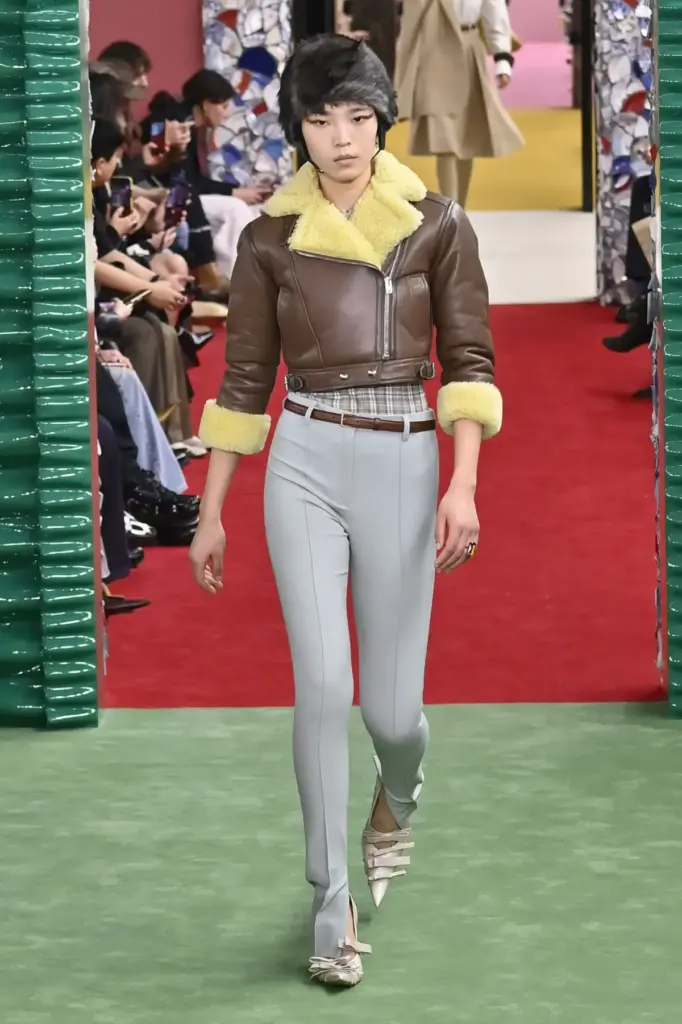
- Styling Strategies: Fashion traditionalists can lean fully into the shrinking aesthetic—exemplified by Acne Studios’ mini shearling-lined leather trousers—or create visual tension by pairing streamlined bottoms with voluminous upper-body garments, such as Balenciaga’s oversized, statement-making leather jackets.
3. Color Blocking: Challenging the Boundaries of Complementary Palettes
Fall and winter palettes have historically relied on muted, monochromatic tones like charcoal, camel, and navy. Fall/Winter 2026, however, rejects cromatographic conservatism through aggressive, joyful color-clashing.
- High-Contrast Execution: Marc Jacobs paired solid-print skirts with contrasting sequined tops, while Mugler channeled an ultra-vivid interpretation of ’80s power dressing by combining jarring, unexpected hues that defy traditional color theory.
- The Aesthetic Philosophy: The underlying premise of this trend is the intentional disruption of rules. The objective is to stretch the limits of visual harmony, proving that discomfort in color pairings often yields the most compelling visual results.
4. Smart Layers: The Architecture of the 12-Hour Day
As modern lifestyles demand greater functional versatility from our wardrobes, designers have responded with sophisticated layering systems capable of bridging professional obligations and evening engagements.
- Masterclasses in Multitasking: Prada’s critically acclaimed presentations—highlighted by extensive runway appearances from top models—served as an instructional guide on functional, multi-tiered dressing. Marni integrated shirts beneath heavy cardigans and technical outwear, while the Michael Kors Collection updated the classic American collegiate prep uniform by layering crisp blue oxford shirts under rich red knitwear and tailored blazers.
- Functional Application: This trend encourages wearers to treat their outfits as modular systems, mixing quirky textures and weights to adapt seamlessly to fluctuating daily environments.
5. Not Your Librarian’s Pencil Skirt: The Slinky Reformation
The traditional, stiff corporate pencil skirt has undergone a radical deconstruction, transforming from a symbol of rigid office wear into a fluid, sensual garment.
- The Catalytic Shift: The pivot began when Matthieu Blazy lowered the waistline of the classic Chanel skirt-suit for his debut collection.
- Contemporary Iterations: Saint Laurent introduced latex-and-lace hybrid skirts featuring dramatic front slits; Chanel unveiled fluid chainmail alternatives; and Marni offered ultra-lightweight iterations secured with heavy utility belts. Whether styled with structural bodysuits for high-drama evening wear or kept classically restrained, the modern pencil skirt prioritizes movement and allure.
6. Doubling Down on Plaids and Tartans
Building upon the momentum established in previous cycles, plaid has transitioned from a seasonal accent to a permanent fixture of cold-weather wardrobing.
- Pattern Scaling: Fall/Winter 2026 runways emphasized extreme scale variation. Celine showcased extra-large, commanding plaid patterns, while Auralee disrupted traditional tartans with asymmetrical, Western-inspired shirting.
- Accessibility: Because plaid exists across a vast continuum of subcultures—from punk heritage to academic prep—wearers can easily integrate the pattern into their personal aesthetic without falling into caricature.
7. Shearling and Fur: The Early-Season Outerwear Arms Race
Outerwear remains the ultimate luxury investment, and Fall/Winter 2026 establishes shearling and plush furs as non-negotiable cold-weather armor.
- Textural Drama: Designers leveraged shaggy textures and oversized collars to inject immediate opulence into everyday dress. Chanel, Valentino, and Gucci presented sumptuous full-length coats, while Saint Laurent focused on exaggerated furry collars that offered drama without overwhelming bulk.
- Lifestyle Integration: Beyond urban thoroughfares, these statement pieces are increasingly styled for rustic escapes—such as weekend retreats to boutique mountain lodges—bridging high-fashion urbanity with rugged, natural environments.
Official Statements and Industry Insights
The commercial transition from runway concept to consumer adoption has prompted notable commentary from leading creative directors and retail analysts regarding the trajectory of contemporary style:
"The modern wardrobe cannot afford to be one-dimensional. When we examine the silhouettes for Fall/Winter 2026, our goal was to eliminate the friction between what is visually arresting on a runway and what a dynamic, modern individual actually requires for a twelve-hour day. Utility and fantasy are no longer mutually exclusive."
— Anonymous Senior Design Director, European Luxury House
Retail economists tracking the secondary luxury market note a distinct behavioral shift among consumers approaching the autumn purchasing window:
"We are observing a more deliberate consumer mindset. Rather than impulse-buying entire seasonal looks, shoppers are identifying one or two anchor pieces—often a statement shearling coat or a heavily tailored low-rise trouser—and utilizing resale platforms and archive sites to acquire them intelligently. Patience has become the hallmark of the modern luxury shopper."
— Global Fashion Retail Analyst, Luxury Goods Sector
Future Outlook: The Evolution of Wardrobe Curation
As the fashion industry looks beyond the immediate horizon of the current retail season, several long-term implications emerge from the Fall/Winter 2026 design philosophy:
- The Erosion of Binary Proportions: The simultaneous embrace of ultra-low-rise trousers and hyper-fitted skinny silhouettes alongside voluminous, structured outerwear indicates that the era of a single, dominating silhouette has ended. Consumers are increasingly encouraged to mix contradictory proportions to define their individual signatures.
- Sustainability Through Strategic Acquisition: With economic pressures and heightened environmental awareness influencing purchasing decisions, the emphasis on timeless investment pieces—such as authentic shearling outerwear and precision-tailored separates—will likely accelerate the growth of the luxury resale and vintage markets.
- The Hybridization of Work and Leisure: As smart layering and flexible uniform dressing continue to evolve, traditional boundaries between formal office wear and casual streetwear will dissolve further. The future wardrobe will rely heavily on modular components that adapt instantly to diverse social and professional contexts.
Ultimately, navigating the Fall/Winter 2026 season requires a balance of audacious experimentation and calculated curation. By understanding the origins and applications of these seven defining trends, the modern consumer is well-equipped to build a wardrobe that is as practical as it is visionary.