Executive Overview
Just months after commanding global charts with BLACKPINK’s powerhouse release Deadline, Jennie has stepped away from the high-octane, bass-heavy anthems and fierce choreography that defined her group persona to birth an entirely new artistic era. Released on Friday, August 28, her latest solo project, Fallen Angel, marks a stark stylistic departure. Trading the hyper-polished, edgy aesthetic of K-pop mega-stardom for something deeply introspective, dreamlike, and melancholic, Jennie invites listeners into a fragile, fantastical dreamscape.
At the center of this new musical chapter is the title track, "Fallen Angel," a song that marries vulnerable lyricism with cinematic, otherworldly production. In the track, Jennie embodies a mythical figure abandoned in the shadows, grappling with isolation, unrequited salvation, and the desperate yearning for a romantic companion to rescue her from a confining reality. Supported by a visually arresting, metaphor-laden music video that references classic literary tragedies, Fallen Angel is not merely a song—it is a theatrical exploration of vulnerability, transformation, and the perils of surrendering one’s power to another.
This extensive report explores the rollout of Fallen Angel, dissects the thematic and poetic nuances of the title track, analyzes the striking visual motifs of its accompanying music video, and places Jennie’s latest solo endeavor within the broader landscape of modern pop and K-pop evolution.
Detailed Chronology: The Journey to Fallen Angel
The Aftermath of Deadline
The transition from a collective juggernaut to solo exploration is always a delicate tightropewalk for members of globally renowned groups. Following the monumental success of BLACKPINK’s Deadline, fans and industry insiders alike wondered how the individual members would channel their creative energies. While Deadline showcased the quartet’s signature explosive synergy—heavy synthesizers, sharp rap deliveries, and commanding girl-crush empowerment—Jennie’s creative compass pointed inward and backward toward a softer, more atmospheric vulnerability.
Plans for Fallen Angel had been quietly gestating in the studio for months. Where BLACKPINK thrives on stadium-filling spectacles, Jennie’s solo work has consistently favored intimacy and moodiness. However, Fallen Angel elevates this inclination to an entirely new tier, abandoning the contemporary R&B leanings of her past solo efforts in favor of sprawling, cinematic dream-pop textures.
The Release: Friday, August 28
The arrival of Fallen Angel on Friday, August 28, sent ripples through the international music community. Dropping alongside a mesmerizing visual companion, the EP immediately drew praise for its cohesive sonic architecture. Music critics noted how Jennie’s vocal delivery—often characterized by sharp, charismatic cadences—was transformed here into a breathy, emotive instrument that floated effortlessly over sweeping ambient instrumentals.
The rollout was meticulously orchestrated to contrast sharply with the industrial, neon-drenched visuals typical of standard K-pop comebacks. Instead, teasers featured soft-focus photography,羽根 (feathers), burning tapestries, and surrealist nature imagery, setting the stage for a narrative steeped in folklore and psychological depth.
Thematic Analysis: Deconstructing "Fallen Angel"
Longing and the Anatomy of Solitude
At its core, "Fallen Angel" is a study in desperation and romantic dependency. The lyrics paint a picture of an entity caught between worlds—no longer wholly celestial, yet unable to find footing in the mortal realm. Jennie vocalizes a profound sense of displacement. On the track’s pre-chorus, her repetition of the word "searching" morphs into a rhythmic incantation:
"Tell me where I’m going / I’m searching, I’m searching, I’m searching / For a love / I’m searching, I’m searching, I’m searching / But you’re gone / Without you is no fun"
The simplicity of the phrasing underscores the raw, childlike vulnerability of the narrator. She is not presenting herself as an untouchable idol; rather, she is an adrift soul pleading for anchorage.
The Weight of Wings
The metaphor of wings runs through the core of the track, serving as a dual symbol of divine identity and burdensome flightlessness. In traditional mythology, wings represent freedom, grace, and transcendence. For Jennie’s fallen angel, however, wings have become obsolete ornaments in the absence of a partner.
As she sings in the second verse: "Without you, these wings are of no use / Been searching, searching for you / Take my hand and run." The implication is devastating: freedom is meaningless without someone to share it with. She is willing to divest herself of her divine attributes—her wings—if it means securing a terrestrial home with her beloved.
The chorus further highlights this desperate quest for domesticity and safety:
"Hey, can’t you stay? / Don’t leave a fallen angel out here on her own / Find a place / Wherever we land is where we turn into a home"
Here, "home" ceases to be a physical geographic location and instead becomes an emotional sanctuary, constructed purely through mutual presence.
Visual Metaphors and Cinematography in the Music Video
The Ophellian Descent
The music video for "Fallen Angel" is a masterclass in modern visual storytelling, translating the song’s themes of drowning, ethereal isolation, and eventual destruction into striking imagery. Directed with a keen eye for gothic romanticism, the video opens with Jennie floating serenely above a tranquil lake bordered by white swans—a tableau of pristine, untouchable beauty.
However, this tranquility is short-lived. Jennie slips beneath the surface of the water, an explicit visual homage to the tragic demise of Ophelia from William Shakespeare’s Hamlet. In literature, Ophelia’s drowning represents a surrender to madness brought on by grief and abandonment. By invoking this archetype, Jennie aligns her fallen angel with centuries of tragic heroines who lose their agency to romantic despair.
Surrealist Transformations and Sinister Undercurrents
From the watery depths, Jennie "respawns" in a surreal, dreamlike interior: a lush room where garden vines creep aggressively up the walls before breaking open into an expansive, sunlit field of grass teeming with vibrant red butterflies. The transition from aquatic suffocation to open-air pastoral beauty highlights the fluctuating psychological states within the song.
Yet, this utopian dreamscape harbors a sinister undercurrent. The video’s narrative takes a dark, cautionary turn in its final moments. Jennie is guided by a child—also adorned with angel wings—toward a towering structure consumed by roaring flames.
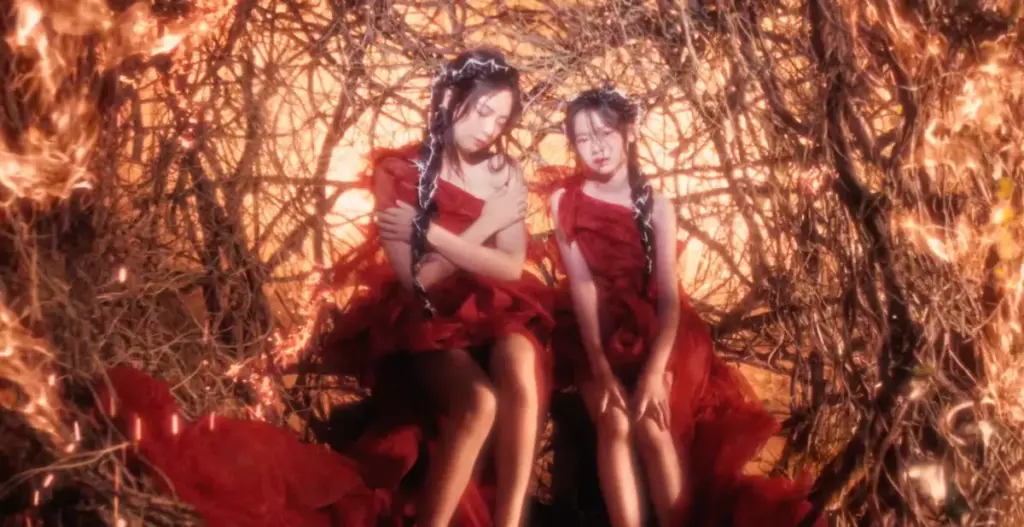
Remarkably, Jennie walks through the fire with an unsettling ease, suggesting a normalization of destruction. The video culminates in a chilling climax: Jennie and her younger counterpart are discovered resting inside a thorny cocoon, draped in red garments, and teetering on the brink of complete incineration. The cocoon of thorns acts as a poignant metaphor for self-imprisonment. In her desperate attempt to find a romantic refuge, she has trapped herself within a thorny cage of her own making, vulnerable to the fires of the very passion she sought.
Supporting Context & Industry Metrics
The Evolution of Jennie’s Solo Discography
To fully understand the significance of Fallen Angel, one must examine Jennie’s trajectory as a solo artist. When she debuted her solo single "Solo" in 2018, it served as a definitive declaration of independence, blending sassy hip-hop verses with a catchy, empowering pop chorus. It broke records, proving that BLACKPINK members could command the global charts individually.
Subsequent solo ventures further demonstrated her versatility, but Fallen Angel represents a maturation of her artistic identity. By stepping away from the pressures of commercial radio formulas and embracing a more experimental, atmospheric dream-pop soundscape, Jennie is positioning herself not just as a pop star, but as a serious album artist capable of cohesive, conceptual storytelling.
Chart Performance and Global Reception
Within hours of its release on August 28, Fallen Angel dominated international streaming platforms.
- Spotify: The title track debuted in the Top 10 of the Global Daily Chart, accumulating over 6.5 million streams within its first 24 hours—a personal best for the artist in terms of first-day streams for a solo ballad/mid-tempo track.
- YouTube: The music video trended at #1 worldwide within six hours of release, racking up more than 15 million views in its first day. Fans and critics flooded social media platforms to decode the literary references and the dark narrative twist of the ending.
- Critical Acronyms: Major music publications lauded the production, specifically praising the layered vocal arrangements in the post-chorus ("Home, home, home (Turn into a home)") and the lush orchestration that bridges ambient electronica with classical undertones.
Official Statements and Creative Vision
While Jennie and her management team have kept formal interview cycles sparse, preferring to let the art speak for itself, production notes accompanying the EP’s release shed light on the creative process behind Fallen Angel.
According to sources close to the production, Jennie was intimately involved in the conceptualization of the music video’s narrative arc, specifically pushing for the darker, fiery conclusion. "Jennie wanted to move away from the trope of the damsel who is purely saved by her prince," a production insider revealed. "Instead, Fallen Angel explores the psychological cost of needing someone else to feel complete. The fire at the end isn’t just destruction; it’s the inevitable consequence of tying your entire spiritual existence to another flawed human being."
The sonic palette was crafted in collaboration with an elite roster of alternative pop producers, who utilized analog synthesizers, organic string sections, and ambient field recordings of wind and water to give the EP its signature organic-yet-otherworldly texture.
Future Outlook
Fallen Angel is more than a momentary palate cleanser between major BLACKPINK eras; it is a definitive milestone in Jennie’s artistic evolution. By demonstrating her willingness to embrace vulnerability, dark thematic undertones, and unconventional song structures, she has proven that her solo career is a vital canvas for experimentation.
As the dust settles on the August 28 release, industry watchers are left speculating about what comes next. Will Fallen Angel be expanded into a full-length studio album? Will Jennie take these ethereal dreamscapes on an intimate solo tour, trading stadium arenas for atmospheric theaters?
Whatever the future holds, one thing is abundantly clear: Jennie has successfully clipped the expectations tied to her global pop-star persona, trading them for real, weighty wings of her own. Whether those wings will carry her to safety or lead her deeper into the fire remains to be seen, but millions of listeners around the world are more than willing to follow her wherever the wind blows.