Executive Overview
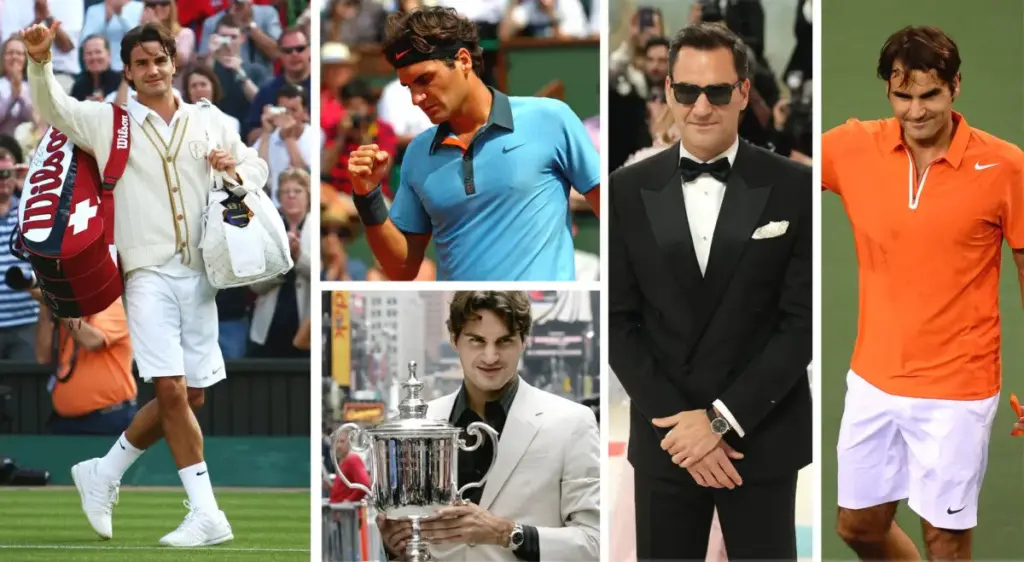
To understand Roger Federer is to understand the absolute mastery of silhouette. On the court, his presence was defined by the crisp architecture of a tailored polo, slim-cut shorts, and pristine white tennis shoes. Off the court, his signature was a sharply tailored suit with a distinctly European ease—unhurried, effortless, and impeccably proportioned. Now, as the 20-time Grand Slam champion takes his rightful place within the hallowed grounds of the International Tennis Hall of Fame (ITHF) in Newport, Rhode Island, it is increasingly clear that his profound legacy extends far beyond baseline dominance, match points, and trophy lifts. It spills directly into the annals of global fashion history.
Federer’s induction solidifies his status alongside historical titans of the sport such as Billie Jean King and John McEnroe. Yet, the weekend in Newport was not merely a traditional retrospective of athletic achievements; it was a living, breathing cultural exhibition titled Tennis, Transcended: Roger Federer’s Path to Greatness. This unprecedented curation traces his trajectory from a fiery, talented young prospect from Basel to a global style icon whose sartorial choices have fundamentally reshaped how the world views tennis fashion.
While men’s tennis has historically played host to charismatic sartorial disruptors—from Andre Agassi’s neon denim rebellion and acid-wash shorts to Björn Borg’s iconic striped Fila tracksuits—Federer charted an entirely different course. He embraced the timeless, classical codes of tennis heritage and elevated them into a modern, highly individualized uniform. In doing so, he proved that true elegance is never loud, but rather a quiet exercise in precision.

Detailed Chronology: Newport Weekend and the Unveiling of Tennis, Transcended
The celebratory weekend kicked off precisely 48 hours before the official induction ceremony with an exclusive cocktail gala held at Newport’s grand, gilded-age Marble House. There, Federer appeared alongside fellow inductee Mary Carillo, setting a tone of understated luxury that would characterize the entire event.
However, the emotional heartbeat of the weekend occurred earlier in the day, when Federer quietly toured the ITHF museum alongside his wife, Mirka, and their children. Walking through the exhibition spaces, the tennis icon came face-to-face with the physical artifacts of his own storied career, marveling at the sweeping evolution of tennis apparel through the generations.
According to Nicole Markham, the ITHF’s curator of collections, who accompanied Federer through the galleries, the champion’s engagement with the exhibits went far beyond nostalgic self-reflection. "We have a René Lacoste blazer, which he pointed out," Markham notes, highlighting Federer’s deep reverence for the sport’s roots. "He was recognizing the evolution of classic style through the generations of tennis. As a player, he’s not just there to play the game; he really knows the history."

The exhibition itself serves as a masterclass in sports curation, pairing match-worn kits, historically significant racquets, and personal artifacts with the narrative of an athlete who made inhuman physical exertion look weightless. Among the marquee attractions are the dapper, sportswear-inspired cardigan and matching separates from his triumphant 2007 Wimbledon campaign, alongside the striking blue Nike polo shirt and shorts ensemble he wore to secure his career-defining and sole French Open title at Roland Garros in 2009.
"It’s cliché hearing ‘elegance’ in the context of Roger," observes JT Buzanga, the ITHF’s collections manager. "But that’s who he is. Every line, every movement, and every garment he wore felt entirely organic to his character."
Supporting Context & Metrics: The Intersection of Sport, Tailoring, and High Fashion
While Federer’s career statistics are staggering—including 310 total weeks spent at world No. 1, 103 career singles titles, and 20 major championships—his cultural metrics are equally formidable. He successfully bridged the gap between traditional athletic performance wear and high-end luxury menswear, transforming sports sponsorships into legitimate haute couture partnerships.

Sunita Kumar Nair, author of the critically acclaimed book Ace: The Times and Style of Tennis, points out the unique longevity of Federer’s visual appeal. "He’s not the one with the most Grand Slams [a record held by Novak Djokovic], but he is the one that everyone wants to emulate," Nair explains. "You can watch his play 50 years from now and not only would his play still be relevant, but what he’s wearing will also be relevant."
This timeless relevance did not mean Federer was entirely risk-averse. Throughout his career, he frequently pushed the boundaries of traditional tennis codes when the moment called for it. A seminal moment occurred during an exhibition match at the 2017 US Open, when Federer stepped onto the court wearing a pair of Virgil Abloh-designed Off-White x Nike Air Jordan 1s. This daring collaboration took place just months before Abloh was appointed as the first Black artistic director of Louis Vuitton Men’s, cementing Federer’s early radar for seismic shifts in global fashion culture.
"Wearing the Virgil Abloh shoes was out of the box for him, but it showed his willingness to explore and try new things," Kumar Nair notes. "Him embracing Virgil as a designer, despite the fact that his style is so classic, shows his understanding of how broad the game’s outreach can be."

This boundary-pushing ethos extended into his post-retirement creative endeavors, most notably his ongoing partnership with the Swiss performance running brand On, where Federer acts as both an investor and an active designer, shaping modern athletic aesthetics for a new generation.
Official Statements and Cultural Impact
The sheer magnitude of Federer’s global fandom was on full display throughout the Newport induction weekend. The historic grounds of the ITHF were flooded with international fans clad in RF-branded merchandise, creating an atmosphere more reminiscent of a Grand Slam final than a museum induction. In a nod to the modern tradition of signature tournament libations—such as the US Open’s famous Honey Deuce—the ITHF partnered with Silent Pool Gin to introduce the "Lemon Aces," a refreshing gin-and-lemon cocktail poured exclusively for the celebratory crowds.
"He’s adored worldwide," says JT Buzanga, reflecting on the overwhelming public turnout and the palpable energy on the grounds. "Even though he’s been retired for several years, he still makes an impact on the sport. The adoration that everyone has for him is unbelievable."

The induction ceremony also featured a sentimental highlight on the court, with Federer participating in a Celebrity Pro Classic match alongside tennis royalty like Martina Navratilova, proving that while his competitive touring days are behind him, his effortless touch remains entirely intact.
Future Outlook: The Enduring Blueprint of the Federer Era
As the International Tennis Hall of Fame officially enshrines Roger Federer, the institution is not merely closing the book on an extraordinary athletic career; it is establishing a permanent benchmark for what modern sports greatness looks like.
Federer’s influence on tennis will continue to reverberate through multiple dimensions:

- The Evolution of Athletic Partnerships: Future tennis stars will continue to look to the Federer-Nike-Uniqlo-On trajectory as the gold standard for long-term brand building and cross-industry relevance.
- Museum Curation Standards: Tennis, Transcended sets a new precedent for how sports museums integrate fashion, cultural history, and personal narrative into cohesive, immersive public exhibitions.
- The Definition of On-Court Elegance: Long after racquets and racket technology evolve, the visual standard set by Federer’s tailored aesthetic will remain the aesthetic North Star for players stepping onto Centre Court at Wimbledon.
The Hall of Fame may have formalized Roger Federer’s place in history, but as his ongoing cultural footprint proves, his influence on the worlds of sport, style, and global culture is far from finished.