Executive Overview
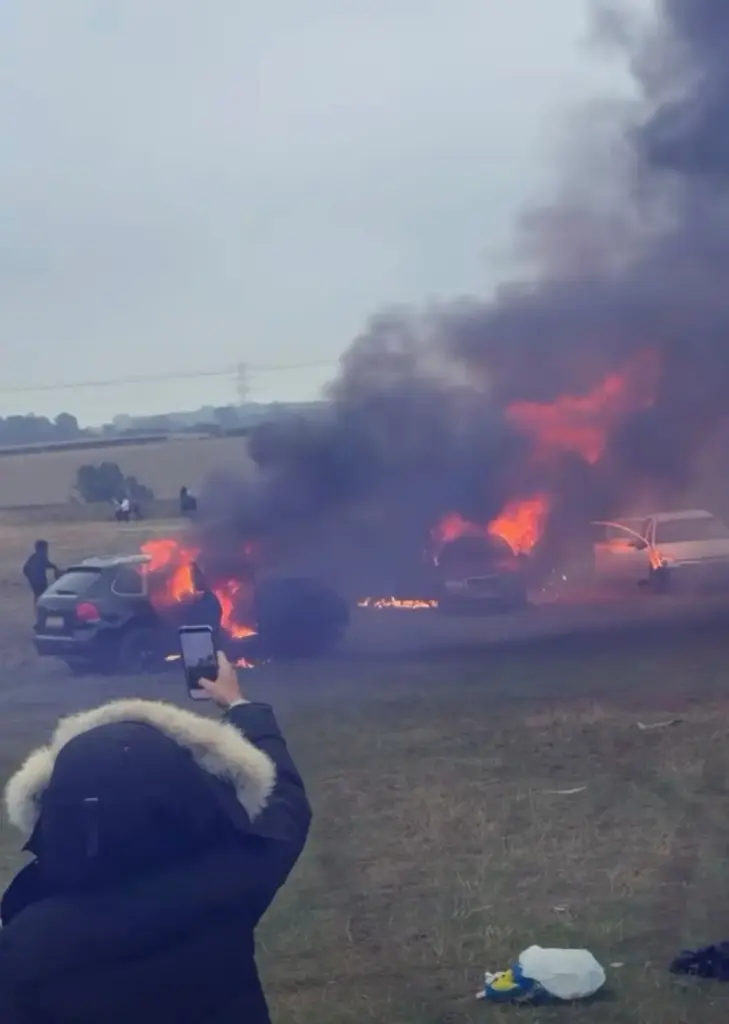
Teesside and County Durham are currently gripped by an unprecedented wave of gangland violence, leaving local communities terrified and emergency services stretched to a breaking point. A bloody escalation in organized crime has resulted in a staggering nine deaths in just five days, fracturing the social fabric of the region. The latest manifestation of this violent unrest unfolded on Thursday night, August 27, 2026, when residents in the Haswell area of County Durham watched in shock as multiple cars were deliberately torched in a field during a chaotic balloon-release memorial.
The memorial was reportedly held for 23-year-old Michael Robert Cahill, one of the occupants who perished in a catastrophic, wrong-way collision on the A66 in Middlesbrough earlier in the week. This fiery roadside gathering is just one of several explosive incidents keeping law enforcement on high alert. Cleveland Police, fortified by an influx of more than 200 mutual-aid officers—including specialized detectives and armed response units—are scrambling to contain a suspected turf war that has spiraled out of control.
With murders, fatal high-speed collisions, and a devastating house fire that claimed the lives of an innocent woman and a seven-year-old child, local leaders are urgently petitioning the national government for enhanced resources. This investigative report breaks down the timeline of terror, the harrowing human cost of the ongoing violence, official responses, and what lies ahead for a community desperate to reclaim its peace.
Detailed Chronology: Five Days of Terror Across Teesside
The rapid descent into chaos began over the weekend, leaving an indelible scar on the region’s collective consciousness. The sequence of events points to a deeply entrenched criminal network warring for supremacy, casting an ominous shadow over innocent families.
The A66 Catastrophe
The initial spark of the current crisis occurred during the weekend, when a high-speed, wrong-way collision on the A66 in Middlesbrough claimed multiple lives. Five men were traveling the wrong direction down the dual carriageway in a Volkswagen Passat when it became involved in a catastrophic impact. Among the deceased was 23-year-old Michael Robert Cahill. Tragically, the carnage on the highway was not restricted to the occupants of the rogue vehicle; the collision also claimed the lives of others, including two dedicated police officers who were responding to the unfolding danger. In total, the A66 disaster left a devastating death toll that instantly destabilized the region’s fragile criminal ecosystem.
The Grangetown House Fire Murders
As the region reeled from the highway tragedy, the violence took an even more sinister and targeted turn in the early hours of Wednesday morning. Just before 05:30 BST, a ferocious house fire tore through a residential property on Birchington Avenue in Grangetown, near Middlesbrough.

The blaze proved fatal for 34-year-old Natalie McDonald and seven-year-old Valentina Foster. A 48-year-old woman was rushed to the hospital in a critical condition, while three others sustained non-life-threatening injuries. Cleveland Police immediately launched a murder investigation, arresting two men in connection with the horrific attack. Investigators are actively probing whether the Birchington Avenue arson is directly linked to the A66 crash, treating it as a possible retaliation or escalation in the suspected gangland turf war.
The Haswell Memorial Chaos
By Thursday evening, tensions reached a boiling point in County Durham. A memorial gathering intended to honor Michael Robert Cahill transformed into a scene of lawlessness in the Haswell area. As mourners released balloons into the evening sky across a rural field, rows of vehicles were deliberately set ablaze.
Footage widely circulated on social media captured the chilling sight of SUVs and cars entirely engulfed in flames, illuminating the night sky with intense orange and yellow hues against a backdrop of dry grass. The incident underscored the brazen nature of the gangs operating in the region, who appear entirely undeterred by the massive police presence flooding the local area.
Supporting Context & Metrics: A Region Under Strain
The cumulative toll of the past week highlights a profound breakdown of public safety in Teesside and County Durham.
- The Death Toll: Nine lives have been lost in just five days, encompassing the victims of the A66 collision—including the two police officers—and the tragic fatalities of the Grangetown house fire.
- Law Enforcement Mobilization: Recognizing the severity of the threat, Cleveland Police have been reinforced by an influx of over 200 officers drawn from forces across the United Kingdom. This auxiliary deployment includes high-level detectives and heavily armed response units capable of managing high-risk tactical engagements.
- Emergency Call Dynamics: According to local government insights, while the sheer volume of general calls made to emergency services has actually dipped slightly over the week, the severity of the incidents has skyrocketed. Law enforcement is forced to divert massive resources toward violent crime, arson, and organized criminality.
- Collateral Damage: The brutal reality of modern gang warfare is its propensity to consume the innocent. While criminal factions settle scores, families like that of Natalie McDonald and young Valentina Foster are left to mourn relatives who had zero connection to the underworld.
Official Statements and Community Outcry
The sheer scale of the violence has prompted immediate responses from local politicians, community leaders, and the grieving families caught in the crossfire.
Josh Kirton, the heartbroken brother of Natalie McDonald, voiced the profound anguish felt by families whose loved ones have been unjustly targeted or caught in the periphery of the violence. Speaking to reporters, Mr. Kirton stated with agonizing clarity:

"My sister was not involved with anything to do with gangs, or the crash on the A66. That’s what makes this so senseless. People think they can do whatever they like. There’s some terrible people in the world and now my sister and Valentina have gone."
Local governance has mobilized rapidly to support the overwhelmed police force. Alec Brown, leader of the Redcar and Cleveland Council, shared details of an emergency briefing he received alongside Redcar MP Anna Turley and local ward councillors from a senior Cleveland Police superintendent. In a public statement, Mr. Brown praised the relentless efforts of the constabulary:
"They are working 20-hour days to ensure the ongoing safety of innocent residents. Over 200 extra police officers from forces around the country are here and are en route, from detectives to armed response. I will be sending a letter today to our Prime Minister asking for even more resource. The police really are doing an amazing job."
Mr. Brown also sought to reassure residents regarding emergency response metrics, noting:
"If it is any reassurance at all, jobs called in to the police are actually down this week, however, the seriousness of the ones that have been called in need serious and swift action. Everyone is heartbroken over the loss of the aunt and little girl in Grangetown yesterday. People need to feel safe in their homes."
Future Outlook: Restoring Law and Order to Teesside
As August 2026 draws to a close, Teesside stands at a critical crossroads. The events of the past week have exposed deep-seated vulnerabilities in regional security, forcing central government and local authorities to reevaluate how organized crime syndicates operate across county lines.

Short-Term Priorities
In the immediate future, the primary objective for Cleveland Police and their mutual-aid partners is containment and deterrence. The presence of armed response units and additional detectives is expected to remain high across Middlesbrough, Grangetown, and County Durham. Investigators are working around the clock to interrogate the suspects arrested in connection with the Grangetown murders, sift through digital evidence from the Haswell vehicle burnings, and reconstruct the precise timeline of the A66 tragedy. Establishing definitive links between these disparate events will be crucial for dismantling the leadership structures of the warring factions.
Long-Term Policy and Community Resilience
Beyond tactical policing, local leaders recognize that restoring permanent peace requires addressing the root causes of entrenched criminality. Calls for increased central government funding, spearheaded by regional leaders like Alec Brown, underscore the reality that local authorities cannot combat sophisticated regional syndicates without sustained national backing.
Furthermore, community leaders face the immense challenge of rebuilding trust and ensuring that ordinary citizens—those like Natalie McDonald and little Valentina Foster, whose lives were stolen by the collateral fallout of lawlessness—are adequately protected in their own neighborhoods. Until the kingpins driving this turf war are brought to justice and stripped of their operational capacity, Teesside will remain a region holding its breath, waiting to see if the fires of Haswell and Grangetown can finally be extinguished for good.