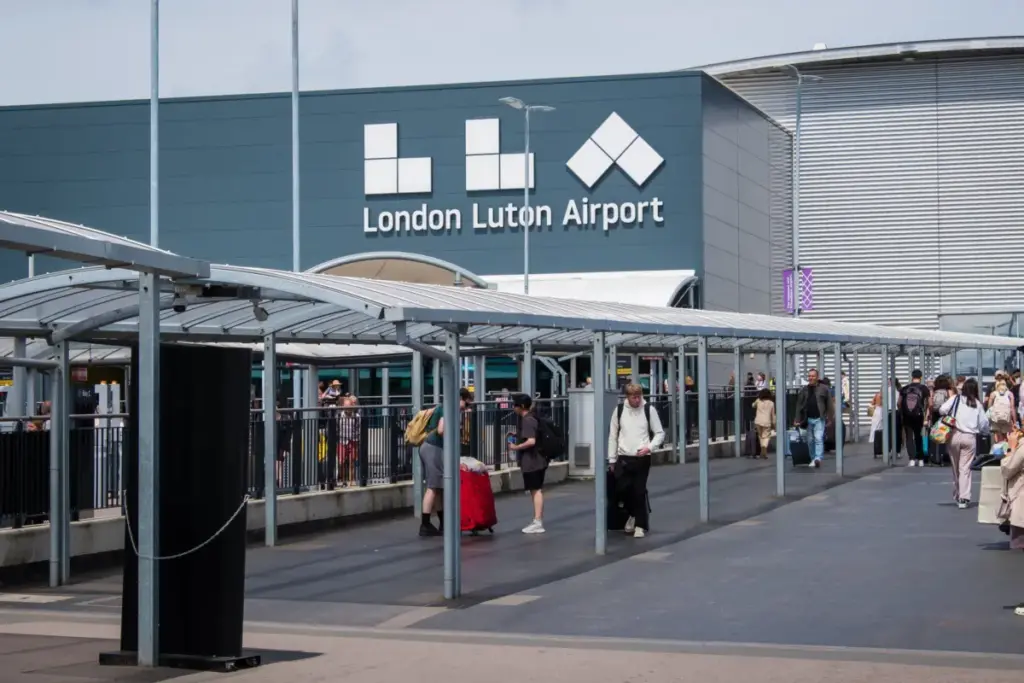
A dramatic convergence of severe weather conditions brought transport infrastructure to a sudden and grinding halt across parts of the United Kingdom, leaving thousands of holidaymakers stranded, exhausted, and confused. London Luton Airport—one of the country’s primary aviation hubs—found itself at the epicenter of the crisis when a fierce electrical storm struck the region, directly impacting critical air traffic control (ATC) equipment.
The cascading failures triggered a complete suspension of flight operations for nearly two hours during peak evening travel times, leading to a wave of cancellations, widespread delays, and emergency flight diversions that rippled across the British aviation network. Compounding the misery on the ground, torrential downpours brought immediate flash flooding to surrounding access roads, plunging major arterial routes into gridlock and forcing bewildered passengers to drag their luggage through rising floodwaters on foot.
While normal flight operations have officially resumed, the systemic aftershocks of the incident continue to reverberate. Airlines are struggling to recover displaced aircraft and crew rosters, while passengers caught in the crossfire grapple with the logistical nightmare of uncoordinated diversions, absent airline representatives, and scrambled travel itineraries. This disruptive event also serves as a stark meteorological punctuation mark, signaling an abrupt and violent end to the prolonged periods of scorching summer weather across England and Wales, as a broader low-pressure storm front triggers yellow weather warnings nationwide.
Detailed Chronology of the Disruption
The crisis unfolded rapidly late in the afternoon, catching ground crews, airlines, and passengers entirely unawares as the atmospheric stability gave way to violent convective storm cells.
The 105-Minute Shutdown
At approximately 5:40 PM, a dense cluster of severe thunderstorms rolled across Bedfordshire and Hertfordshire. According to airport authorities and aviation tracking data, a high-intensity lightning strike directly impacted essential air traffic control infrastructure at London Luton Airport. The surge or disruption to the sensitive technical gear forced safety controllers to suspend all incoming and outgoing flights immediately to prevent navigational blind spots or mid-air coordination errors.
For 105 agonizing minutes—stretching until 7:15 PM—the tarmac remained locked down. Aircraft holding on the tarmac were frozen in place, while inbound planes were forced into holding patterns or diverted entirely to alternative airports hundreds of miles away. Passengers already seated aboard aircraft experienced long, tense delays on the tarmac before being informed that their flights would not be landing at their intended destination.
Flash Floods and Foot Travel on the A-Roads
While passengers in the air were being redirected across the country, those attempting to arrive at the airport by road faced an entirely different crisis. Torrential rain fell at rates exceeding standard drainage capacities, turning access roads and nearby roundabouts into improvised lakes. Submerged under feet of water, critical approach routes were abruptly closed off by local authorities.
Footage captured by stranded motorists and travelers depicted a surreal scene: hundreds of holidaymakers, weighed down by heavy suitcases and children’s buggies, wading through water and walking directly along busy A-roads to make their flights or escape the gridlock. Describing the chaotic conditions on social media and to news crews, travelers characterized the environment as "an absolute disaster" and a logistical breakdown.
The Diverted Flights and the East Midlands Bottleneck
With Luton’s airspace effectively closed, air traffic controllers scrambled to slot diverted aircraft into neighboring regional airports. One of the primary alternative destinations was East Midlands Airport, located nearly 70 miles north.
Aviation insiders note that East Midlands received approximately 10 sudden, unscheduled diversions within a compressed window. This influx introduced thousands of unexpected passengers into a terminal that does not regularly host operations for several of the affected airlines—most notably easyJet. Consequently, passengers faced an acute absence of ground handling agents, airline representatives, or customer service desks to guide them through the emergency protocols.
Supporting Context & Metrics: The Human Impact and Passenger Rights
The physical toll of flight diversions is frequently underestimated by automated scheduling algorithms. When a plane scheduled to land at Luton from Belfast is instead grounded at East Midlands Airport, the psychological and physical strain on passengers is immediate.
Stories from the Tarmac and Terminal
Consider the experience of 22-year-old Amy, whose easyJet flight from Belfast was diverted mid-journey. After enduring a frustrating two-hour confinement on the tarmac at East Midlands Airport, passengers were eventually permitted to disembark into a terminal ill-equipped to process them.
Her mother, Sue, recounted the distressing scene to reporters: "She found herself waiting for a bus with lots of very confusing people with no idea of where they were going. They were in an unfamiliar place with no idea of when and if they would get a bus."
Facing an information vacuum and realizing that the promised replacement coach services were either non-existent or indefinitely delayed, Amy and four other young women—all traveling alone—made the pragmatic decision to pool their resources. They booked a private Uber to drive them over 70 miles south toward St Albans, taking matters into their own hands to salvage what remained of their weekend plans.
Navigating Passenger Rights Under Duress
In the wake of mass disruptions, consumer rights organizations and aviation regulators enforce clear mandates regarding airline responsibilities, though these are frequently obscured during chaotic incidents.
The Duty of Care: Under UK and EU aviation regulations (such as UK Denied Boarding Regulations), airlines are legally mandated to look after passengers experiencing significant delays or cancellations. This encompasses the provision of food, beverages, and appropriate communication facilities (such as vouchers for phone calls or data).
Accommodation and Transfers: If a cancellation or diversion necessitates an overnight stay, or forces a traveler into an extended delay, the operating airline must provide hotel accommodation alongside the transportation costs required to travel between the hotel and the airport.
The Expense Claim Process: Passengers who are forced to organize their own alternative transport—such as the rideshare arrangements made by stranded travelers at East Midlands—are generally entitled to reclaim these costs. However, consumer advocates advise travelers to retain every digital receipt, keep itemized logs of communications, and ensure that expenses remain "reasonable" under the circumstances. Premium or luxury transit options are frequently rejected by airline claims departments unless no other viable alternative was provided.
Jurisdictional Limitations: These robust protections apply primarily to flights operated by UK or EU carriers, or departing from UK/EU airports. Travelers utilizing non-European airlines must consult specific international carriage agreements.
Official Statements and Meteorological Outlook
As recovery operations slowly took effect, transport executives and meteorological agencies released coordinated updates regarding the incident and the broader weather picture.
London Luton Airport’s Official Response
In an official statement released late in the evening, airport management confirmed the root cause of the shutdown and outlined the ongoing recovery timeline:
"Flights to and from London Luton Airport have now resumed, following an earlier suspension caused by a lightning strike affecting Air Traffic Control equipment.
While flights are operating again, some services may continue to experience delays or cancellations as airlines work to recover their schedules. Passengers are advised to check the status of their flight with their airline before traveling to the airport.
We apologise for the disruption caused and thank passengers for their patience and understanding while the issue was resolved. Safety will always remain our highest priority."
Despite these assurances, budget carriers like easyJet reported lingering rolling delays throughout the following morning as displaced aircraft sat hundreds of miles away from their scheduled morning departure slots, forcing operational planners to scramble for replacement crews within legal flight-time limitations.
The Meteorological Shift: End of the Heatwave
The severe storms at Luton did not occur in a vacuum; they marked the dramatic termination of a prolonged spell of hot, humid weather that had gripped the British Isles for weeks. The rapid transition from stagnant, high-temperature air masses to unstable, moisture-laden low-pressure fronts created ideal thermodynamic conditions for severe supercells, sudden cloudbursts, and frequent electrical activity.
In response to the advancing front, the Met Office issued a series of yellow weather warnings spanning vast tracts of England and Wales. The warnings highlighted extreme risks of:
Sudden lightning strikes capable of disabling local power grids and sensitive aviation infrastructure.
High-volume rainfall totals accumulating between 30mm to 50mm within the span of a single hour, directly exceeding urban and rural drainage capacities.
Flash flooding across low-lying transport corridors, residential zones, and agricultural lowlands.
The active warning zone encompassed London and the South East, the East Midlands, the East of England, and stretches of Yorkshire and the Humber, remaining in force well into the following afternoon.
Future Outlook: Infrastructure Vulnerability and Resilience
The incidents at London Luton Airport have reignited an ongoing debate among transport economists, civil engineers, and aviation analysts regarding the resilience of critical national infrastructure against extreme weather events.
As global climate patterns shift toward more frequent, high-intensity convective storms, aviation hubs face unprecedented vulnerabilities. While commercial airframes are meticulously engineered to withstand direct lightning strikes through sophisticated Faraday cage designs and static discharge wicks, ground-based navigation arrays, radar towers, and air traffic control systems remain chronically susceptible to localized electrical surges.
Industry experts argue that airports across the United Kingdom must accelerate infrastructure hardening programs. This includes investing in redundant, localized power grids, fiber-optic isolation transformers, and advanced surge-suppression architecture capable of absorbing direct atmospheric discharges without triggering a system-wide safety shutdown.
For the traveling public, the message is clear: while modern aviation remains one of the safest modes of transit, the intersection of volatile meteorology and high-density scheduling leaves the modern travel network exceptionally fragile. Passengers embarking during periods of active weather warnings are increasingly advised to monitor real-time radar applications, maintain flexible itineraries, and remain intimately familiar with their statutory rights to ensure they are adequately supported when the skies turn hostile.