By Laura Howard in Blackpool
Published: August 21, 2026, 12:05 PM
Executive Overview
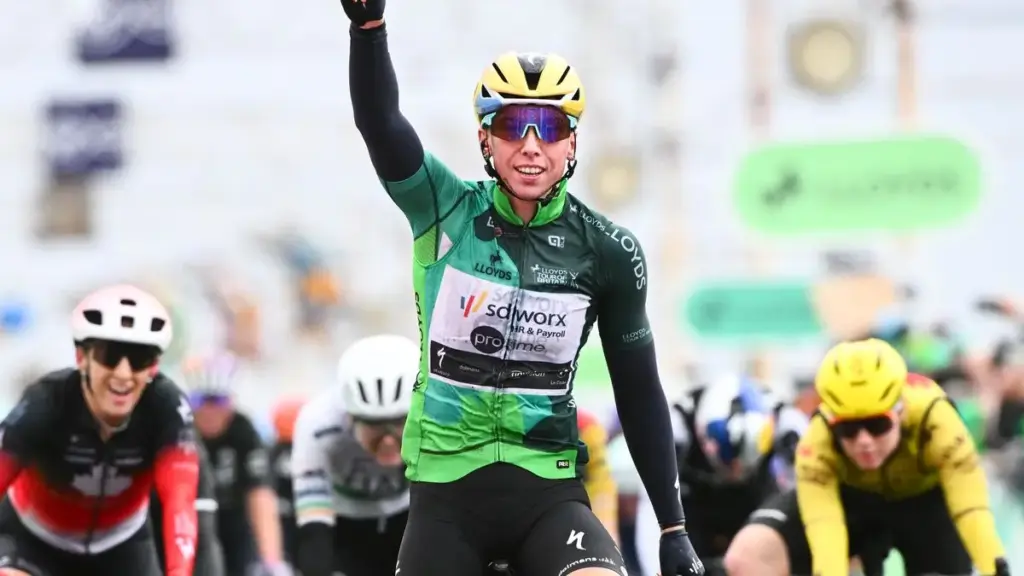
Beneath the iconic, flashing glow of Blackpool’s legendary glitterball and under a slate-gray Lancashire sky weeping typical west coast rain, Dutch powerhouse Lorena Wiebes reaffirmed her status as the undisputed queen of modern sprinting. In what unfolded as a chaotic, drama-filled edition of the Lloyds Tour of Britain, the 27-year-old Team SD-Worx rider delivered a tactical masterclass, launching an early, ferocious charge down the promenade to secure her second consecutive stage victory of the race.
For Wiebes, this marked her ninth career stage win at the Lloyds Tour of Britain—a testament to her peerless consistency, raw acceleration, and tactical acumen. Yet, the triumph was far from a simple procession. Stage 2 was severely disrupted mid-course by an unexpected traffic accident ahead of the race convoy, forcing organizers to reroute the peloton at the 17.5-kilometer mark and cancel the day’s second Queen of the Mountain (QOM) climb.
Despite the logistical hurdles, tactical cat-and-mouse games from rival squads, and a biting headwind sweeping off the Irish Sea, Wiebes once again proved untouchable. Her victory not only solidified her grip on both the general classification and the points classification jerseys but also cast a long shadow over the rest of the peloton, forcing rival teams to completely rethink their strategies just to find a glimmer of daylight against the SD-Worx juggernaut.
Detailed Chronology: Chaos, Stoppages, and Seaside Glory
The day began with high ambitions across the paddock, but the neutral rollout in Lancashire quickly gave way to unpredictable variables that test the mettle of even the world’s most elite cyclists.
The Mid-Course Disruption and Rerouting
As the peloton navigated the early kilometers of the stage, intense racing was brought to an abrupt halt. An unforeseen road traffic accident occurred directly ahead of the race convoy, necessitating an immediate intervention by race marshals and local authorities. To ensure rider safety, the decision was made to neutralize and subsequently reroute the course at the 17.5km mark.
The logistical reshuffle had an immediate impact on the race’s secondary classifications. The cancellation of the second Queen of the Mountain climb altered the anticipated points battle for the polka-dot jersey. However, it did little to dampen the aggression of the early animators of the race.
The Breakaway Battle and Aalerud’s Charge
Recognizing the futility of trying to outsprint Wiebes in a traditional bunch finish, rival teams immediately went to work to animate the race from the front. Among them, Uno-X Mobility’s Katrine Aalerud emerged as the day’s most combative rider. The 31-year-old Norwegian launched a spirited breakaway, actively driving the pace at the precise moment the race encountered its enforced pause.
Aalerud and her fellow escapees managed to carve out a precarious advantage over a chasing peloton that was eager to keep the sprinters’ teams within striking distance. Yet, the undulating terrain and the relentless, organized-if-harried-looking chase orchestrated by SD-Worx and rival lead-out trains meant that no breakaway was ever truly safe. As the kilometers ticked down toward the coast, the gap steadily evaporated, setting the stage for a high-stakes, high-speed showdown on the iconic Blackpool seafront.
The Run-In and the Winning Move
Entering the final 10 kilometers, the race profile flattened into a dangerously straightforward, high-speed drag toward the finish line on Blackpool’s famous promenade. Such direct run-ins notoriously heighten the risk of crashes, tactical stalemates, and riders becoming hopelessly boxed in.
Sensing the closing trap, Wiebes made a calculated, instinctive gamble. Rather than waiting for the final 200 meters as most pure sprinters prefer, she initiated her sprint early. Gritting her teeth against a punishing headwind blowing off the sea, she surged past the fading lead-out trains, established a decisive gap, and crossed the finish line with clear daylight between her and her closest competitors.
Supporting Context & Metrics: The SD-Worx Hegemony
To fully appreciate Lorena Wiebes’ performance in Blackpool, one must examine the broader metrics of her dominance and the structural supremacy of Team SD-Worx in the women’s professional tour.
Statistical Breakdown of the Victory
- Race: Lloyds Tour of Britain (Stage 2)
- Location: Blackpool Promenade, Lancashire
- Winner: Lorena Wiebes (Team SD-Worx)
- Age: 27
- Milestone: 9th career stage victory at the Lloyds Tour of Britain
- Current Jerseys Held: General Classification (Leader’s Jersey), Points Classification
- Teammate Accolades: Steffi Häberlin (Queen of the Mountains Jersey)
The Dominance Matrix
SD-Worx’s tactical playbook in stage races continues to be the envy—and the frustration—of the women’s professional peloton. By locking down both the general classification and the points classification through Wiebes, while simultaneously picking up the QOM jersey via teammate Steffi Häberlin, the team displayed a totalizing control over the race dynamics.
However, as Häberlin’s QOM jersey demonstrates, SD-Worx is not necessarily interested in defending every secondary classification across all stages. Their singular, laser-focused objective remains the accumulation of stage victories and overall leadership. This selective prioritization makes them exceptionally difficult to counter; they allocate their energy reserves precisely where it hurts their rivals the most, leaving crumbs for the rest of the WorldTour paddock.

Official Statements & Reactions
The post-race press enclosure captured a mix of tactical relief from the victor and philosophical resignation from the vanquished.
Reflecting on the frantic finale, Lorena Wiebes candidly admitted to the underlying anxieties that prompted her early surge to the line:
"I take quite some confidence when it goes to a sprint," the 27-year-old Dutch star remarked. "But today was also quite hard because it was pretty much straight to the finish with 10km to go, so there was a bigger risk of getting boxed in.
That’s why I started the sprint early at the end because I was afraid to get boxed in, but it was enough so I’m happy with it because there was a lot of headwind into the finish."
Wiebes’ comments underscore the fine margins that separate victory from defeat in elite cycling. A fraction of a second’s hesitation on a straight, wind-swept promenade could easily have relegated her to the murky depths of the bunch. Instead, her proactive racing instincts paid off handsomely.
On the other side of the competitive spectrum, Katrine Aalerud, awarded the day’s most combative rider honors after her tireless efforts for Uno-X Mobility, offered a brutally honest assessment of why traditional tactics are failing against the SD-Worx powerhouse:
"We cannot win the sprint so why should we wait and see if Lorena wins anyway?" Aalerud stated, encapsulating the collective frustration of the peloton’s non-sprinters.
"She is the biggest sprinter and most of the time she will win the sprint so we just have to try and race our way, so why not just try the breakaway and see if it will succeed?"
Aalerud’s words highlight a tectonic shift in tactical thinking across the women’s tour. When facing a generational talent like Wiebes, orthodox defensive racing is rendered obsolete. Teams are increasingly forced to throw out the rulebook, abandoning conventional chase-and-catch strategies in favor of aggressive, long-range flyers designed to disrupt the race before it can naturally settle into a bunch sprint.
Future Outlook: What Lies Ahead in the Lloyds Tour of Britain
As the Lloyds Tour of Britain moves forward from its dramatic Lancashire chapter, the landscape of the race has been firmly etched.
For Lorena Wiebes and Team SD-Worx, the immediate future is about defense and consolidation. Holding both the yellow leader’s jersey and the green points jersey places a heavy tactical burden on the squad. They will be forced to control the pace of the upcoming stages, absorbing attacks from desperate rival teams eager to shatter the Dutch rider’s stranglehold on the race.
Yet, if Stage 2 taught us anything, it is that Wiebes possesses not only unmatched top-end speed but also the tactical maturity to read danger before it materializes. Her ability to improvise—launching an early, preemptive strike into a biting headwind—proves she is more than just a fast pair of legs; she is a complete bike racer.
For the chasing pack, including animators like Katrine Aalerud and squads like Uno-X Mobility, the blueprint for the remaining stages is clear: throw caution to the wind. Expect more audacious, long-range breakaways, aggressive echelon formation attempts if the British weather plays its part, and relentless pressure on SD-Worx’s domestiques.
Ultimately, the Lloyds Tour of Britain continues to serve as a breathtaking showcase for the sport, bringing elite cycling directly to the public as Britain’s biggest free-to-spectate sporting event. As British Cycling works to inspire new generations of riders and fans across the country, performances like Wiebes’ masterclass in Blackpool provide a shimmering benchmark of athletic excellence. Whether anyone can find a way to crack the SD-Worx code before the race concludes remains the compelling question defining the remainder of the tour.