Executive Overview
It is a sweltering summer evening in London, deep into the grip of a relentless heatwave baking the European continent. Beads of sweat glisten on foreheads, pool in the hollows of necks, and dampen the backs of legs on a crowded, airless London Underground carriage. “Thank fuck Wembley has air conditioning,” a young woman mutters to her companion, clutching a pink cowboy hat and a matching marabou feather boa. She didn’t need to announce her destination; the carriage—indeed, nearly the entire Tube line—was already broadcasting its terminus through a uniform sartorial code.
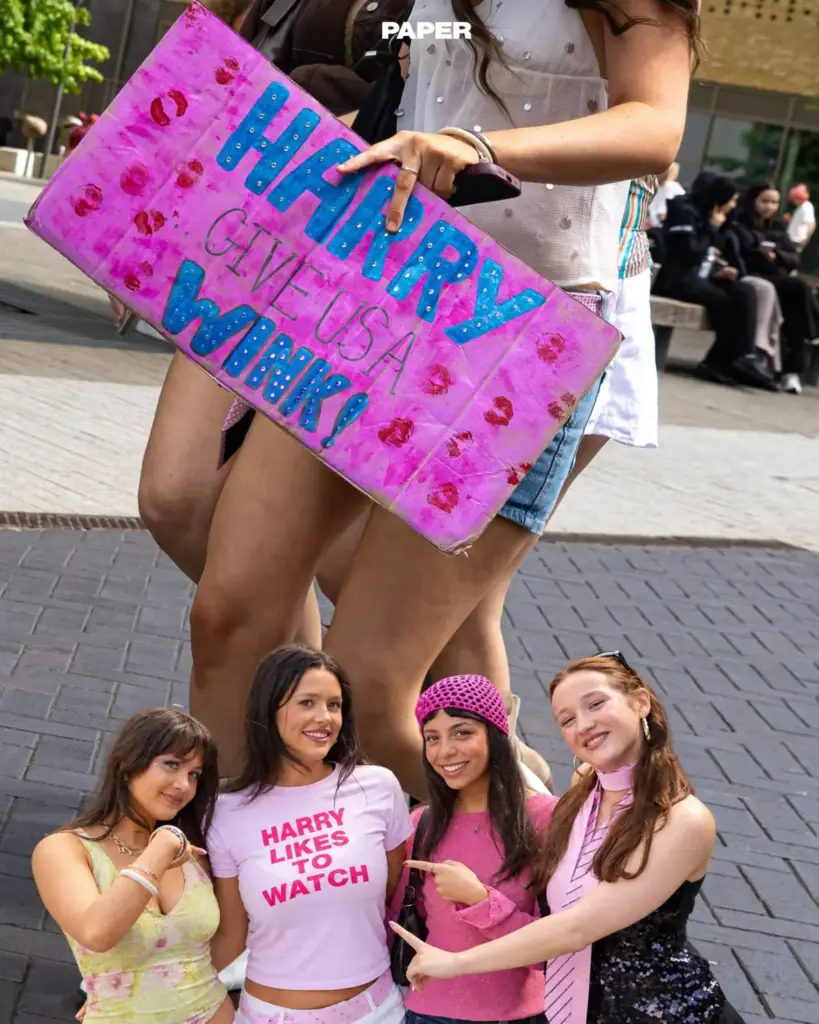
It was another night of Harry Styles’ residency at Wembley Stadium, and the transit system had effectively transformed into a moving pink-and-feathered pavilion. Outside the station, amidst boots and mini-skirts that once defined the universal standard of concert attire, the reality of modern pop performance culture became glaringly clear. These traditional outfits looked suddenly austere, almost out of place. It is the mid-2020s, and standard gig-going wear—a trusty pair of jeans, a vintage band tee, or a simple leather jacket—has been thoroughly upstaged by the Big Live Pop zeitgeist.
Today, the concourses outside major stadiums are oceans of feather boas, bespoke sequins, and themed memorabilia worn not just by teenagers, but by mothers, grandmothers, and peer groups looking to signal absolute allegiance. This is no longer merely about supporting an artist; it is about participating in an immersive, highly orchestrated community ritual. Concert dressing has evolved from a passive form of leisure into a vibrant, high-stakes subculture—a secular religion complete with vestments, sacraments, and unwritten dogmas.
Detailed Chronology: The Evolution of Immersive Fandom
The metamorphosis of concert fashion from casual individual expression to hyper-coordinated tribal uniform did not happen overnight. It represents a steady escalation in how artists, digital platforms, and audiences interact in the post-pandemic live entertainment landscape.
Phase 1: The Pre-Pandemic Paradigm (Before 2020)
For decades, concert dressing followed a relatively relaxed, highly individualistic formula. Attendees dressed to impress themselves, occasionally nodding to a genre or a specific band. One might don a Nirvana t-shirt to a contemporary rock gig to project a sense of pedigree, or rely on the reliable, near-constitutional British decree of "jeans and a nice top" for mainstream pop and indie-pop acts.
For pop fans specifically—such as the "Directioners" of One Direction’s heyday—outfits were occasionally deployed to catch the eye of the heartthrob on stage. Fandom fashion was anchored in the classic WattPad-fueled fantasy of being individually noticed, singled out from the sea of thousands by the object of one’s teenage affection.
Phase 2: The Post-Lockdown Live Music Renaissance (2022–2023)
When global live music roared back to life following pandemic-era lockdowns, an acute societal hunger for connection manifested physically. Audiences returned to stadiums not just to hear music, but to heal from years of isolation.
This era was catalyzed by landmark tours that weaponized collective aesthetics. Beyoncé’s 2023 Renaissance World Tour stands as a watershed moment. The global megastar explicitly commanded her audience—affectionately dubbed the Beyhive—to dress in silver and metallic hues, particularly for shows occurring during Virgo season. Fans responded with staggering precision, transforming stadiums into shimmering, futuristic expanses of chrome, mirrors, and avant-garde couture.
Phase 3: The Era of Hyper-Specialized Lore (2024–Present)
By 2024, Taylor Swift’s record-shattering Eras Tour accelerated this phenomenon into hyper-drive, turning concert attendance into an exhaustive anthropological exercise. Fans did not merely attend the show; they dressed as specific albums, distinct eras, or deep-cut lyrical references. Meeting a fellow concertgoer prompted immediate, ritualistic interrogations: "What Era are you meant to be?"
Simultaneously, the ritual of crafting and trading friendship bracelets—inspired by a single lyric from Swift’s Midnights track "You’re On Your Own, Kid"—swept across stadiums globally. What began as a cute craft project metastasized into a massive communal exchange program, executed with the dedicated earnestness of cottage-industry artisans.
By the time Charli XCX launched her Brat tour, the phenomenon had evolved yet again. Charli herself never mandated a dress code, yet audiences intuitively coalesced around her signature aesthetic: raw, rave-ready shades, white ribbed tank tops, and a hyper-specific, highly visible shade of chartreuse green that saturated social media algorithms and physical venues alike.
Supporting Context & Metrics: The Economics and Psychology of Cult Dressing
To write off modern concert dressing as a mere fleeting fashion trend is to ignore the complex economic, psychological, and sociological forces driving it.
The Financial Footprint of Fandom
The commercialization of concert culture represents a massive boon for the live entertainment and retail sectors. According to recent live-event consumer data:
- Merchandise and Apparel Spending: Up to 35% of total concert-goer expenditures are now allocated prior to the event, spent on custom outfits, accessories, and specialized footwear rather than just on-site venue merchandise.
- The Fast-Fashion Feedback Loop: E-commerce platforms now regularly drop dedicated curations weeks before major tours (e.g., "Taylor’s Version" edits or "Brat Summer" collections), capitalizing on real-time TikTok trends.
- The Craft Economy: Millions of dollars are spent annually on raw materials—beads, threads, sequins, hot glue guns, and wholesale feathers—as fans build their outfits from scratch, fostering a peer-to-peer micro-economy.
The Psychology of Belonging vs. Validation
Historically, fandom fashion was vertical: fan-to-artist. Young people dressed to secure validation, eye contact, or a nod of recognition from the celebrity on stage.
Today’s concert fashion is resolutely horizontal: fan-to-fan. In an era marked by unprecedented levels of reported youth anxiety, digital saturation, and post-isolation alienation, young people are utilizing live music as a physical anchor for community. Dressing up in a heavy-metal-meets-pop-royalty costume or a head-to-toe green rave outfit acts as an immediate badge of belonging. It serves as a visual passport that says to thousands of strangers: You and I speak the exact same language.
Even legendary outliers like Pitbull have become viral meme-monarchs; his audiences routinely make it mandatory to don bald caps and aviator sunglasses—a playful, democratized communion in shared absurdity.
Official Statements & Industry Perspectives
Cultural critics, fashion historians, and industry insiders have increasingly turned their attention to this seismic shift in audience behavior.
Dr. Aris Thorne, a sociologist specializing in modern subcultures and digital-age fandoms, notes:
"What we are witnessing is the displacement of traditional civic and religious institutions by pop-cultural fandoms. Young people are constructing their own rituals, shared calendars, and visual vestments. When a stadium of 80,000 people coordinates their wardrobe around an album’s aesthetic, they are performing a secular liturgy. It provides ontological security in an unpredictable world."
A senior fashion buyer for a major European high-street retailer weighed in on the commercial reality:
"Five years ago, festival style was bohemian and generic. Today, concert style is hyper-targeted to a specific intellectual property or musical era. We don’t design collections based on seasons anymore; we design collections based on tour itineraries. If Beyoncé or Taylor announces a date, the supply chain scrambles to match their visual universe within weeks."
Concertgoers themselves express a deep sense of agency in the practice. Maya, a 22-year-old fan interviewed outside Wembley, explained her elaborate handmade costume:
"Nobody cares if Harry [Styles] notices my outfit. That’s not the point. I spent three weeks sewing this with my best friend. When we walk down the concourse and people scream, ‘I love your look!’—that’s the high. We built this community together. The concert is just the soundtrack to our gathering."
Future Outlook: Where Goes Live Music Fashion?
As the live entertainment industry continues to break box-office records, the trend of immersive, cult-like concert dressing shows no signs of abating. Several trajectories are currently shaping the future of this phenomenon:
- Augmented Reality (AR) Integration: Future concert dress codes are expected to bridge the physical and digital realms. We are rapidly approaching an era where physical outfits will be embedded with near-field communication (NFC) tags or designed to trigger custom AR filters when viewed through smartphones within the stadium bowl.
- Sustainability and Circular Fandom Economies: Given the ecological critique of fast-fashion micro-trends (such as cheap polyester feather boas ending up in landfills), the fandom ecosystem is naturally pivoting toward peer-to-peer clothing rental platforms, swap meets, and upcycling collectives dedicated exclusively to tour wardrobes.
- The Decentralization of Star Power: As demonstrated by Charli XCX’s audience-led Brat aesthetic, future tours may rely less on explicit directives from the artist and more on organic, internet-native swarm intelligence. The audience will increasingly dictate the visual culture of the tour in real-time, completely independent of stylist-driven marketing plans.
Conclusion
Ultimately, the phenomenon of cult concert dressing is far more than an Instagram trap or a commercial cash grab. For a generation raised predominantly online—many of whom had formative developmental years disrupted by the very pandemic that recalibrated live entertainment—this evolution is profoundly human.
It is sweet, ingenious, and fiercely sincere. Pop music has always been a powerful commercial engine, but the way modern audiences leverage it to build supportive, tactile communities is genuinely revolutionary. Whether it costs twenty dollars for a shedding feather boa or hundreds of hours of labor crafting friendship bracelets and sequined bodysuits, these modern vestments prove one undeniable truth: today’s music fans aren’t just going to a concert. They are building a world together.