In the cinematic adaptation of Colleen Hoover’s explosive, bestselling psychological thriller Verity, audiences are plunged into a labyrinth of marital deception, psychological terror, and literary intrigue. Yet, amidst the tension of a foreboding Vermont lake house and the chilling discoveries unearthed within manuscript pages, a distinct narrative unfolds quietly through the character’s wardrobe. Dakota Johnson, stepping into the role of the struggling novelist Lowen Ashleigh, delivers a performance mirrored entirely by her costume evolution. Directed by Michael Showalter and brought to life under the creative vision of costume designer Jacqueline Demeterio, Lowen’s style serves as a masterclass in capsule dressing, high-and-low mixing, and narrative costuming.
From the financial desperation of impending eviction to the heavy, armored outerwear required to face the Crawford household, and finally to the polished, wealthy minimalism of a newly claimed empire, Lowen’s wardrobe is far more than background dressing. It is a psychological shield, an emotional map, and arguably one of the most compelling style moments of contemporary cinema. This deep-dive investigative feature breaks down the architecture of Lowen Ashleigh’s wardrobe, exploring how Demeterio sourced, curated, and styled the ultimate fall-weather aesthetic.
Detailed Chronology: The Wardrobe Evolution of Lowen Ashleigh
The trajectory of Lowen’s clothing tracks her emotional vulnerability, physical protection, and ultimate psychological transformation throughout the film’s tense narrative arc.
Act I: Financial Desperation and the "Everyday Armor"
When audiences first encounter Lowen Ashleigh, she is dangling precariously over the financial abyss. Juggling the agonizing grief of her mother’s passing with an imminent eviction notice, her wardrobe reflects a life stripped of luxury but rich with resilience.

Before witnessing the gruesome, tone-setting car accident that catalyzes the film’s events, Lowen is en route to a high-stakes publishing meeting. She wears a classic, practical wool coat by Theory. According to Demeterio, initial discussions gravitated toward a more ostentatious, oversized piece from ultra-luxury label The Row. However, the design team pivoted toward a more "nondescript" aesthetic.
"We got to a point where we were like, Maybe it is too much, you know? You don’t really want it to look like an editorial because she is playing this character," Demeterio explains. The Theory coat provided a grounded, toned-down realism, establishing Lowen as an authentic creative fighting for survival rather than a fashion editorial subject.
Act II: Entering the Labyrinth in Vermont
The mood shifts drastically when Lowen accepts a lucrative publishing advance to complete the bestselling book series of the incapacitated author Verity Crawford (Anne Hathaway). The catch: she must relocate to the Crawford family’s isolated, gothic lake house in Vermont.
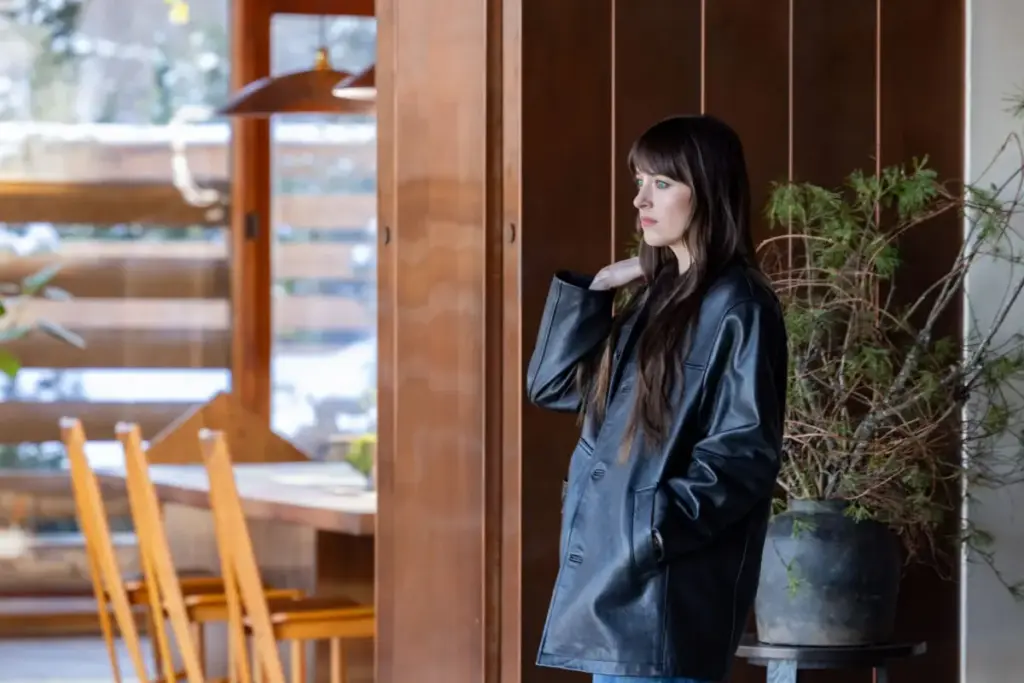
To brace against the cold—both literal and psychological—Lowen adopts her ultimate piece of emotional armor: an oversized, statement-making leather jacket by Dunst, paired with rugged boots.

"She definitely arrives there protected because I feel like she doesn’t know what she’s getting into," Demeterio notes. "That image of her against that house in Vermont was very important—she’s this city girl coming into the country in her leather jacket."
As she begins to sift through Verity’s deeply disturbing notes, the physical toll of the house’s dark secrets forces her to layer up further. She leans heavily on protective knits, pairing slim-cut Re/Done white T-shirts with sweater vests from Éterne and vintage-inspired cardigans. These layers act as literal cocoons, shielding her from the mounting psychological dread and physical illness induced by Verity’s manuscripts.
Act III: The Usurpation and the New Wealth
By the film’s conclusion, Lowen’s circumstances have shifted radically. Having unlocked the horrifying truths of the Crawford household—and culminating in a self-righteous, morally ambiguous ending complicated by Verity’s final letter—Lowen sheds her dark, defensive New York palette. She steps into a lifestyle of luxury, sporting a pale blue ribbed knit midi dress by Proenza Schouler and a supple, high-end suede trench coat by Mango.
"The suede trench was still Lowen, but the luxury version of what she would wear with this successful career," Demeterio observes. In an ironic twist of costuming philosophy, this symbol of newfound wealth was sourced not from a high-fashion runway house like The Row, but from the accessible European retailer Mango, proving that cinematic impact relies on visual truth rather than price tags.

Supporting Context & Metrics: Decoding the Pieces
Demeterio’s approach to costuming Verity offers practical takeaways for everyday style enthusiasts looking to replicate Lowen’s downtown-Brooklyn-cool aesthetic. Below is a breakdown of the key garment categories featured in the film and how they were brought to life:
The Outerwear Hierarchy
- The Wool Coat: Theory (Practical, understated, foundational).
- The Leather Shield: Dunst Unisex Alter-Leather Half Jacket (Oversized, protective, urban-meets-rural contrast).
- The Success Statement: Mango Long Suede Trench with Belt (Luxurious, tactile, indicative of a power shift).
Denim Fundamentals
Lowen’s signature denim look relies heavily on high-rise cuts and relaxed silhouettes that bridge the gap between vintage authenticity and modern comfort. Sourced primarily from Levi’s (such as the 725 High-Rise Bootcut) and AGolde (specifically the ’90s Pinch Waist Straight Leg jeans), the denim was purchased in multiples to accommodate active production schedules.
"When you’re having these conversations with your actors, you’re like, What jeans look good on you?" Demeterio reveals, noting that while the aesthetic aligns with Dakota Johnson’s personal off-duty style, wardrobe duplicates were essential for filming.
Knitwear and the Art of Layering
Lowen’s cold-weather layering is defined by a delicate balance of proportions. To avoid a bulky silhouette while layering cozy cardigans (including an argyle Céline cardigan and pieces by Isabel Marant) over knit vests and tees, Demeterio emphasizes strategic sizing.

"I tend to like more of a slimmer cut for underneath to layer, but not too tight either," she notes of pairing Re/Done slim tees with sweater vests. "It’s a very weird balancing act." Finished with a delicate stack of gold jewelry—featuring pieces from Ana Luisa and Gorjana—the look achieves an effortless, collected texture.
Official Statements & Design Philosophy
Jacqueline Demeterio’s overarching philosophy for Verity centers on character psychology over brand snobbery. Whether Lowen is struggling to pay rent or inheriting a literary empire, the clothes must speak authentically to who she is at that exact moment in the narrative.
"Obviously her character doesn’t have a lot of money," Demeterio says of mixing high- and low-end pieces. "I wasn’t necessarily like, Oh, she can’t afford this label, as long as it was feeling correct to me."
This philosophy democratizes the film’s fashion, allowing audiences to view Lowen’s wardrobe not as an unattainable luxury portfolio, but as an achievable capsule collection. By prioritizing texture, structure, and camera-readiness over designer pedigree, Demeterio crafted a visual language that resonates far beyond the screen.

Future Outlook: Translating Cinematic Style to Real-World Autumn Capsule Wardrobes
As Verity continues to captivate audiences and spark fervent online debates about its ambiguous ending, the film’s fashion footprint is leaving an equally indelible mark. Fall fashion enthusiasts are increasingly moving away from fast-trend cycles and toward the grounded, protective, and timeless capsule elements championed by Lowen Ashleigh.
The enduring appeal of Lowen’s wardrobe lies in its utility. An oversized leather jacket paired with straight-leg denim and a fitted white tee is a timeless formula. Add a tactile suede trench coat or a classic wool blend coat, and you have an outfit rotation built to withstand both unpredictable autumn weather and psychological thrillers alike.
Whether you are stepping into a mysterious lake house in Vermont or simply navigating the urban jungle, adopting Lowen Ashleigh’s approach to layering, texture, and everyday armor ensures you will look impeccably pulled together—even when you feel like you’re at the end of your rope.