LOS ANGELES — In the ever-shifting landscape of modern popular music, milestones are frequently established only to be broken within a matter of months. Yet, within the upper echelons of the Billboard charts, certain records stand like monolithic monuments—defying the test of time, format shifts, and the mercurial nature of public consumption.
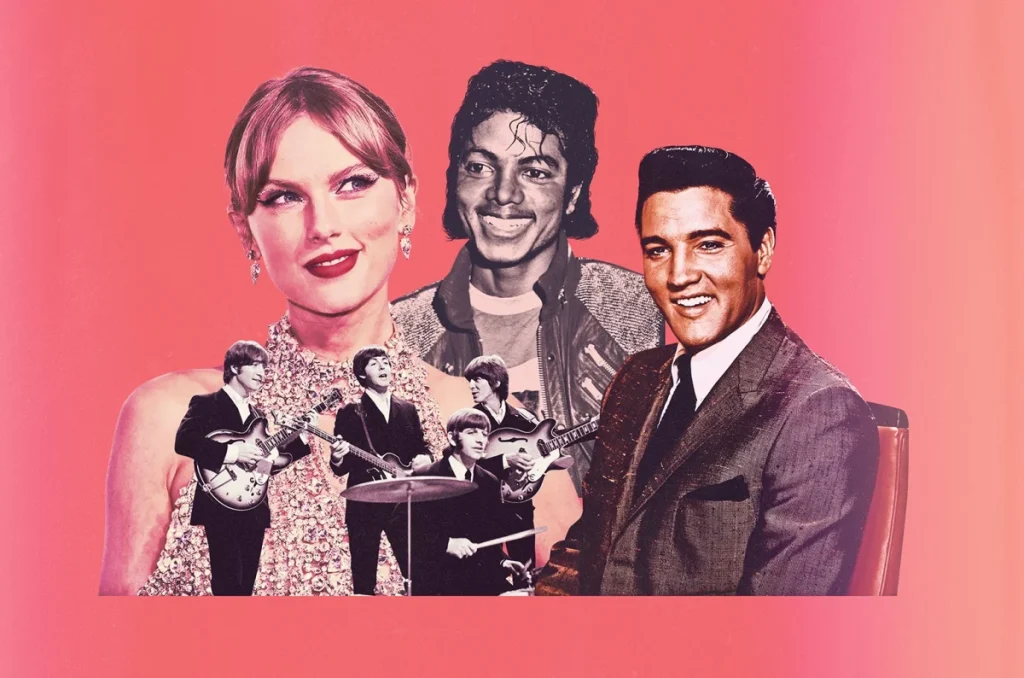
As Taylor Swift vaults back to the No. 1 position on the Billboard 200 chart (dated October 10) with her latest release, The Life of a Showgirl, she has officially accumulated 99 cumulative career weeks atop the definitive album tally. This latest achievement pushes the superstar further into uncharted territory, cementing her status as one of the most commercially dominant forces in recording history. Having already outpaced legendary acts like Whitney Houston and Elvis Presley, Swift now gazes upward at the final, seemingly insurmountable titan of recorded music history: The Beatles.
With the Fab Four’s historic record of 132 weeks at No. 1 looming in the distance, industry analysts, casual listeners, and die-hard fans alike are forced to ask a compelling question: Will Taylor Swift eventually equal or surpass the greatest band in rock-and-roll history?
Executive Overview
To understand the magnitude of Swift’s current trajectory, one must evaluate the mechanics of the Billboard 200, a chart that has tracked the popularity of albums in the United States since March 1956. Over nearly seven decades, thousands of releases have vied for the top spot, but only a microscopic fraction of artists have managed to sustain dominance for triple-digit weeks.

Swift’s journey to 99 weeks at No. 1 is not merely a byproduct of contemporary streaming algorithms or hyper-engaged fandoms; it is the result of a meticulously constructed multi-decade discography, strategic re-releases, and an unprecedented cultural resonance. While traditional album sales have given way to equivalent album units—incorporating track-equivalent streams (TEA) and streaming-equivalent units (SEA)—Swift has mastered the art of physical and digital retention, ensuring her catalog remains perpetually relevant.
As she edges closer to the 100-week milestone, the conversation surrounding her legacy has shifted from whether she is a defining artist of her generation to whether she is, by quantifiable metrics, the most commercially successful solo recording artist of all time.
Detailed Chronology of a Chart Monarch
Swift’s ascent up the Billboard 200 leaderboard has been characterized by consistent, compounding momentum rather than a single explosive era. To appreciate how she reached 99 weeks, it is vital to trace her journey through the historical hierarchy of the charts.
Breaking the Gender Barrier: Surpassing Whitney Houston
For decades, Whitney Houston stood as the gold standard for female solo artists on the Billboard 200. Houston’s staggering run of blockbuster albums—anchored by Whitney Houston, Whitney, and the historic The Bodyguard soundtrack—accumulated 46 weeks at No. 1.

Swift eclipsed that milestone years ago, systematically dismantling the ceiling for women in music. Through relentless album output, including her re-recorded Taylor’s Version projects, she expanded her footprint across the charts simultaneously, often occupying multiple spots within the top ten and pushing her cumulative weeks at the summit far beyond any female contemporary.
Dethroning the King: Surpassing Elvis Presley
Having conquered the records set by her female peers, Swift set her sights on solo artist supremacy, a title long held by Elvis Presley. The King of Rock ‘n’ Roll commanded the Billboard 200 for 67 cumulative weeks, starting with his self-titled debut album in March 1956.
When Swift surpassed Presley’s 67-week tally, it marked a symbolic passing of the torch from the pioneer of mid-century rock-and-roll commercialism to the architect of the 21st-century streaming-era monolith. With Presley behind her, Swift cleared the board of all solo competitors, leaving only a legendary British rock band standing between her and absolute historical dominance.
Supporting Context & Metrics: The Playing Field Analyzed
To fairly assess Swift’s chase of The Beatles (132 weeks at No. 1 between February 1964 and February 2001), musicologists and data analysts often point to the structural nuances of how charts have evolved over the decades.

The Elvis Presley Baseline Nuance
A critical footnote in chart history involves Elvis Presley’s earliest commercial breakthroughs. Presley’s explosive cultural arrival in 1956 actually predated the formal launch of Billboard’s flagship weekly album chart by more than two years. Consequently, some of his earliest cultural peaks occurred during an era when album tracking was fragmented.
However, once the Billboard 200 began publishing on a consistent weekly basis on March 24, 1956, Presley’s entire career was captured faithfully. His debut, Elvis Presley, entered the chart at No. 11 on March 31, 1956—the chart’s second-ever tracking week—initiating a legacy that Swift spent decades systematically hunting down.
The Soundtracks and Group Anomalies: The Bee Gees Factor
When evaluating chart longevity, anomalies frequently complicate the data. For instance, if one were to classify the cultural behemoth that is the Saturday Night Fever soundtrack (which spent 24 consecutive weeks at No. 1 in 1978) strictly as a Bee Gees album, the iconic trio’s resume would swell significantly.
The Bee Gees contributed six tracks to the multi-platinum milestone, five of which became No. 1 hits on the Billboard Hot 100. Yet, under strict archival guidelines, Billboard recognizes the release as a multi-artist soundtrack rather than a pure Bee Gees studio album, keeping the group’s direct studio tally at 31 weeks on top.

Acts with 30 or More Weeks at No. 1 on the Billboard 200
Since the chart’s consistent weekly publication began on March 24, 1956, only a select cadre of acts has achieved 30 or more weeks at the summit:
- The Beatles: 132 weeks
- Taylor Swift: 99 weeks (and counting)
- Elvis Presley: 67 weeks
- Garth Brooks: 52 weeks
- Michael Jackson: 37 weeks
- Whitney Houston: 46 weeks (across catalog peaks)
Official Statements and Inter-Generational Camaraderie
Despite the competitive nature of chart statistics, Swift’s historic run has been met with mutual admiration rather than rivalry, particularly from the remaining members of the very band she is chasing.
Swift and Sir Paul McCartney share a famously warm, mutually respectful relationship that spans generations. Demonstrating this deep artistic kinship, Swift recently took to her Instagram Stories to publicly congratulate McCartney on his latest studio release, The Boys of Dungeon Lane, captioning the post with high praise: "Never not inspired by this eternally exceptional artist."
The admiration is reciprocal. In a moment that bridged decades of musical evolution, McCartney performed The Beatles’ timeless anthem "I Want to Hold Your Hand" during Swift’s recent high-profile wedding celebration, underscoring the profound personal and professional respect that exists between the undisputed past and present royalty of popular music.

Future Outlook: Can Swift Catch The Beatles?
As Taylor Swift sits comfortably at 99 weeks with The Life of a Showgirl, the mathematical realities of catching The Beatles come into sharp focus. The gap currently stands at 33 weeks—a formidable margin, but one that is entirely within the realm of possibility for an artist who continues to release new material, unearth vault tracks, and command global culture with unmatched precision.
The Variables Driving the Chase
- Catalog Expansion and Re-Recordings: Swift’s ability to mobilize her fanbase around archival projects ensures that her older works routinely re-enter the conversation, occasionally pushing older albums back toward the upper tiers of the charts.
- Streaming Resilience: Unlike legacy acts whose physical sales were vulnerable to retail distribution shifts, Swift’s catalog benefits from permanent, ubiquitous availability across digital streaming platforms. Every time a new era launches, listeners stream her entire back catalog, creating a compounding baseline of chart points.
- Unrivaled Productivity: At her current creative output rate, Swift shows no signs of slowing down. Should she release subsequent studio albums or continue expanding her existing discography over the next few years, securing an additional 33 weeks at No. 1 across new projects and catalog revivals is not an impossibility—it is a calculated projection.
Conclusion
Whether Taylor Swift ultimately equals or surpasses The Beatles’ legendary 132-week record remains one of the most thrilling narratives in modern entertainment. Regardless of how the final numbers settle, the mere fact that a 21st-century solo artist is within striking distance of a record set by the most celebrated band in human history speaks volumes.
Taylor Swift has already rewritten the rulebooks of the music industry. As the clock ticks toward her next chart tabulation, the entire world watches to see if she will complete the ultimate climb to the absolute summit of recorded music.